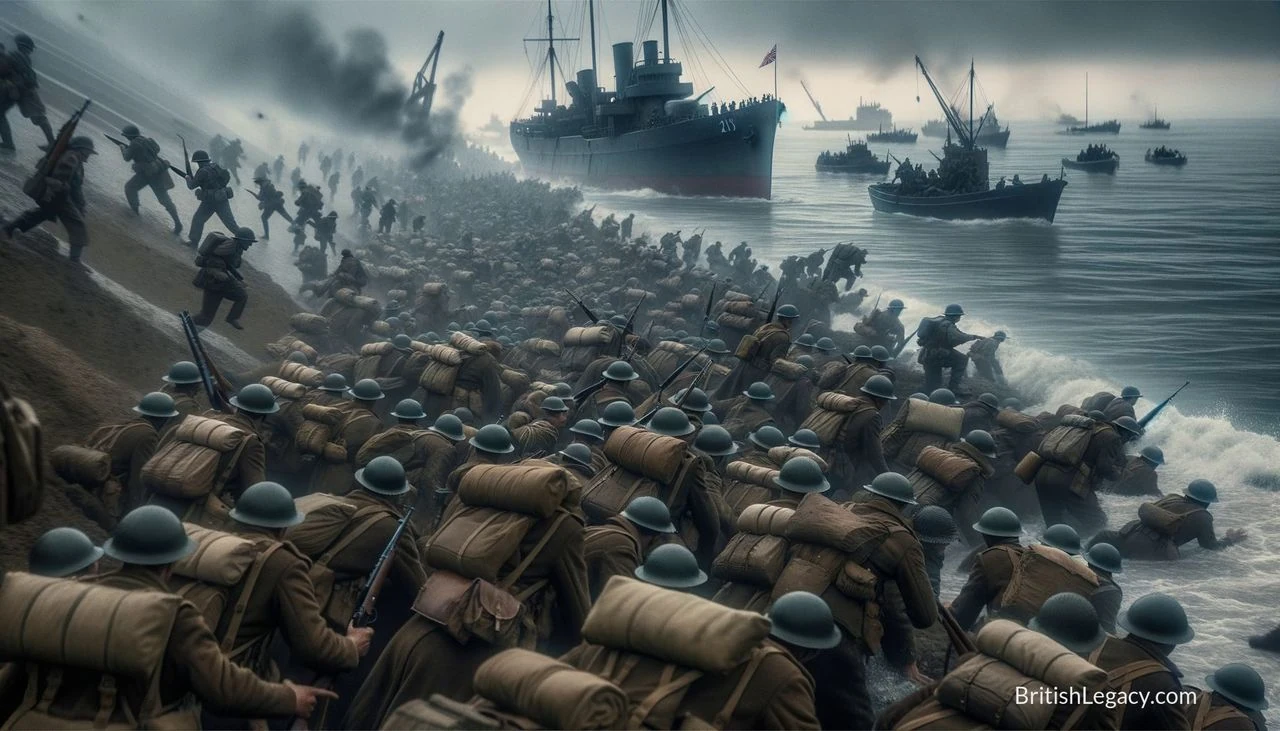
Dunkirk is remembered less as a British victory on the battlefield than as an evacuation carried out under pressure. From 26 May to 4 June 1940, Operation Dynamo brought 338,226 Allied soldiers from the French coast to safety. The retreat did not erase the defeat that had left them encircled. It did, however, preserve troops who could continue the war, and gave Britain a defining account of collective effort in a moment of danger.
The retreat to the coast
In the spring of 1940, German forces advanced rapidly through Europe. British, French and Belgian troops became trapped around Dunkirk, a French port on the Channel coast. With escape by land appearing impossible, evacuation became the urgent objective. The episode is often called the Battle of Dunkirk, but its lasting place in British memory rests chiefly on the attempt to withdraw and rescue the forces there, rather than on a battlefield victory.
The danger was real: the troops had to be taken from a coast exposed to enemy fire, and the operation had little time to spare. The predicament helps explain why the evacuation, rather than a conventional military success, became the central story. Dunkirk’s significance lies in what could be brought out of a desperate position, not in a claim that the retreat itself settled the wider conflict.
Operation Dynamo and the boats
Vice Admiral Bertram Ramsay directed Operation Dynamo. Naval vessels and civilian craft took part, including merchant ships, fishing boats, pleasure yachts and lifeboats. The smaller civilian vessels came to be known collectively as the “Little Ships of Dunkirk”. Working alongside the Royal Navy, civilian sailors helped ferry soldiers from the coast to larger ships waiting offshore. The evacuation lasted nine days and brought 338,226 Allied soldiers out of Dunkirk.
The familiar image of small boats crossing the Channel can make the operation seem like a single, simple act of rescue. The account is more substantial: a large-scale evacuation organised under fire, involving naval personnel, civilian sailors and vessels of different kinds. The figures and the range of craft convey the scale of the effort without turning the withdrawal into a victory on the battlefield. Dunkirk was a retreat, but one that succeeded in rescuing a great many of the troops caught there.
Retreat, morale and memory
On 4 June 1940, Prime Minister Winston Churchill addressed the House of Commons. His speech included the words: “We shall fight on the beaches, we shall fight on the landing grounds, we shall fight in the fields and in the streets, we shall fight in the hills; we shall never surrender.” The speech gave public expression to a determination to continue the war, while the evacuation itself had secured the return of troops who might fight again.
Dunkirk consequently came to stand for both loss and endurance: Allied forces had been driven into retreat, yet the evacuation prevented their position from ending in their capture or destruction. The rescued soldiers could serve in later campaigns, which contributed to the eventual liberation of Europe. The story also entered British cultural memory through films and literature. Its appeal is not only the dramatic image of civilian boats, but the clear account of people and institutions combining to meet an immediate military need.
Beyond the national story
The evacuation is also remembered beyond Britain as an example of withdrawal under pressure and of civilian resources being mobilised in wartime. Its relevance does not depend on presenting Dunkirk as an uncomplicated triumph. Rather, it lies in the contrast between the scale of the crisis and the number of Allied troops who were brought to safety. That is a more grounded account of its importance than claims of universal reverence or lessons that every later generation must draw from it.
For Britain, Dunkirk became a story of resolve at a point when the military situation was grave. The boats and their crews remain its most recognisable human element, while Operation Dynamo’s scale gives the rescue its historical weight. Remembering both the retreat and the evacuation keeps the event in proportion: the troops were saved, but the danger and the wider war continued.
Why Dunkirk deserves a place in British Legacy
Dunkirk deserves a place in British Legacy because it captures a consequential moment in which Britain’s wartime story was shaped by withdrawal as well as resistance. Operation Dynamo rescued 338,226 Allied soldiers from a perilous position on the French coast. The Royal Navy and civilian sailors, using vessels that ranged from naval ships to fishing boats and pleasure craft, made that evacuation possible. These are specific achievements, not simply symbols of courage: people and ships were organised to bring troops out of immediate danger.
The rescue also mattered beyond the days spent at Dunkirk. The soldiers who returned could fight in later campaigns, and the evacuation became part of the public language of resolve, famously joined to Churchill’s 4 June speech. Its British legacy should not be mistaken for a claim that the withdrawal was a battlefield victory or that it ended the crisis. Its importance is more precise: a retreat became an operation that saved a large Allied force, while leaving a durable cultural memory of shared effort under pressure. That combination of military consequence and public remembrance makes Dunkirk an essential part of Britain’s Second World War history.