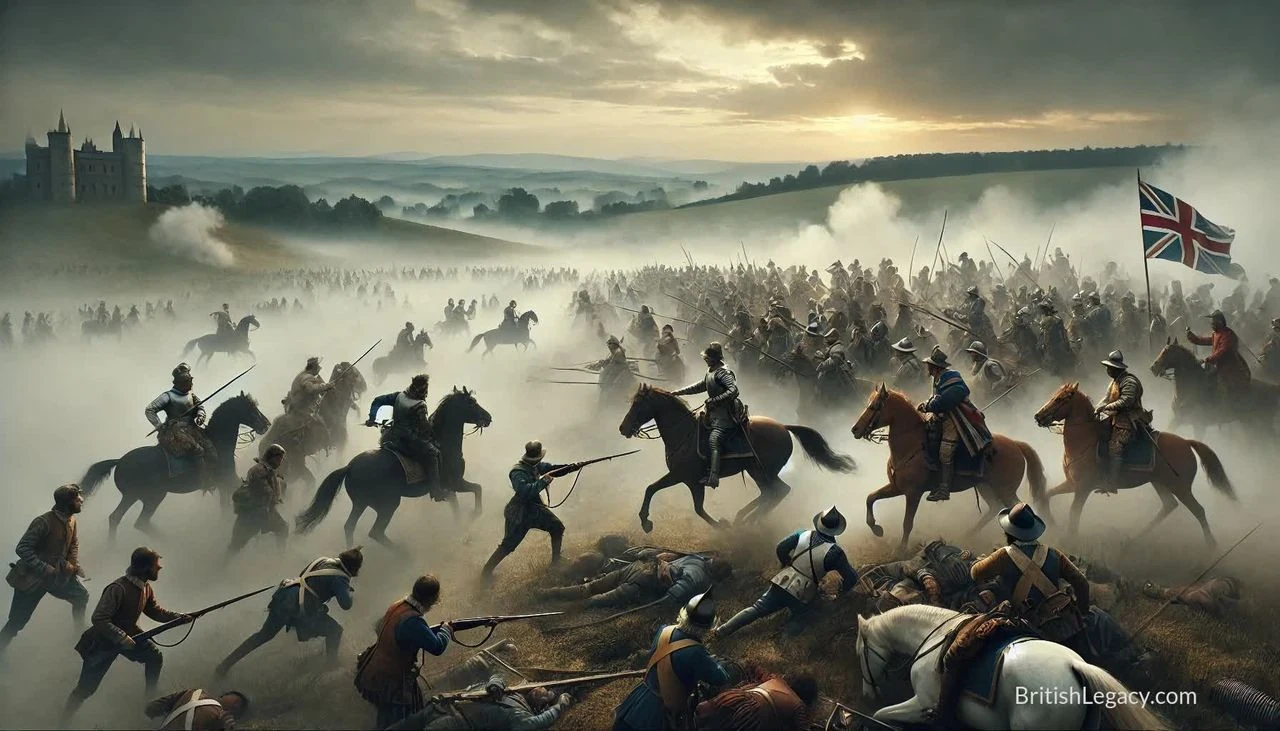
On 23 October 1642, Royalist and Parliamentarian armies met near Kineton in Warwickshire in the first pitched battle of the English Civil War. The fighting at Edgehill did not settle which side would prevail. Instead, the armies withdrew without a decisive victory, leaving the conflict to continue and making the encounter an opening test of a war that would transform England’s political order.
A kingdom divided
The battle emerged from years of tension between King Charles I and an increasingly assertive Parliament. Their disputes had political, religious and social dimensions. Parliamentarians sought greater power and reform; Royalists remained loyal to the King and wanted to preserve the existing monarchical order. These broad positions framed the conflict, though they do not by themselves capture every reason people took sides.
In 1642 Charles raised his standard at Nottingham, signalling the outbreak of war against Parliament. The country divided as communities and families faced the conflict. The opposing armies’ movements brought the struggle to Warwickshire: Charles led his Royalist forces from Shrewsbury towards London, while the Parliamentarian army commanded by Robert Devereux, 3rd Earl of Essex, sought to intercept him. They converged near Kineton, at the foot of Edgehill.
The fighting at Edgehill
Prince Rupert of the Rhine, the King’s nephew, commanded part of the Royalist army. His cavalry charge initially scattered Parliamentarian lines. The account of the battle describes the cavalry as pursuing the advantage too far and becoming separated from the main Royalist force. That separation weakened the effect of the charge: an early success did not become a decisive result for the King’s army.
Essex’s Parliamentarians regrouped and counterattacked. The fighting included cannon fire and close combat, but neither side secured a clear victory. By nightfall, both armies had withdrawn from a battlefield marked by casualties. The encounter’s outcome was therefore inconclusive: it showed that the Royalists could bring substantial force to bear, while the Parliamentarians could recover from an initial setback and continue fighting.
That lack of resolution matters to the battle’s place in the war. Edgehill was the first pitched engagement, not its conclusion. The armies’ withdrawal left the wider contest unsettled; neither the King’s authority nor Parliament’s challenge had been resolved on the field. The battle began a sequence of military confrontations in a conflict that continued for years.
What the battle did—and did not—settle
The English Civil War continued until 1649, when Charles I was executed. Edgehill’s immediate result was much narrower than the eventual consequences of the conflict: the battle established no settlement between King and Parliament, and its inconclusive ending did not predict the war’s final outcome. Its importance lies first in its place as the opening pitched battle and in what it revealed about the opposing forces’ ability to fight on.
The war raised enduring questions about the balance of power between monarchy and Parliament, and about political authority. But it would overstate the evidence to present Edgehill itself as the direct beginning of modern democracy or as a proven influence on later revolutions. The battle belongs to a larger and contested history; its specific contribution was to mark the point at which the armed conflict between Charles and Parliament became a pitched engagement.
Why the Battle of Edgehill deserves a place in British Legacy
Edgehill deserves a place in British Legacy because it gives a concrete point of entry into the conflict over the relationship between Crown and Parliament. The opposing armies met in Warwickshire on 23 October 1642, and their inconclusive encounter made clear that the dispute would not be settled by one confrontation. The Royalist cavalry’s early success, the Parliamentarian recovery under Essex and the withdrawal of both armies offer a focused account of how the war began on the battlefield.
The battle also helps distinguish an event’s immediate result from its later significance. Edgehill did not itself establish a new political system; the war continued, and Charles I was executed in 1649. Remembering the engagement as an opening rather than a decisive turning point keeps its place in the story proportionate. It connects a specific Warwickshire landscape to a defining period in England’s political history, while avoiding the claim that one battle alone created the freedoms or institutions of later centuries.