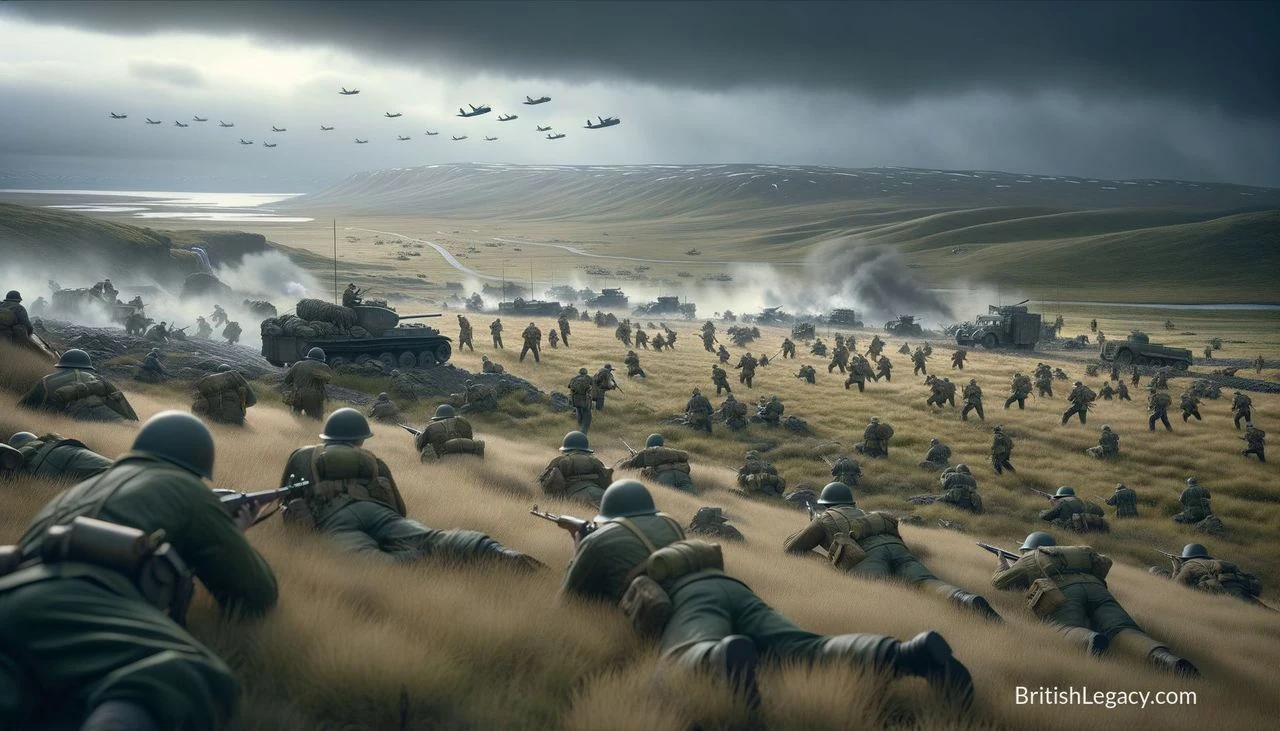
The Battle of Goose Green was a hard-fought British victory in the Falklands War, but not the straightforward operation its location was first thought to offer. In the early hours of 27 May 1982, the 2nd Battalion, Parachute Regiment, advanced against Argentine positions on East Falkland. By the following day, the settlement had been secured and Argentine troops had surrendered. The fighting cost lives on both sides, including that of the battalion’s commanding officer, Lieutenant Colonel H. Jones.
From invasion to the advance on Goose Green
Argentina invaded the Falkland Islands in April 1982, seeking to assert sovereignty over the British Overseas Territory in the South Atlantic. Britain responded by sending a maritime task force to reclaim the islands. The campaign then developed through a series of engagements on land and at sea.
Goose Green, a settlement on East Falkland, became an objective for British forces. It had been regarded as isolated and lightly defended, and so potentially a relatively straightforward target. The expectation did not match the positions the battalion encountered: Argentine forces had fortified the area, making the advance a demanding fight.
On the night of 27 May, 2 Para, under Jones’s command, moved against those positions. The advance began under cover of darkness, with exchanges of fire between the forces. As daylight came, the open ground offered the British troops little protection. Argentine machine-gun positions pinned down advancing soldiers, turning what might have seemed a limited operation into a prolonged and costly engagement.
Jones and the battle’s human cost
Jones became the best-known British figure in accounts of the battle. With his men under intense fire, he attempted to assault a key Argentine position. He was critically wounded but continued to lead and encourage his troops before dying of his injuries. He was posthumously awarded the Victoria Cross for his actions.
Goose Green was secured on 28 May, when the Argentine troops surrendered. The battle had cost the British 17 soldiers, including Jones. The account records more than 50 Argentine fatalities and nearly 1,000 captured. Those figures underline the price of the victory, rather than allowing its significance to be measured only by the ground taken.
The result also had a wider effect on the British campaign. The capture showed that the expeditionary force could achieve its objectives in the face of prepared resistance, and was described as a boost to morale. British operations continued after Goose Green; the conflict ended with the recapture of the Falkland Islands and British victory on 14 June 1982.
What the battle came to represent
Goose Green is remembered in accounts of the Falklands War for the difficult conditions of the advance, the leadership and loss of Jones, and the surrender that followed. The battle has also been described as a source of lessons for military tactics and doctrine, with its experience studied in military academies. The available account does not specify which later operations or particular tactical changes resulted from those lessons, so its influence should not be overstated.
Its place in British military history is closely tied to the war’s central purpose: Britain had sent a task force to retake territory occupied by Argentina. The victory at Goose Green did not end the conflict, but it formed part of the campaign that continued until 14 June. Remembering the battle therefore means holding together its operational result and its human cost, rather than treating either as the whole story.
Why the Battle of Goose Green deserves a place in British Legacy
The Battle of Goose Green deserves a place in British Legacy as a specific episode in the 1982 campaign to reclaim the Falkland Islands. Its significance rests on what happened there: 2 Para advanced against fortified Argentine positions, overcame a defence made harder by open terrain and machine-gun fire, and secured the settlement on 28 May. The result contributed to the progress of the British campaign, while the surrender of Argentine troops marked the conclusion of this particular engagement. That is a more concrete legacy than broad claims about national character or an unsupported assertion that one battle alone turned the war.
The battle’s human consequences belong in that account too. Seventeen British soldiers died, among them Lieutenant Colonel H. Jones, whose actions led to a posthumous Victoria Cross; the Argentine forces also suffered fatalities and prisoners. Recording both the outcome and the losses gives readers a fuller understanding of the cost of the operation. Goose Green matters to British history not as a simple tale of triumph, but as a hard-fought military action within a campaign to recover a British Overseas Territory, remembered for its outcome, its casualties and the people who fought there.