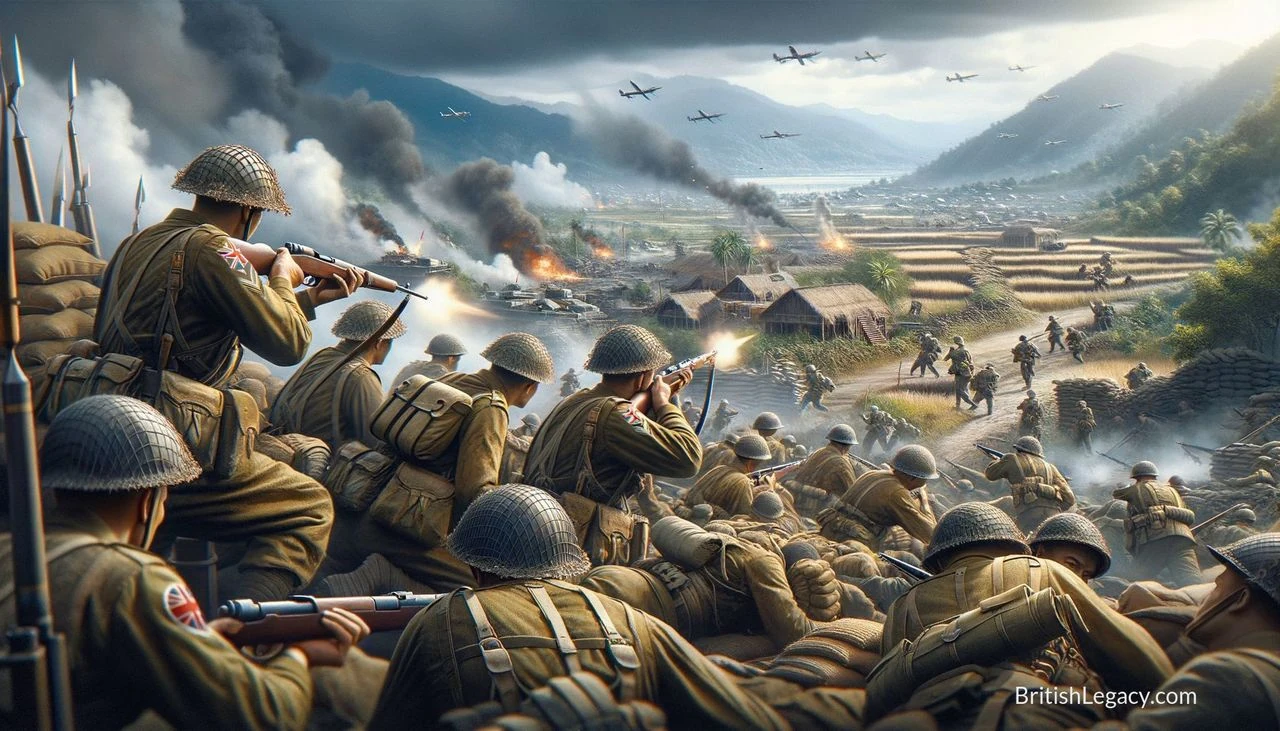
In 1944, Japanese forces crossed into India in an attempt to break the Allied position at Imphal and Kohima. The fighting that followed joined two distinct but connected struggles: the defence of a major supply base at Imphal and the contest for Kohima, whose position mattered to the supply route. British and Indian troops resisted the advance in the hills and valleys of Manipur. The outcome checked Japan’s ambitions in the region and kept India from occupation.
The plan to enter India
The Japanese operation, codenamed U-Go, was conceived in early 1944. Its aims included cutting off Allied forces at Imphal and Kohima and, according to the account of the campaign, potentially encouraging an uprising against British rule. In March, three Japanese divisions commanded by Lieutenant-General Renya Mutaguchi advanced into Manipur. Imphal contained a major Allied supply base; Kohima was an important link in the supply chain.
Japanese forces laid siege to Imphal. British and Indian troops, initially taken by surprise, defended the position under commanders including General Geoffrey Scoones and General William Slim. The campaign involved thousands of soldiers from Britain, India and other parts of the Commonwealth, including Africa. Their task was made harder by the rugged landscape, which constrained movement and complicated the effort to maintain supplies.
Imphal, Kohima and the turning point
As Imphal was besieged, fighting at Kohima centred on the ridge above the town. At the Tennis Court, Allied and Japanese forces faced one another at close range. The battle became a particularly intense part of the campaign, with the British and Indian defenders fighting to hold their ground. The description of the fighting as a contest of hand-to-hand combat conveys its proximity, but does not make the two battles a single encounter: Imphal and Kohima were separate positions within the same wider Japanese offensive.
Monsoon rains added to the challenges posed by the terrain. Allied aircraft brought in reinforcements and supplies, helping the defenders withstand the pressure. By June 1944, the Japanese siege of Imphal had been broken. The defeat at Imphal and Kohima dealt a severe blow to Japanese plans in the region; the campaign account connects that setback with the later Allied capture of Burma.
A multinational campaign and its remembrance
The defence brought British and Indian forces, alongside soldiers from the wider Commonwealth, into a shared campaign. That cooperation was an important feature of the battles, but the fighting also took place in the context of British rule in India: the Japanese plan was described as including the possibility of provoking opposition to that rule. The result prevented Japanese occupation of India and left the subcontinent available as a base for further Allied operations in South-east Asia.
The battles are commemorated in Britain and India. Kohima War Cemetery is associated with the epitaph, “When You Go Home, Tell Them Of Us And Say, For Your Tomorrow, We Gave Our Today.” The words make remembrance an appeal to the living, while the cemetery stands as a memorial to those killed. The legacy of the campaign includes both its military outcome and the cost borne by the people who fought it.
Why the Battle of Imphal and Kohima deserves a place in British Legacy
Imphal and Kohima deserve a place in British Legacy because they mark a consequential campaign in which British and Indian forces helped halt Japan’s advance into India. The defence of Imphal preserved a major Allied supply base, while the fight for Kohima concerned a vital link in the supply chain. The battles show how the campaign depended on more than a plan or a battlefield position: difficult terrain, monsoon weather, and the delivery of reinforcements and supplies by air all shaped the struggle. By June 1944, the siege of Imphal had been broken, and Japan’s ambitions in the region had suffered a serious defeat.
This British connection should be understood as part of a wider, multinational and colonial history. British troops fought alongside Indian forces and other Commonwealth soldiers, while the Japanese plan was also described as seeking to encourage an uprising against British rule. Commemoration therefore belongs alongside an account of the political setting and the human cost, not in place of them. The epitaph at Kohima War Cemetery gives that cost a lasting public expression. Remembering the campaign in Britain can recognise the contribution of those who fought while acknowledging the Indian setting and the forces whose cooperation shaped the outcome.