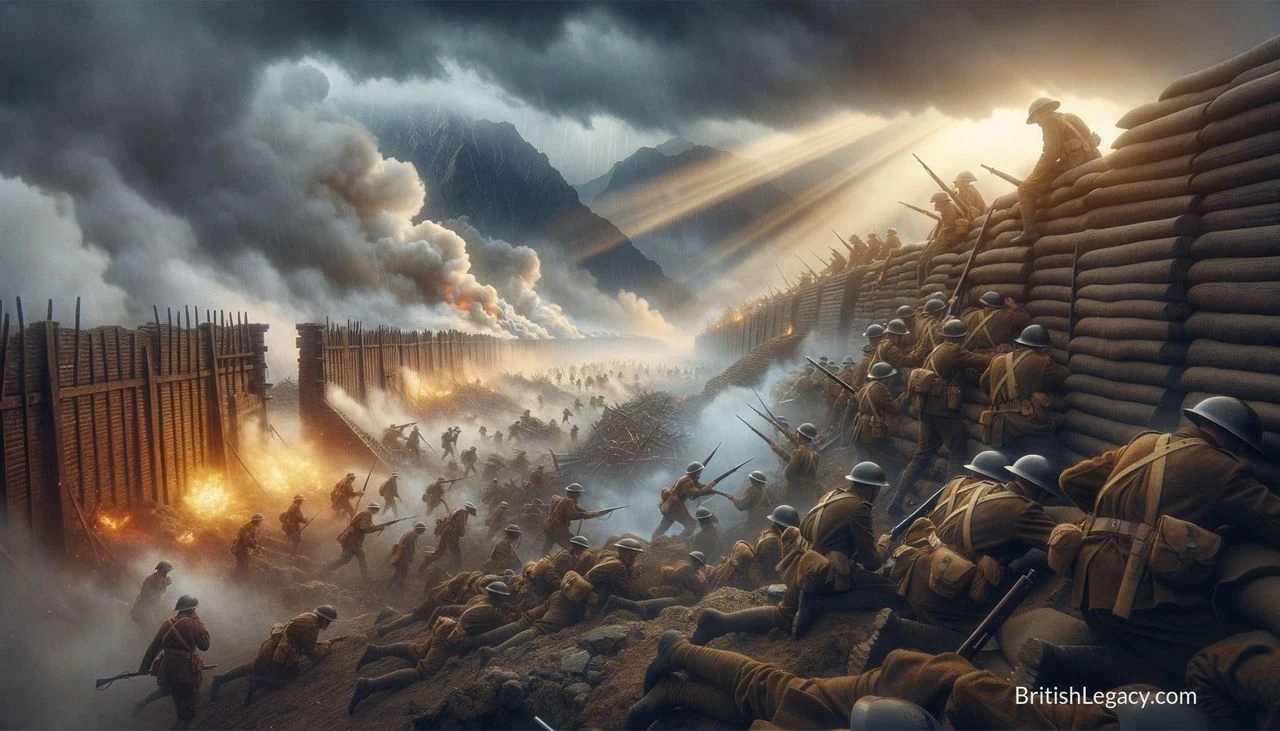
From March to July 1944, Japanese forces sought to capture Imphal in north-east India, disrupt Allied supply lines and open a route towards Assam. British and Indian troops were encircled, but air supply, defensive positions and counterattacks helped them hold the town. The Japanese retreat, alongside the outcome at Kohima, marked a turning point in the Burma Campaign.
The campaign’s aims and opposing forces
The Battle of Imphal formed part of a wider Japanese offensive. Capturing the town would cut off British troops in Burma from supplies and reinforcements, according to the account of the campaign, and create scope for further advances towards Assam. The offensive was also intended to encourage rebellion against British rule in India. The fighting therefore brought military objectives together with the political context of British India.
Lieutenant General William Slim led the British and Indian troops as commander of the 14th Army. The force is described as multinational, comprising British, Indian, African and Burmese soldiers. It faced the Japanese 15th Army, led by Lieutenant General Renya Mutaguchi. Indian soldiers made a significant contribution to the defence, fighting alongside British troops. The battle’s history is consequently not only a story of British command, but also one of the different forces assembled in the Allied army.
Encirclement and air supply
As the Japanese advanced, they encircled Imphal and adjoining areas, severing the defenders’ supply routes. The British and Indian troops were left isolated and surrounded. Holding the position depended on maintaining the defence despite that isolation. The account credits Slim’s leadership and the resilience of the soldiers, while also describing the practical measures that helped the Allies withstand the siege.
Aircraft dropped supplies to the defenders, allowing them to continue resisting even as ordinary supply routes were cut. Defensive positions helped hold the line; tactical counterattacks gave the Allies a means to oppose the Japanese advance and, eventually, break the encirclement. The monsoon added another complication. It initially presented a hurdle, but also slowed the Japanese, buying the Allies time to reorganise and strengthen their defences. The outcome thus depended on a combination of sustaining the besieged force, resisting attacks and using the delay to prepare.
Retreat and the wider campaign
After months of fighting and severe losses, Japanese forces were forced into retreat. By July 1944 the siege had ended, and the 14th Army’s counteroffensive marked the start of the Japanese withdrawal from Imphal. The victory was closely connected to the simultaneous success at the Battle of Kohima. Together, the two battles marked a turning point in the Burma Campaign, substantially weakening Japanese forces in the region and bolstering Allied morale.
Imphal also belongs to the history of the defence of British India. The account connects the Allied victory with securing the subcontinent’s eastern front and with regional developments leading towards Indian independence. These consequences sit alongside the immediate military result: the defence held, the Japanese encirclement was broken and the enemy retreated. The campaign’s significance was therefore regional as well as local, although its military outcome should not be confused with a detailed account of the later political changes.
Commemoration and historical memory
The battle remains part of British and Indian military history and the wider account of the Second World War. It is associated with memorials and annual remembrances honouring those who fought. Its place in the Burma Campaign reflects both the months-long defence at Imphal and the connection with Kohima, rather than a victory considered in isolation. Remembering the battle also means recognising the Indian soldiers who fought alongside their British counterparts and the multinational composition of the 14th Army.
Why the Battle of Imphal deserves a place in British Legacy
The Battle of Imphal deserves a place in British Legacy because it reveals the demands of defending British India during a major Japanese offensive. The defenders were encircled and their supply routes cut, yet air supply, defensive positions and counterattacks enabled them to hold out. By July 1944 the Japanese had retreated. In conjunction with the victory at Kohima, the result marked a turning point in the Burma Campaign and weakened Japanese forces in the region. These specific military consequences give the battle a clear place in the history of Britain’s wartime presence in India.
That history must also make room for the Indian soldiers who fought alongside British troops. The 14th Army included British, Indian, African and Burmese soldiers; its defence of Imphal was a multinational effort, not a solely British achievement. The battle’s connection to the eastern front of British India and to the regional circumstances before Indian independence adds further context, without making the military victory a complete explanation of later political change. Remembering Imphal in this way recognises both the campaign’s strategic significance and the people whose combined effort sustained the defence.