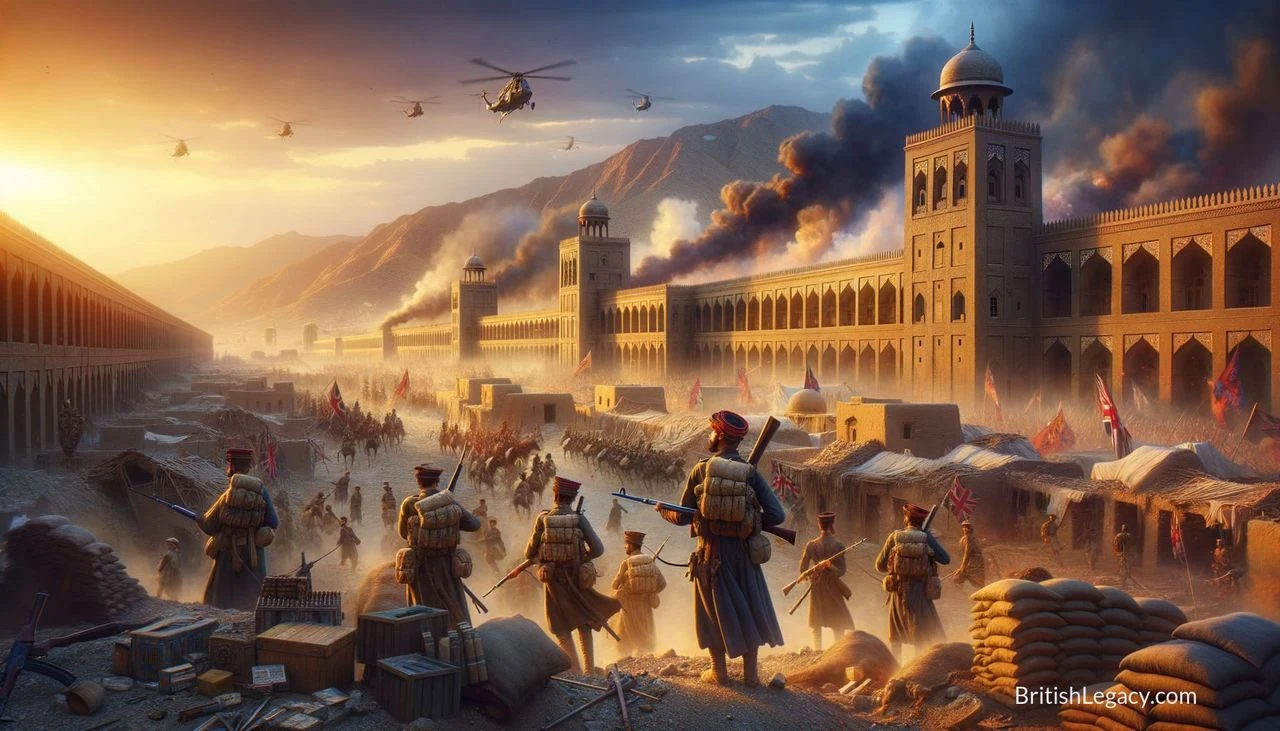
In September 1842, British forces retook Kabul after the retreat that had shattered their occupation of Afghanistan. The return brought a punitive campaign against the city, but it did not establish lasting control: British forces withdrew soon afterwards. The episode is best understood alongside the disastrous retreat that preceded it, rather than as a straightforward military victory.
Occupation and retreat
The First Anglo-Afghan War, fought from 1839 to 1842, began amid British concern about Russian expansionism and Afghanistan’s strategic importance. The British East India Company sought a government in Kabul friendly to its interests. In 1839, forces under Sir John Keane captured the city and installed Shah Shuja Durrani as ruler. The occupation encountered resentment, while Shah Shuja’s unpopularity contributed to unrest.
The British garrison, commanded by Major-General Sir William Elphinstone, became increasingly isolated. In January 1842, troops and camp followers retreated from Kabul through winter conditions and mountain passes, facing repeated attacks. The article gives the force as approximately 4,500 troops and 12,000 camp followers, and identifies Dr William Brydon as the famous sole survivor to reach the relative safety of Jalalabad. The retreat became the campaign’s defining disaster.
Pollock’s return
In autumn 1842, General George Pollock led the force described as the “Army of Retribution” back towards Kabul. After fighting through resistance, his troops retook the city in September. This return answered the retreat with a military demonstration, but it did not restore a durable occupation.
During the campaign’s final phase, British troops demolished the Great Bazaar and dismantled the Bala Hissar fortress. These actions gave the recapture a punitive character. British forces then withdrew from Afghanistan. The brief return to Kabul therefore closed the occupation without resolving the difficulty of maintaining control in the face of opposition.
Imperial aims and the limits of occupation
The campaign had begun with an attempt to shape Afghanistan’s government in response to perceived strategic threats. Its course exposed the costs of trying to enforce that aim. The retreat was followed by a return intended as retribution; neither the recapture nor the destruction in Kabul produced a lasting British presence. The account links the withdrawal to the expense of sustaining an occupation through continuing military engagement.
It also mentions debate in Britain about imperial policy and diplomacy, and refers to the Durand Line, established in 1893. That later boundary should not be treated as a direct result of the 1842 campaign: the connection is not established here. The recapture’s significance lies more securely in its place within the war’s sequence of occupation, resistance, retreat, retaliation and withdrawal.
Why the retaking of Kabul deserves a place in British Legacy
The retaking of Kabul deserves a place in British Legacy because it brings into focus both the reach and the limits of British imperial power. The British East India Company sought to influence Afghanistan’s government for strategic reasons; British and Indian forces captured Kabul, lost control of the situation and endured a disastrous retreat before returning to the city. The September recapture was a military success in the narrow sense, but the subsequent withdrawal shows why that description cannot stand alone.
Remembering the demolition of the Great Bazaar and the dismantling of the Bala Hissar alongside the retreat also prevents the story from becoming a simple account of resolve or triumph. The episode records the human and political consequences of an imperial campaign, including resistance to occupation and punitive action before withdrawal. Its specifically British connection is the East India Company’s intervention and the British-led forces involved, not a generic claim about national character. Taken together, these events make Kabul in 1842 a revealing episode in Britain’s imperial history: an attempt to impose influence, a costly reversal, and a return that did not make occupation sustainable.