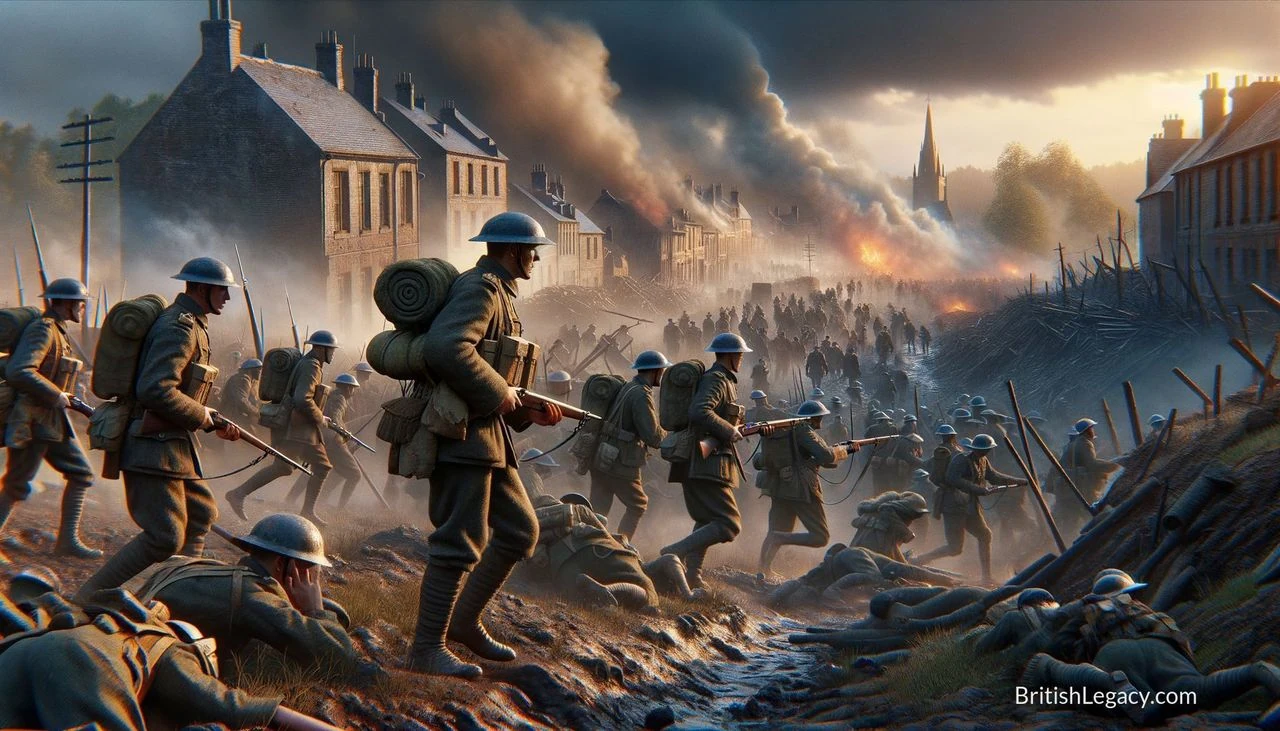
On 26 August 1914, two days after the Battle of Mons, British forces under General Sir Horace Smith-Dorrien halted their retreat to fight a rearguard action at Le Cateau. They did not secure a decisive victory, but their stand resisted the advancing German army and, according to the account of the battle, delayed its advance. The engagement belongs to the early, unsettled weeks of the First World War, when the British Expeditionary Force (BEF) was withdrawing and seeking to give Allied forces time to regroup.
From Mons to Le Cateau
The Battle of Mons took place on 23 August. British troops fought there before withdrawing in the face of a German advance. Le Cateau followed as part of that retreat: rather than continue moving without resistance, Smith-Dorrien decided that his force would stand and fight. The decision was risky. The British troops were described as stretched and exposed, and the fighting that followed was fierce.
British forces established defensive positions and used the landscape to support their resistance. The existing account characterises them as outnumbered and under-equipped, though it gives no numbers or further detail. It also describes casualties as high. These circumstances make Le Cateau a costly defensive action, not a straightforward British victory.
A stand during the retreat
The purpose of the action was to impede the German advance and create time for the Allies. The account says that the British resistance delayed the Germans, allowing retreating British and French forces to reorganise further south. It connects this pause with preparations for subsequent fighting on the Western Front, including the Marne counter-offensive, but gives no operational detail with which to assess the precise effect.
That limit matters when describing the battle’s significance. Le Cateau can be understood as a rearguard action within a wider Allied retreat: British troops made a stand under pressure, and the retreat continued. The available detail supports that outline, but not claims about the exact scale of the delay or a decisive influence on later events.
Remembering Le Cateau
The account presents the battle as a moment of resistance rather than a conventional victory. It also refers to monuments and memorials and to the battle’s place in historical studies and commemorations, but names no particular memorial or commemoration. What remains clear from its narrative is the combination of withdrawal, a deliberate stand and heavy cost. The episode shows how a battle fought during a retreat could be remembered for the time its resistance was said to provide, as well as for the fighting itself.
Why the Battle of Le Cateau deserves a place in British Legacy
Le Cateau deserves a place in British Legacy as part of the story of the BEF’s opening campaign in the First World War. Fought shortly after Mons, it records British forces under Smith-Dorrien stopping their retreat to resist the German advance. The action was not a decisive victory, and its precise strategic effect cannot be established from the available account. Its significance can be stated more carefully: the British stand was credited with delaying the advance and giving retreating British and French forces time to reorganise further south.
That makes the battle a useful part of Britain’s military history without requiring grand claims about national character or battlefield brilliance. The account describes exposed troops, defensive positions, fierce fighting and high casualties. Taken together, these details show both the purpose and the cost of a rearguard action. Remembering Le Cateau alongside the retreat from Mons preserves that distinction: resistance could matter to the movement of the wider Allied forces without turning a difficult, costly engagement into a simple story of victory.