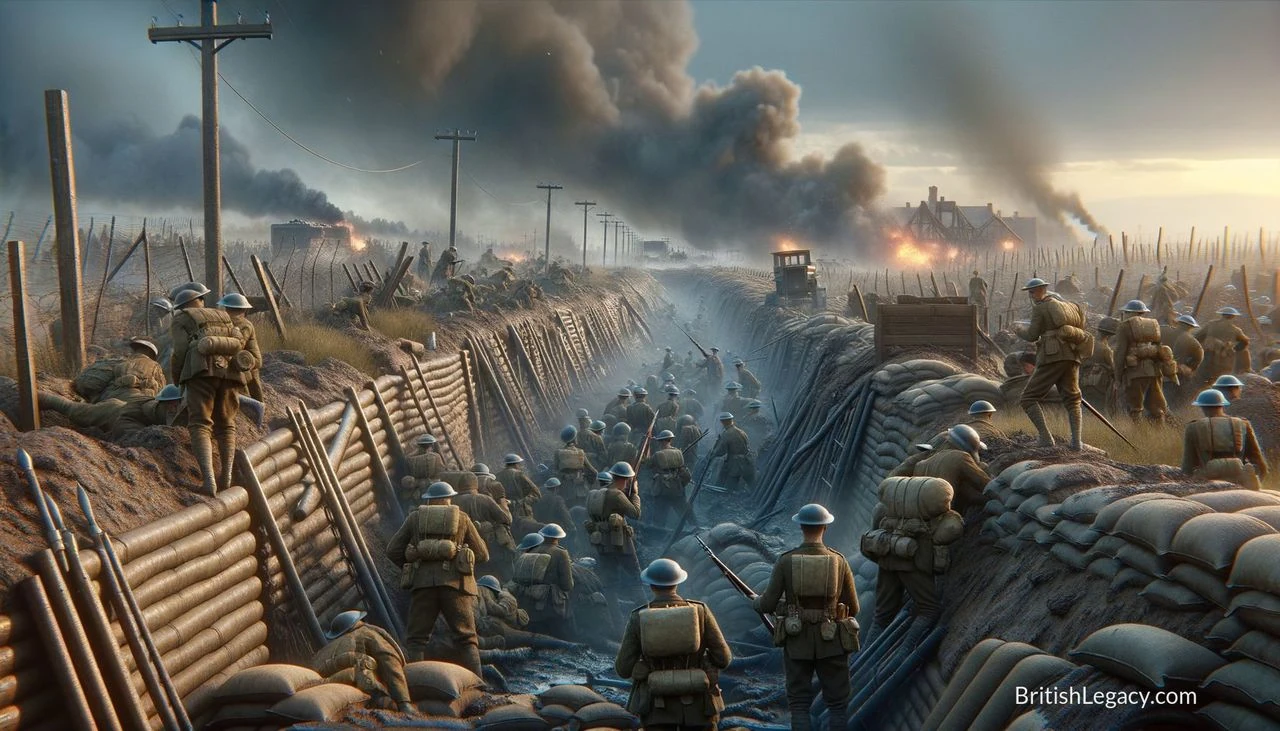
On 25 September 1915, British troops attacked German positions near Loos-en-Gohelle in northern France. The offensive opened with the largest British attack of the war to that point and the British Army’s unprecedented use of poison gas. It initially gained ground: troops entered Loos and broke through the first German line. But the advance could not be sustained. A shortage of reserves, German counter-attacks, coordination problems and the terrain around the mining town all impeded further progress.
The Western Front and the plan at Loos
By the middle of 1915, trench lines and barbed wire were part of a Western Front that had settled into stalemate. The Allies sought a way to break through German defences, and the British offensive at Loos formed part of the effort in the Artois region. The original account describes pressure to relieve French lines there as one part of the planning behind the attack.
Nearly 75,000 troops took part. On the morning of 25 September, British forces released chlorine gas and then advanced towards the German positions. The use of gas was a striking and grim development in the battle: a new weapon was being introduced into an assault intended to open a way through entrenched defences. The attack initially disrupted the German front. British troops captured the town of Loos and breached the first line, but those gains were not enough to secure a lasting breakthrough.
Why the advance stalled
Once the first assault had passed, the British lacked adequate reserves to exploit its gains. German counter-attacks further checked the advance, while problems in coordination and communication added to the difficulties. An initial breach required men and support to move forward and press the attack; without sufficient reserves, the British were unable to turn the opening success into continued progress.
The ground also favoured the defenders. Mining around Loos had left slag heaps, which offered the Germans strong positions. These obstacles compounded the problems of reinforcement and resistance. By 8 October, the battle had effectively ground to a standstill.
The cost was severe. The account gives British casualties at around 60,000. John Kipling, the son of poet Rudyard Kipling, went missing in action during the battle. His loss gives the campaign a personal dimension, but also points to the many families whose experience of the fighting was shaped by absence and uncertainty.
Loss, memory and the battle’s limits
Loos did not achieve the immediate aim of breaking through German defences. Its course instead shows how early gains could be checked when an attacking force could not bring sufficient reserves forward and faced counter-attacks from prepared positions. The battle’s experience is also linked in the original account to coordination between artillery and infantry. Broad claims that its lessons reshaped later warfare, however, are not detailed enough to establish a specific effect.
Remembering Loos has involved both public memorials and literary responses to private loss. Rudyard Kipling’s reflections on his son’s death connect the battle’s military history with the grief of a family. The story is not simply one of an assault that faltered: it is also a record of the human cost of fighting on a front where an initial advance could lead to prolonged, deadly resistance.
Why the Battle of Loos deserves a place in British Legacy
The Battle of Loos deserves a place in British Legacy because it captures a significant moment in the British Army’s experience of the First World War. The offensive began with the largest British attack of the war to that date and included the British use of poison gas. Its forces took the town of Loos and broke through the first German line, yet could not turn those gains into a decisive advance. The shortage of reserves, German counter-attacks, communication and coordination difficulties, and the slag heaps around the mining area help explain the difference between the opening success and the eventual halt.
That outcome matters alongside the human losses. Around 60,000 British casualties and John Kipling’s disappearance give the battle a scale and a personal connection that neither a simple account of failure nor a story of initial gains could convey alone. Memorials and Rudyard Kipling’s reflections on his son’s death show how Loos entered remembrance beyond the battlefield. Its place in British history rests on this specific combination: an ambitious offensive, a limited early advance, the failure to break through, and the lasting grief carried by those who lost family members.