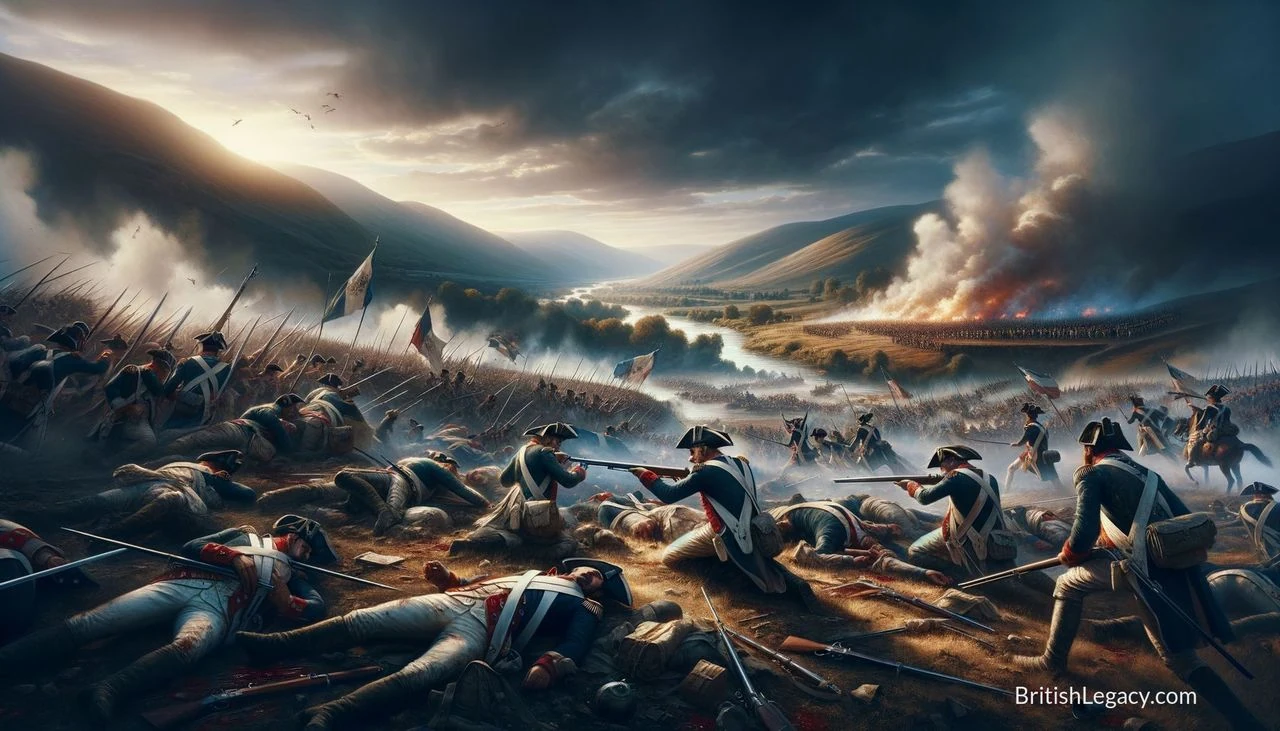
On 11 September 1709, an allied army led by the Duke of Marlborough and Prince Eugene of Savoy fought French forces near Malplaquet, in the Spanish Netherlands. The allies won the field, but the casualties were so severe that the result was widely remembered as a victory bought at an extraordinary price. The battle was part of a wider contest over the balance of power in Europe, and its immediate success did not erase the human cost or the controversy it provoked within the Grand Alliance.
A war over the Spanish succession
The War of the Spanish Succession began in 1701, following the death of Charles II of Spain without a child to succeed him. European powers feared that the Bourbon family might unite the crowns of France and Spain. The Grand Alliance—England, the Dutch Republic and the Holy Roman Empire—opposed that prospect, seeking to prevent one power from dominating the continent. John Churchill, Duke of Marlborough, was one of the alliance’s principal commanders.
By 1709, years of campaigning had left the conflict unresolved. The allied forces turned towards Mons, a fortified town in the Spanish Netherlands, now Belgium. Their advance brought them against a French army commanded by Marshals Villars and Boufflers. Malplaquet was therefore fought in the course of an operation intended to break the French defence around Mons, rather than as an isolated encounter.
The battle and its cost
The French had prepared a strong defensive position. The allied plan combined a frontal attack with feints and movements against the flanks. Fighting developed into repeated attacks and counter-attacks, with heavy losses on both sides. The account of the battle gives an estimate of more than 30,000 men killed or wounded in total; the figure is an estimate, but it conveys the scale of the casualties that made Malplaquet notorious.
The French eventually withdrew from the field, leaving the allies in possession. Yet winning the ground came at a steep cost to Marlborough’s army. The losses prompted debate and criticism within the Grand Alliance, complicating any simple description of the battle as an unqualified triumph. The allies had achieved their immediate military objective on the battlefield, but the price raised questions about what such a victory could reasonably be said to have secured.
In the aftermath, Marlborough went on to capture Mons. The battle account presents this success as a strategic consequence of the French withdrawal and the weakening of their position. It also places the fighting within the longer struggle to restrict the power of Louis XIV. Malplaquet thus combined a tactical outcome favourable to the allies with a cost that made its strategic value contested.
Aftermath and historical meaning
The War of the Spanish Succession continued after Malplaquet and ended in 1714. Treaties including Utrecht and Rastatt reshaped the European political settlement. The battle did not itself settle the succession or end the war; its significance lies in how it formed part of the larger effort by the Grand Alliance to resist a concentration of Bourbon power.
Malplaquet is often characterised as a Pyrrhic victory: the allies took the field, but suffered losses that invited scrutiny of the price paid. That tension matters. The battle’s outcome can be described as an allied success without treating the casualties as incidental or claiming that one engagement determined the fate of Europe. Its place in the campaign around Mons and in the wider war gives it significance, while its bloodshed complicates any celebratory account.
Why the Battle of Malplaquet deserves a place in British Legacy
Malplaquet belongs in a British history of Europe because English forces and a leading English commander took part in a major Grand Alliance campaign against French power. Marlborough’s role connects the battle to the military and political history of England at a time when the English crown was part of a broader coalition. The allied army’s capture of the field and the subsequent capture of Mons were meaningful campaign achievements, but they should be remembered in their full context: the allies fought alongside Dutch and imperial forces, and their success came with exceptionally heavy losses.
The battle also offers a useful way to examine what a military victory means. At Malplaquet, gaining the field did not make the cost disappear, nor did it end the war. The casualties provoked criticism among the allies, while the conflict’s eventual settlement came years later through treaties. For British Legacy, this is more than a story of a celebrated commander or a battlefield success. It is a record of Britain’s participation in a European coalition, the limits of describing victory in simple terms, and the human consequences of the strategic choices made in wartime.