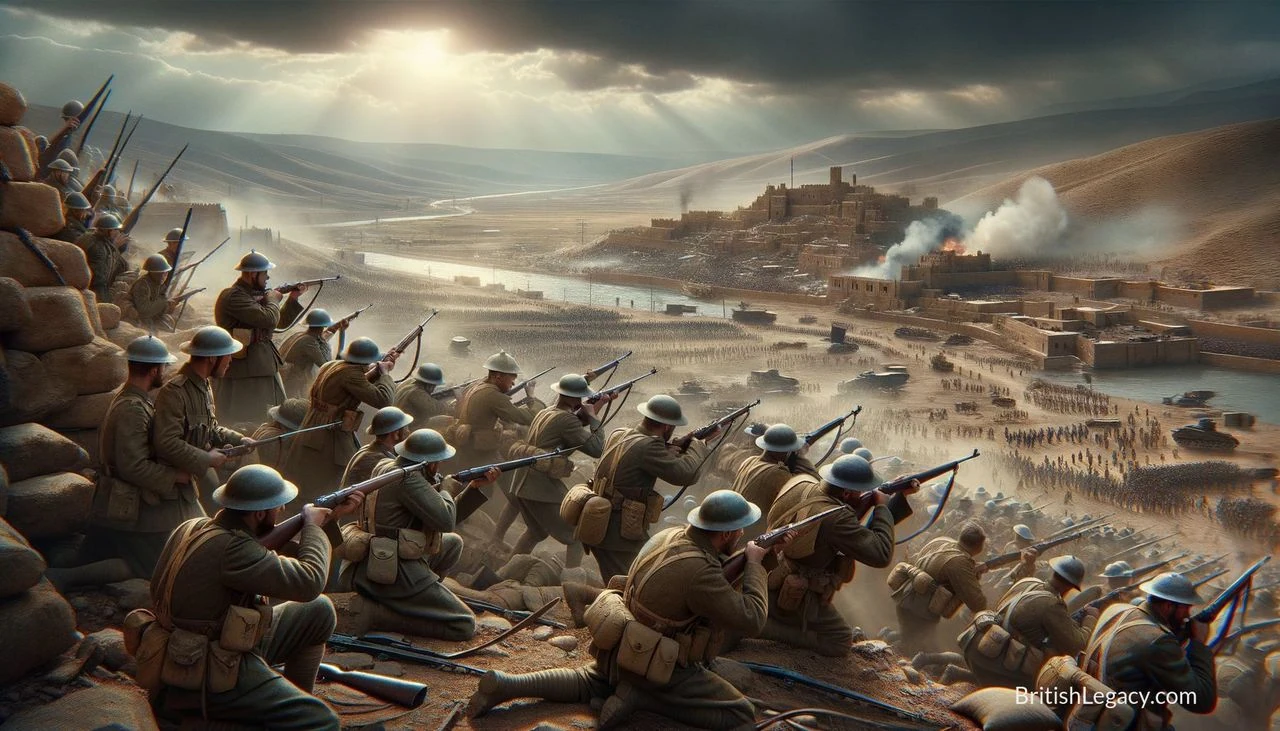
In September 1918, British and Commonwealth forces defeated Ottoman troops at Megiddo, in the Sinai and Palestine campaign. Under General Edmund Allenby, the attack used deception to achieve surprise, followed by an enveloping movement in which cavalry helped exploit the breakthrough. The victory was followed by an advance towards Damascus and Aleppo, and contributed to the end of the war in the Near East.
A campaign tied to British interests
Megiddo was part of a wider First World War campaign against Ottoman forces in the Middle East. The British campaign in Sinai and Palestine was intended to weaken Ottoman control and, according to the account of the campaign, to protect British imperial interests that included the Suez Canal. The battle was therefore both a military engagement and one stage in a larger effort to change the balance of power in the region.
Allenby commanded the British-led forces. Before the attack, he arranged a deception intended to mislead the Ottoman defenders about where the main assault would fall. By drawing attention away from the intended point of attack, the plan allowed the Allied forces to concentrate and achieve surprise. The operation’s success depended on coordination as well as the element of surprise.
Surprise, encirclement and pursuit
British and Commonwealth troops attacked Ottoman positions in a pincer movement, enveloping the defenders. Cavalry played an important role in the ensuing advance. The forces named in the account include the Australian Light Horse and cavalry of the British Indian Army; their speed and mobility helped turn the initial success into a rapid victory.
The result opened the way for British troops to advance towards Damascus and eventually Aleppo. These subsequent operations contributed to the collapse of Ottoman resistance in the region and helped bring the war in the Near East to an end. Megiddo was thus one decisive engagement within a larger campaign, rather than the entirety of the fighting that preceded the Ottoman defeat.
Military victory and political aftermath
The consequences extended beyond the battlefield. The campaign’s defeat of Ottoman forces in the Levant was followed by major political changes, including the establishment of British mandates in Palestine and Mesopotamia. Those developments belong to the post-war settlement, not to the battle itself, but they form part of the longer context in which the victory is remembered. The resulting political arrangements also contributed to changes in governance and boundaries in the region.
The forces involved reflected the reach of the British Empire and the multinational character of the campaign. The account identifies participants from Australia, New Zealand and India alongside British forces. Recognising those contributions gives a fuller picture of the victory and avoids presenting it as the achievement of British troops alone.
Why the Battle of Megiddo deserves a place in British Legacy
Megiddo deserves a place in British Legacy as a significant victory in the First World War’s Sinai and Palestine campaign. Its military course can be explained through specific elements: Allenby’s deception plan, the surprise attack, the pincer movement and the cavalry advance that helped exploit the breakthrough. The victory was followed by operations towards Damascus and Aleppo and contributed to the end of the war in the Near East. Together, these details show how the battle fitted into a wider campaign rather than standing alone.
Its British connection is also inseparable from its imperial and Commonwealth setting. The campaign served British interests, including the protection of the Suez Canal, while the forces described included Australians, New Zealanders and Indians as well as British troops. Remembering that shared participation makes the history more complete. The battle’s aftermath, including the later establishment of British mandates, also shows how military success was connected to political change in the region. Megiddo is therefore worth remembering not only for its rapid victory, but for the campaign’s wider reach and consequences.