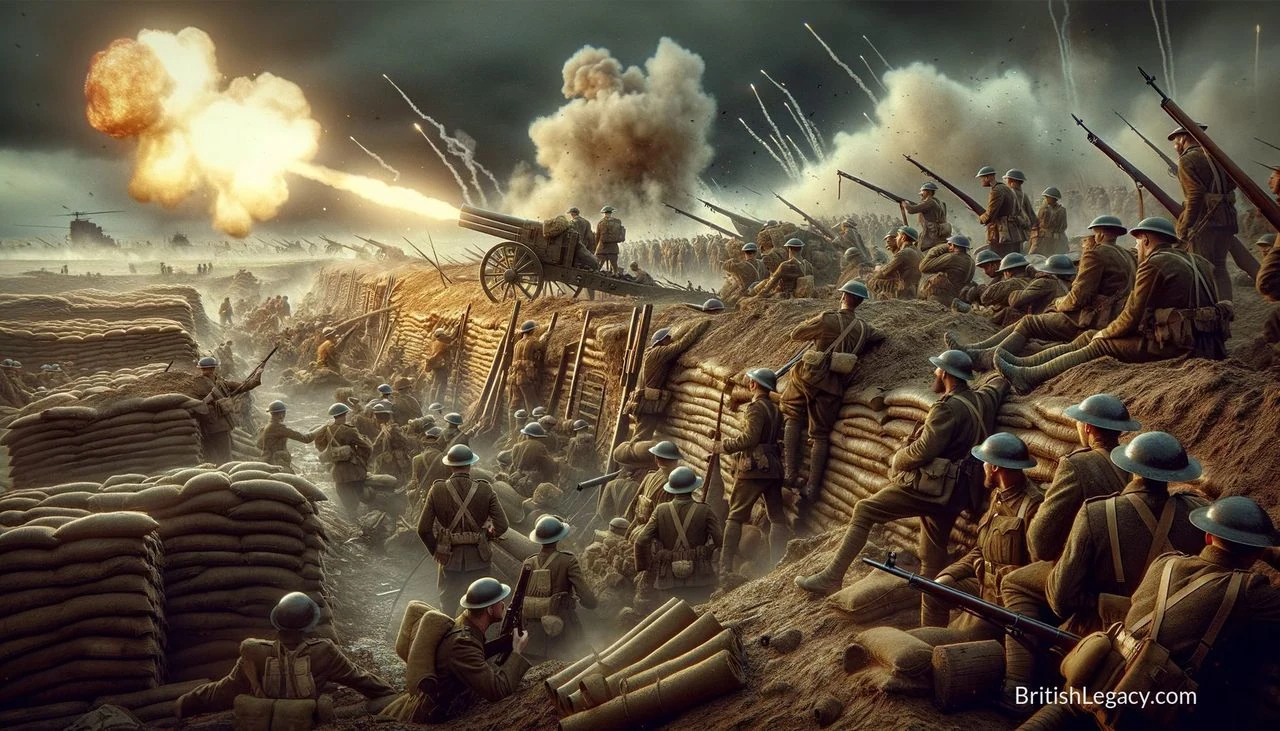
On 23 August 1914, the British Expeditionary Force (BEF) fought its first major action of the First World War near Mons, in Belgium. British troops had taken up positions along the Mons–Condé Canal as the German First Army advanced. After a day of fighting, Field Marshal Sir John French ordered the BEF to withdraw. Mons was a retreat, not a British victory; its place in the campaign lies in the resistance there and in the battle’s connection to the wider German advance through Belgium.
The BEF takes position
Britain had sent the BEF to the Western Front to support French and Belgian forces against the advancing German armies. It was a relatively small force compared with the French and German armies, but was described as highly trained and professional. The BEF, whose soldiers came to be known as the “Old Contemptibles”, took defensive positions along the canal near Mons.
Opposing it was the German First Army, commanded by General Alexander von Kluck. Its advance through Belgium formed part of the Schlieffen Plan, which aimed to outflank the French armies and capture Paris. The BEF’s position at the canal put British troops in the path of that advance.
Fighting and withdrawal
The fighting began on 23 August. British soldiers, armed with Lee–Enfield rifles, defended their positions against German attacks. The account of the battle records that the speed and accuracy of British rifle fire led German troops to believe they were facing numerous machine guns. The troops’ discipline and marksmanship became part of the story told about Mons, though the battle’s outcome was not a British victory.
As German pressure mounted, Sir John French ordered a retreat. He judged that continuing to fight risked encirclement and potentially severe losses. The withdrawal marked the immediate result of the engagement. In the broader campaign, the resistance at Mons is associated with delaying the German advance and giving Entente forces time to regroup before the Battle of the Marne, where the German advance was halted. Mons formed part of that campaign; the events described here do not establish that the battle alone determined what followed.
Places of remembrance
Mons is remembered through memorials connected with the battle. The account identifies the Nimy bridge as the place associated with Lieutenant Maurice Dease and Private Sidney Godley, who received the first Victoria Crosses of the conflict. Their association with the battle gives the bridge a specific place in the remembrance of the BEF’s first major action.
The Menin Gate at Ypres is also a major First World War memorial, but it is not directly connected to Mons. It lists the names of soldiers missing from the Ypres Salient. Keeping that distinction clear separates remembrance of the Mons engagement from a memorial to losses in a different area of the war.
Why the Battle of Mons deserves a place in British Legacy
Mons deserves a place in British Legacy as the first major action of the British Expeditionary Force in the First World War. The engagement brings together a defined moment in the war’s opening campaign: British troops defended the Mons–Condé Canal against the German First Army, and their commander ordered a withdrawal as the risk of encirclement grew. Remembering the battle as a retreat preserves the difference between its immediate outcome and its place in the wider campaign. It also avoids turning the fighting into a simple victory story.
The British connection is concrete in the BEF’s role, the command of Sir John French and the people associated with the Nimy bridge. The account names Maurice Dease and Sidney Godley in connection with the first Victoria Crosses of the conflict, while memorials in Mons keep the battle present in local remembrance. The Menin Gate belongs to a different part of that history: it commemorates missing soldiers of the Ypres Salient, not the Battle of Mons. Together, these details make Mons a specific part of Britain’s military history and of the wider remembrance of the First World War.