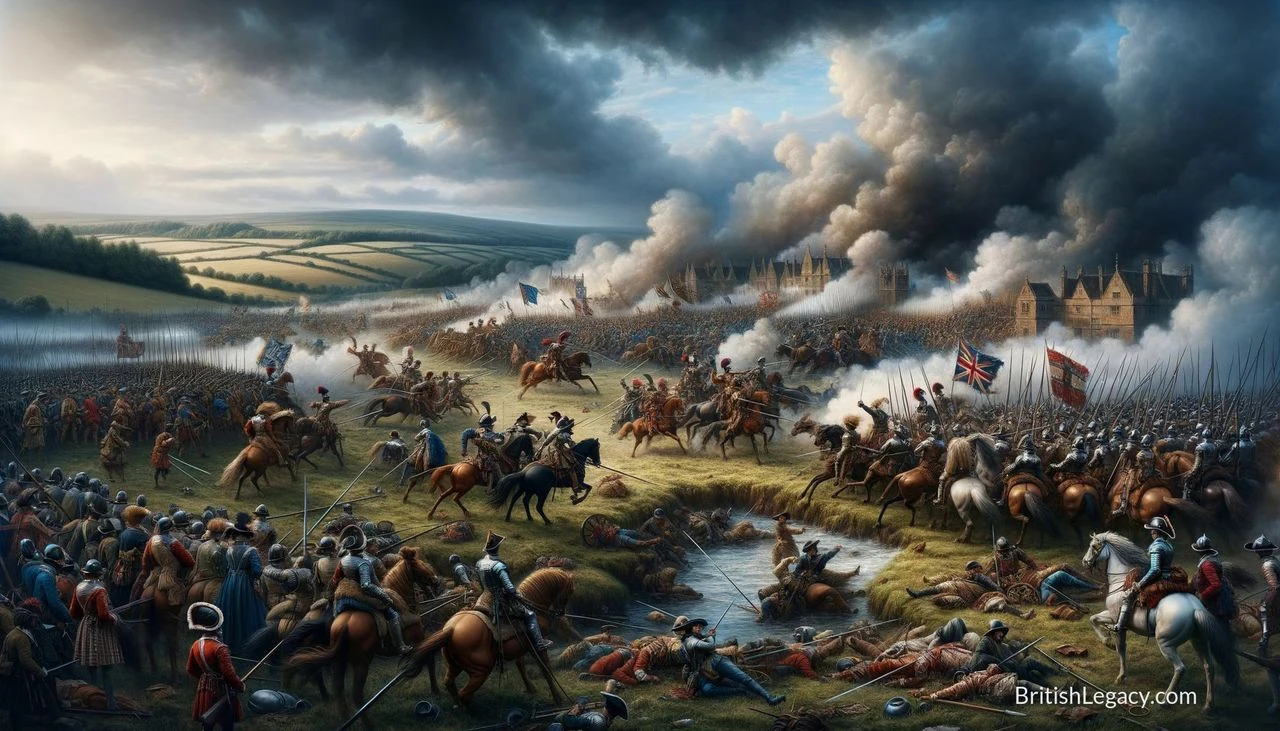
On 14 June 1645, the armies of King Charles I and Parliament met near Naseby in Northamptonshire. The Royalists began the battle with a cavalry charge that broke through one flank of the Parliamentarian line. But the pursuit that followed left the Royalist army exposed elsewhere, and Parliament’s forces went on to win a decisive victory. The defeat cost the King men, weapons and supplies, while the capture of his correspondence added a political blow to his military losses.
A kingdom divided
The English Civil War grew out of a struggle between Charles I and Parliament over authority and the government of the kingdom. Supporters of the King became known as Royalists; those fighting for Parliament were Parliamentarians. The conflict had begun in the early 1640s and, by 1645, the Royalist position was under pressure.
Charles sought to regroup as Parliament’s army, led by Sir Thomas Fairfax and Oliver Cromwell, closed in. The Parliamentarian forces had been reorganised as the New Model Army, a disciplined force formed after earlier, less successful campaigning. At Naseby, Fairfax commanded the army, with Cromwell serving as a senior cavalry commander. The Royalist army was led by Prince Rupert of the Rhine.
The numbers in the two accounts of the battle are estimates: about 14,000 Parliamentarians faced roughly 7,500 Royalists. The figures underline the Royalists’ numerical disadvantage, but the battle’s outcome was not simply a matter of size. The movement and discipline of the forces during the fighting helped determine what followed.
The fighting at Naseby
Rupert’s cavalry attacked the Parliamentarian right and initially broke through. The Royalists then pursued the retreating infantry rather than consolidating their position. That advance took them away from the main struggle and left the Royalist left vulnerable.
Cromwell’s cavalry exploited the opening, charging the Royalist left. At the same time, hard fighting between the infantry brought pressure on the Royalist centre. The combination of the cavalry attack and the collapse of the central position turned the battle against the King’s army. By early afternoon, the Royalists were in disarray. Many were taken prisoner, including senior officers, while Charles escaped. The Royalists also left artillery, arms and other military supplies on the field.
The account of the fighting shows how an early success did not secure the Royalist position. Rupert’s initial breakthrough was followed by a pursuit that drew his men away from the battle’s central contest. Cromwell’s cavalry took advantage of the resulting gap, while the infantry fighting added to the pressure on the Royalist centre. Naseby was therefore a defeat in which the sequence of decisions and attacks mattered as much as the armies’ starting numbers.
Military defeat and political consequences
Parliament’s forces captured Charles’s personal correspondence after the battle. The letters revealed attempts to seek foreign intervention and other politically damaging dealings. Their seizure gave Parliament material with which to challenge the King’s standing, compounding the loss of soldiers and supplies. Naseby was a military victory, but its consequences also reached the political struggle between King and Parliament.
The Royalist defeat marked a major reversal in the war. Further losses followed, and the King’s forces surrendered in 1646. Charles was tried and executed in 1649; the Commonwealth was then established under Oliver Cromwell. Naseby did not, by itself, settle every question of government, but the battle weakened the Royalist cause at a critical point and helped shape the course of the conflict that followed.
Why the Battle of Naseby deserves a place in British Legacy
Naseby deserves attention because it brings the military and political dimensions of the English Civil War into sharp focus. Parliament’s victory depended not only on having a larger force, but on what happened after Rupert’s cavalry broke through: the pursuit left an opening, Cromwell’s cavalry exploited it, and fighting in the centre helped turn the Royalist army’s position into a rout. The battle’s result was concrete. The King’s forces lost men, senior officers, artillery, arms and supplies, and Charles himself had to escape.
The capture of the King’s correspondence connected the battlefield outcome to the wider contest over authority. The letters gave Parliament politically damaging evidence at a time when the Royalist cause had already suffered a severe military defeat. Naseby was followed by further Royalist losses, surrender in 1646 and, later, the trial and execution of Charles I and the establishment of the Commonwealth. Remembering the battle in British history is not a claim that it created modern democracy or settled the constitutional questions of its age. Its significance lies in the specific way a decisive battlefield defeat weakened the King’s position and altered the course of the war.