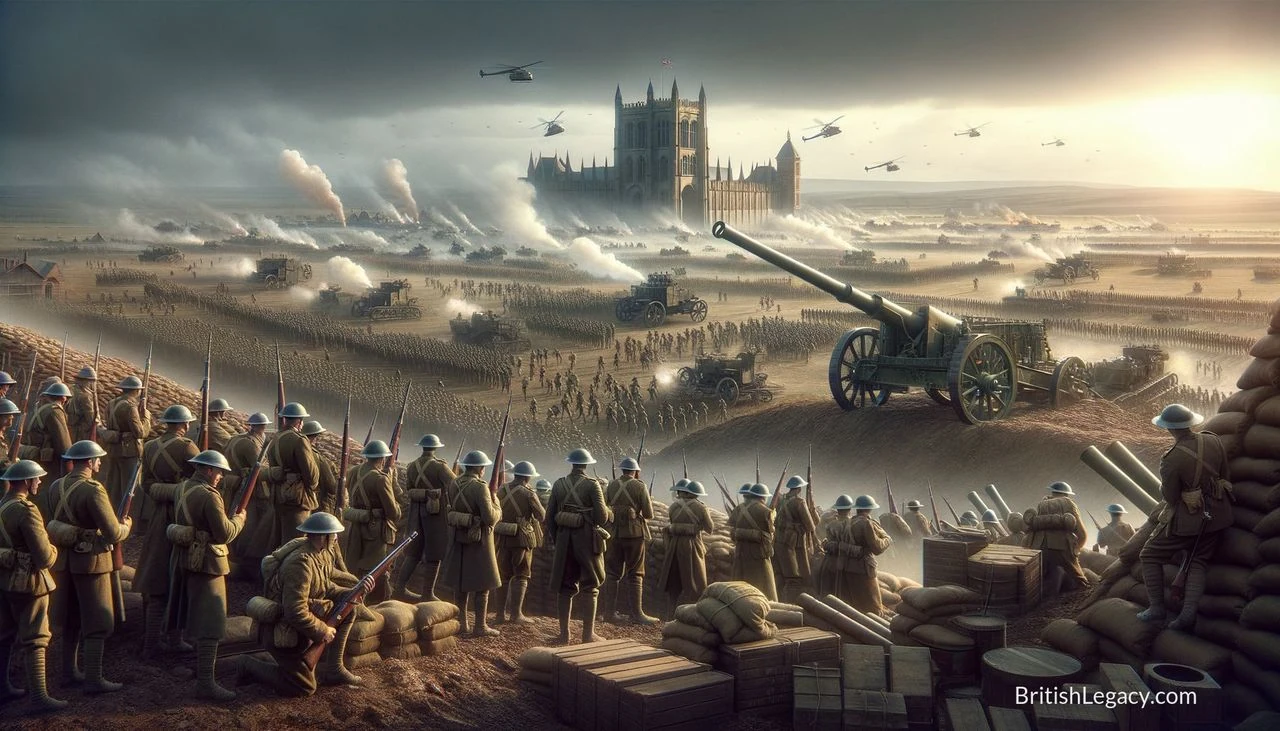
In March 1915, British forces attacked German positions at Neuve Chapelle in northern France. The British Expeditionary Force (BEF) made significant early gains, breaking through the German lines and capturing the village. But the advance did not deliver the wider strategic success its commanders sought. Difficulties in moving supplies and reinforcements, problems communicating across the battlefield and renewed resistance brought the offensive to a halt.
Planning an offensive
The attack was commanded by Field Marshal Sir John French, head of the BEF, and General Sir Douglas Haig, who led the First Army. Their plan began with an artillery bombardment intended to damage German defences before British infantry advanced towards the village. The operation was presented in the contemporary account as the first large-scale, organised attack by British forces in the war, an effort to break out of the trench-bound fighting on the Western Front.
The opening assault made rapid progress. The bombardment weakened German positions, and British troops penetrated the lines within the first hours. Their early gains raised hopes of a swift, decisive result. The village of Neuve Chapelle was captured, but taking it did not amount to achieving the larger objectives of the offensive.
When the advance stalled
As the attack developed, the BEF struggled to sustain its momentum. Reinforcements and supplies did not reach the front in time, while communication difficulties made it harder to coordinate the assault. The battlefield was fragmented, and British troops met resistance as the element of surprise faded. After three days, the advance had ground to a halt.
The operation therefore combined a tactical success with an incomplete strategic outcome: British forces had broken through and taken the village, but they had not achieved the broader aims of the attack. The existing account describes casualties as high but gives no figures, so the scale cannot be stated more precisely here. The contrast between the rapid initial gains and the subsequent stall is central to understanding the battle’s mixed result.
Lessons and limits
Neuve Chapelle exposed the importance of logistics and communication in an offensive. A breakthrough could not be sustained simply by capturing ground: troops also needed timely supplies and reinforcements, and commanders needed to coordinate movement across a confused battlefield. The account says the British High Command reassessed its approach and made improvements in these areas for later battles, although it does not specify what changed or when.
The experience also cautions against treating the battle as a straightforward model for later success. Its opening showed that a concentrated artillery attack and infantry advance could make significant gains; its stalled progress showed how quickly those gains could lose momentum when support and coordination failed. The result was neither the decisive victory hoped for by the commanders nor a complete failure: the village was captured, but the wider objectives remained unmet.
Why the Battle of Neuve Chapelle deserves a place in British Legacy
The Battle of Neuve Chapelle belongs in British Legacy because it captures both the ambition and the practical limits of the British Expeditionary Force’s early operations on the Western Front. The assault began with a planned artillery bombardment and achieved a breakthrough, followed by the capture of its immediate objective, the village. Yet the failure to sustain that advance makes the episode more instructive than a simple account of victory. The difficulties described—supply, communication and resistance—show how military plans depended on the less visible work of moving men and materials and coordinating action under battlefield conditions.
Its place in British history is therefore not a claim that the operation transformed warfare or secured a decisive result. The account supports a more measured legacy: Neuve Chapelle demonstrated what an organised attack could initially achieve and what could prevent those gains from becoming a wider success. Remembering the battle also keeps its human cost in view. British troops advanced, met resistance and suffered casualties, while the strategic aims remained unfulfilled. That combination of achievement, limitation and loss gives the battle enduring value as a case study in Britain’s First World War military experience.