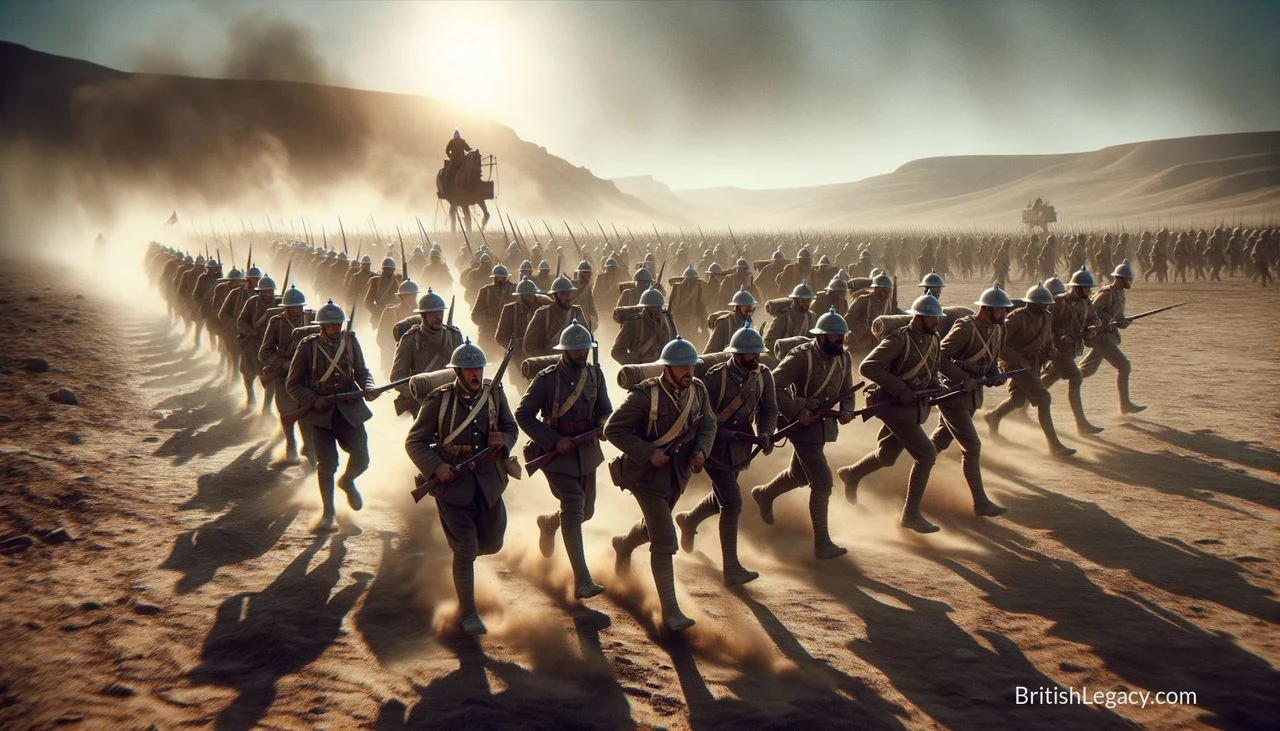
On 2 September 1898, British and Egyptian forces fought the Mahdist army on the plains north of Omdurman, in Sudan. The engagement ended in a decisive defeat for the Mahdists and became a defining episode in the Mahdist War. Led by General Herbert Kitchener, the Anglo-Egyptian force brought artillery, Maxim machine guns, river gunboats and railway-supported logistics to a campaign that culminated in the end of the Mahdist state and the establishment of Anglo-Egyptian rule.
A conflict over Sudan
The Mahdist War had begun in 1881. Its movement, led by Muhammad Ahmad, who proclaimed himself the Mahdi, sought to overthrow Egyptian control. Ahmad died in 1885, but the movement continued under his successor, Khalifa Abdullah, whose forces retained control over much of Sudan. The conflict therefore involved both the Mahdist effort to sustain its rule and British and Egyptian interests in the region.
Britain appointed Kitchener to lead the Anglo-Egyptian campaign to reassert its influence in Sudan. The march towards Omdurman relied on planning and preparation as well as military force. River gunboats and the railway helped move troops and supplies, bringing transport and logistics into the campaign alongside the weapons used in battle.
The fighting at Omdurman
The account of the battle gives the Anglo-Egyptian army a strength of about 25,000, facing a Mahdist force of approximately 50,000. The imbalance was not simply one of numbers. Kitchener’s troops had artillery and Maxim machine guns, while the Mahdist army was described as relying on more conventional weapons.
Anglo-Egyptian artillery opened the fighting. Mahdist forces then charged the opposing line, meeting the defenders’ firepower and organised resistance. The defeat was severe: the account estimates that more than 10,000 Mahdist soldiers were killed, with many more wounded and others captured. These figures convey the scale of the loss but should be read as estimates, rather than a precise count.
The battle’s outcome reflected the sharp difference between the forces’ weapons and the effects of concentrated fire. The Mahdist army’s larger numbers did not prevent its defeat. Omdurman thus became an example of the destructive advantage that modern armaments could give an industrialised army over a force equipped with more conventional weapons.
Conquest and consequences
The defeat ended the Mahdist state and enabled the establishment of the Anglo-Egyptian Condominium. Sudan was formally administered jointly by Britain and Egypt, although British interests predominated. Omdurman therefore marked more than the end of a battle: it opened a new phase of outside rule over Sudan, with British influence central to the political settlement.
The victory enhanced Kitchener’s reputation in Britain, where he was celebrated as a national hero. He later became Lord Kitchener of Khartoum. His rise connected the campaign in Sudan with British imperial policy and the extension of British influence in Africa. The battle also brought military technology and colonial ambition into public view, while its heavy casualties underline the human cost behind the language of victory.
Why the Battle of Omdurman deserves a place in British Legacy
Omdurman deserves attention in British history because it shows how British power was exercised beyond Britain and how military victory helped determine another country’s political future. British and Egyptian forces defeated the Mahdist army, and the resulting settlement placed Sudan under joint administration in which British interests predominated. The British connection is therefore not just Kitchener’s command or the celebration of his success at home; it is also the imperial influence that followed the battle.
The campaign illustrates the combined role of organisation, transport and weapons in late nineteenth-century warfare. Railway logistics and river gunboats supported the advance, while artillery and Maxim guns shaped the fighting itself. At the same time, the estimated scale of Mahdist casualties resists a purely triumphant account. Remembering Omdurman means holding both sides of its legacy together: a landmark in British imperial and military history, and a violent defeat with lasting political consequences for Sudan.