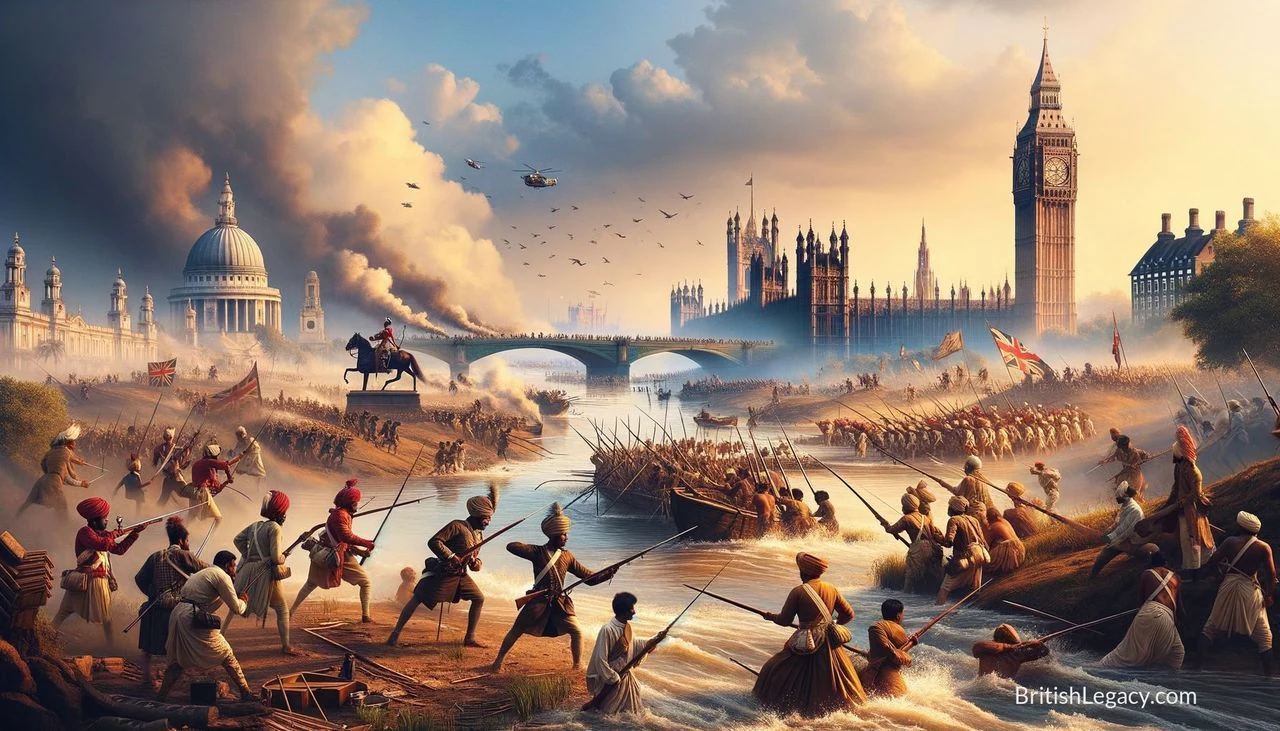
On 23 June 1757, near Plassey in Bengal, a battle between the East India Company and the forces of Nawab Siraj-ud-Daulah ended with consequences far beyond the field. Robert Clive’s Company force was much smaller than the Nawab’s army, but divisions within the latter’s ranks shaped the encounter. The Company’s victory gave it a new measure of political influence in Bengal and became a turning point in the expansion of British power in India.
Bengal amid a wider conflict
The Battle of Plassey took place during the Seven Years’ War, which ran from 1756 to 1763 and involved Britain and France among other European powers. Although the conflict’s principal theatres were elsewhere, their rivalry also extended to India, where British and French interests met. Bengal, an affluent province in eastern India, was ruled by Siraj-ud-Daulah. Its wealth and industries made it important to the East India Company, a British trading organisation increasingly seeking political leverage as well as commercial returns.
The Company, led in this episode by Robert Clive, conspired against the Nawab with the involvement of internal dissenters. Among them was Mir Jafar, one of Siraj-ud-Daulah’s commanders. The alliance of interests and promises behind the conspiracy mattered as much as the contrast in the armies’ numbers: the confrontation was not simply a contest between two forces on open ground, but a struggle in which the Nawab’s position was weakened by dissent within his own ranks.
Rain, artillery and betrayal
The battle was fought near the village of Plassey, on the Bhagirathi River. Clive commanded approximately 3,000 men; Siraj-ud-Daulah’s army numbered around 50,000. Those figures suggest a decisive numerical advantage for the Nawab, but numbers alone did not determine the outcome. The account of the battle places Mir Jafar’s disloyalty at the centre of the Company’s success.
Rain fell on the battlefield the night before the fighting. The Nawab’s gunpowder was left unusable, while the Company’s ammunition had been protected, allowing its artillery to continue operating. Fighting began on the morning of 23 June. By midday, the effect of Mir Jafar’s betrayal was apparent and the balance had shifted. The result depended on a combination of preparation, artillery and political fracture, rather than the size of the forces alone.
From trading interests to political power
Plassey’s importance lay in what the victory enabled. The East India Company remained a commercial organisation, but it now exercised much greater political influence. Clive’s victory established the Company as a formidable force in Bengal’s politics and gave it control there. In this way, an encounter involving a trading company became a major step in the growth of British power in India.
The battle is often connected with the later British Raj, but the account here describes Plassey as an opening stage in a longer transformation, not as the Raj itself. It presents the Company’s victory as the start of an extended period of British dominance across the subcontinent, lasting nearly two centuries and reshaping political, economic and cultural life. That broad legacy should not be mistaken for a simple story of military achievement: the same Company advance that increased British power began a period of colonial subjugation for India.
Why the Battle of Plassey deserves a place in British Legacy
Plassey deserves a place in British Legacy because it helps explain how British influence in India expanded beyond trade. The East India Company’s victory in Bengal was a pivotal change in its political position: a commercial organisation became a force in regional government. The story also shows that the result was not determined by numbers alone. A smaller Company army faced a much larger one, while the Nawab’s internal dissent, the protection of ammunition from rain and the effective use of artillery all shaped the outcome.
Its British connection is therefore substantial, but it cannot be told only as a tale of British strategy or success. The Company’s increased power in Bengal was part of the beginning of a longer period of colonial rule, with profound consequences for India. Remembering Plassey means holding both parts of that history together: the growth of a British trading company into a political power, and the subjugation that accompanied that expansion. That tension makes the battle important to British history and to an honest account of Britain’s imperial legacy.