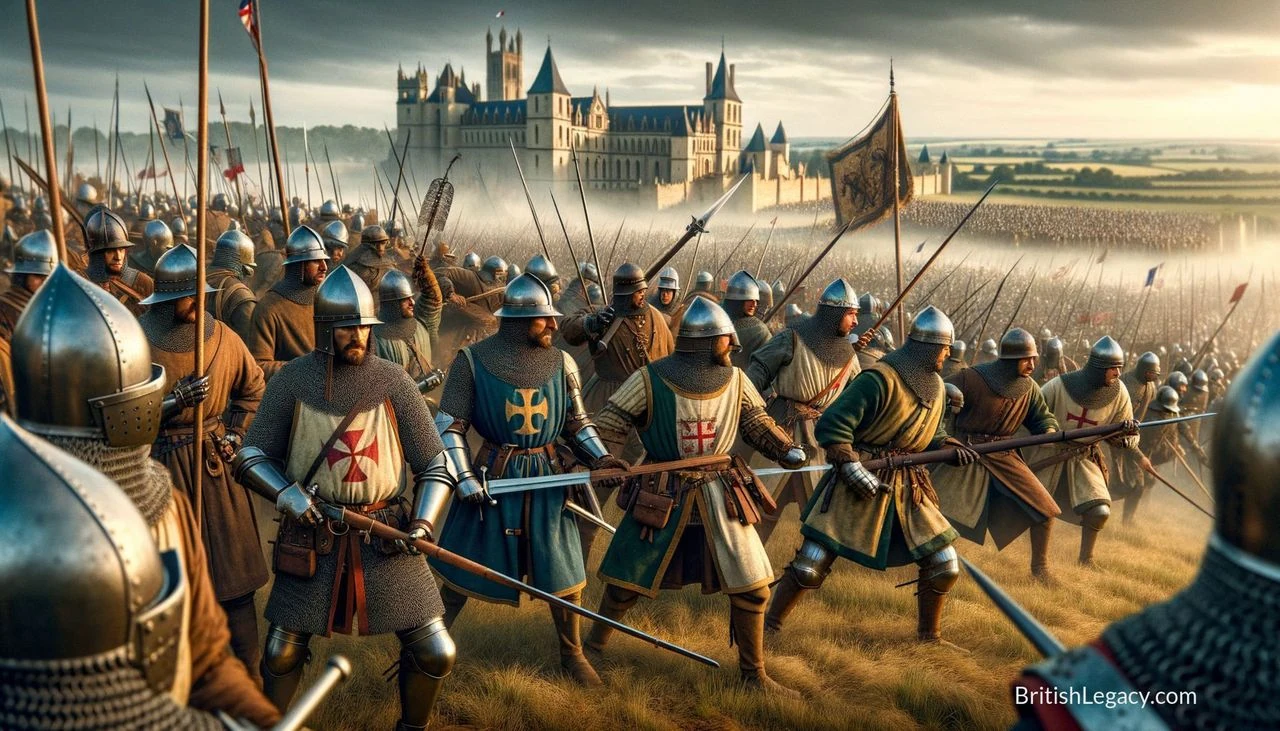
The Battle of Poitiers: A Pivotal Victory in the Hundred Years' War
In the grand tapestry of British history, few events stand out as both as dramatic and influential as the Battle of Poitiers in 1356. This pivotal conflict, nestled within the protracted Hundred Years' War, dramatically underscored the might of the English military and their strategic ingenuity. As much a tale of daring and valor as it is of grim realpolitik, the Battle of Poitiers has left an indelible mark on the British legacy and has reverberated through the annals of European history.
The Prelude: A Fractured Kingdom
The context of the Battle of Poitiers is set against the backdrop of the Hundred Years' War, a serpentine and often brutally complex series of conflicts between England and France from 1337 to 1453. What began ostensibly as a dispute over feudal rights eventually morphed into a dynastic struggle, brimming with battles, truces, and shifting alliances. By the 1350s, the war had reached a fever pitch.
Henry of Grosmont, Duke of Lancaster, and King Edward III of England sought to entrench English power in France while simultaneously expanding their territories. The French, under King John II, known as John the Good, were determined to resist such incursions and to reclaim territories that had slipped from their grasp.
The Lead-Up to Battle
The Plantagenets, under the capable command of Edward, the Black Prince, son of King Edward III, launched a daring campaign through French territories. Edward the Black Prince, so named due to the distinctive black armour he reputedly wore, was a military genius. Emboldened by his earlier successes, he conducted sweeping raids, or chevauchées, that targeted French agricultural heartlands, aiming to cripple the French economy and morale.
In September of 1356, the Black Prince's forces found themselves near Poitiers with a much larger French army hot on their heels. The English, numbering around 6,000-8,000 troops, faced a formidable array of some 12,000-15,000 French soldiers. Despite the seemingly insurmountable odds, the English prepared for battle with tenacity and tactical acumen.
The Strategy and the Battle
The English army's defensive positioning was masterful. They chose a narrow front between natural obstacles, which neutralised the French numerical superiority. The English archers, wielding the deadly longbows for which they were famed, were strategically placed to unleash devastating volleys of arrows upon the French cavalry and infantry.
The morning of September 19, 1356, saw a brilliant display of English tactical prowess. King John II, eager to crush the upstart English forces, ordered his knights to charge. The French found themselves ensnared in a killing field—literally and figuratively. The muddy terrain hindered their advance, while arrows rained down with lethal precision.
The battle soon devolved into disarray for the French. English soldiers held firm, and the Black Prince capitalised on every misstep made by the French command. With discipline and strategic discipline, the English infantry closed in, and in the ensuing melee, the French army was shattered.
The Aftermath and the Capture of a King
In a staggering turn of events, King John II of France was captured along with a host of French nobles. The sight of a captured monarch being led away to London as a prisoner was unprecedented and stunned Europe.
The ramifications were immediate and far-reaching. The ransom demanded for King John II's release, a staggering three million gold crowns, plunged France into economic disarray. The Treaty of Brétigny (1360), which followed, yielded vast territorial gains in south-western France for England, enhancing English presence and power significantly.
Legacy and Historical Impact
The Battle of Poitiers remains a landmark in the great British legacy. It was a testament to the ingenuity and courage of English forces, showcasing their ability to overcome overwhelming odds through superior tactics and strong leadership. The battle is emblematic of the martial prowess that would characterise much of British military history in the centuries to follow.
In a broader context, the victory at Poitiers solidified England's position as a formidable power in medieval Europe, contributing to a burgeoning sense of national identity and martial pride. It also served as a precursor to the eventual decline of feudal warfare, with the effectiveness of the longbow signalling a shift in military tactics.
The Battle of Poitiers, thus, stands as a defining chapter in the grand narrative of British heritage. It is a stirring reminder of the nation's historical resilience and strategic brilliance, qualities that have shaped Britain’s legacy and continue to inform its global impact to this very day.