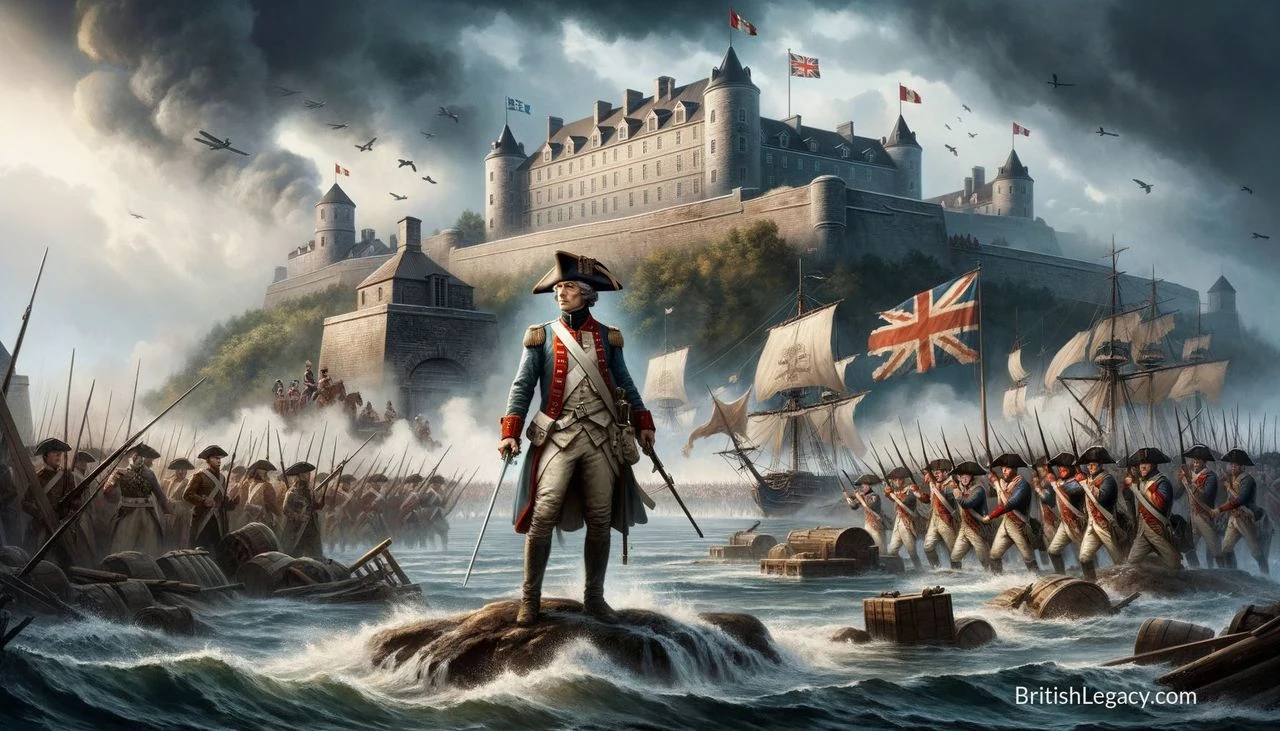
On 13 September 1759, British and French forces met on the Plains of Abraham outside Quebec. The battle was brief, but its consequences reached beyond the battlefield: British troops under General James Wolfe won, Quebec was captured, and the balance of colonial power in North America shifted. Wolfe and his French opponent, General Louis-Joseph de Montcalm, were both mortally wounded.
Quebec and the contest for North America
The battle took place during the Seven Years’ War, a conflict between major European powers that extended across continents. In North America, Britain and France competed for territory and influence. Quebec, on the Saint Lawrence River, was a stronghold of French Canada and a focal point in that contest. Its capture was therefore an important objective for the British campaign.
Wolfe led the British expedition against the city, while Montcalm commanded its French defence. The fortifications and rugged terrain made the approach difficult for the attackers. The campaign brought the opposing forces into a direct engagement on the Plains of Abraham, west of Quebec, on 13 September.
The battle and its cost
The encounter was fierce but short. Wolfe’s British forces fought Montcalm’s troops, and the British emerged victorious. Wolfe was mortally wounded during the fighting; Montcalm was also fatally injured. The deaths of both commanders give the battle a stark human dimension, but the immediate military result was clear: the victory enabled the British capture of Quebec.
The city’s fall marked a major setback for French colonial ambitions in North America. It did not, by itself, settle every question of control in the region. The battle belonged to a wider war, and the political outcome followed through later developments, including the Treaty of Paris in 1763. That treaty formalised Britain’s supremacy over former French territories, placing the capture of Quebec within a broader change in the continent’s political map.
A turning point in a larger conflict
The significance of the battle lies in the combination of its immediate outcome and its place in the wider contest between Britain and France. The British victory helped bring Quebec into British hands; the subsequent treaty formalised a larger territorial change. Together, those events altered the position of the two powers in North America.
It is more accurate to see the battle as a decisive stage in that history than as a single event that settled the continent’s future. The fighting produced a British victory at Quebec, while the later treaty established the formal terms of Britain’s supremacy over former French territories. The distinction matters: battlefield success and political settlement were connected, but they were not the same moment.
Why the Battle of Quebec deserves a place in British Legacy
The Battle of Quebec deserves a place in British Legacy because it was a consequential British military victory in the Seven Years’ War. Under Wolfe, British forces defeated Montcalm’s army on the Plains of Abraham and captured a major French stronghold on the Saint Lawrence. The outcome contributed to a change in colonial power that was formalised by the Treaty of Paris in 1763. Its importance rests on that specific connection between the battle, Quebec’s capture and the wider political settlement, rather than on claims that one engagement alone determined North America’s future.
The battle also resists a simple triumphal account. Wolfe and Montcalm were both mortally wounded in the short engagement, even as its result favoured Britain. Remembering the event means holding its military consequence alongside that human cost, and recognising that the political consequences unfolded over time. That combination makes the battle a significant part of Britain’s imperial history and of the wider history of North America.