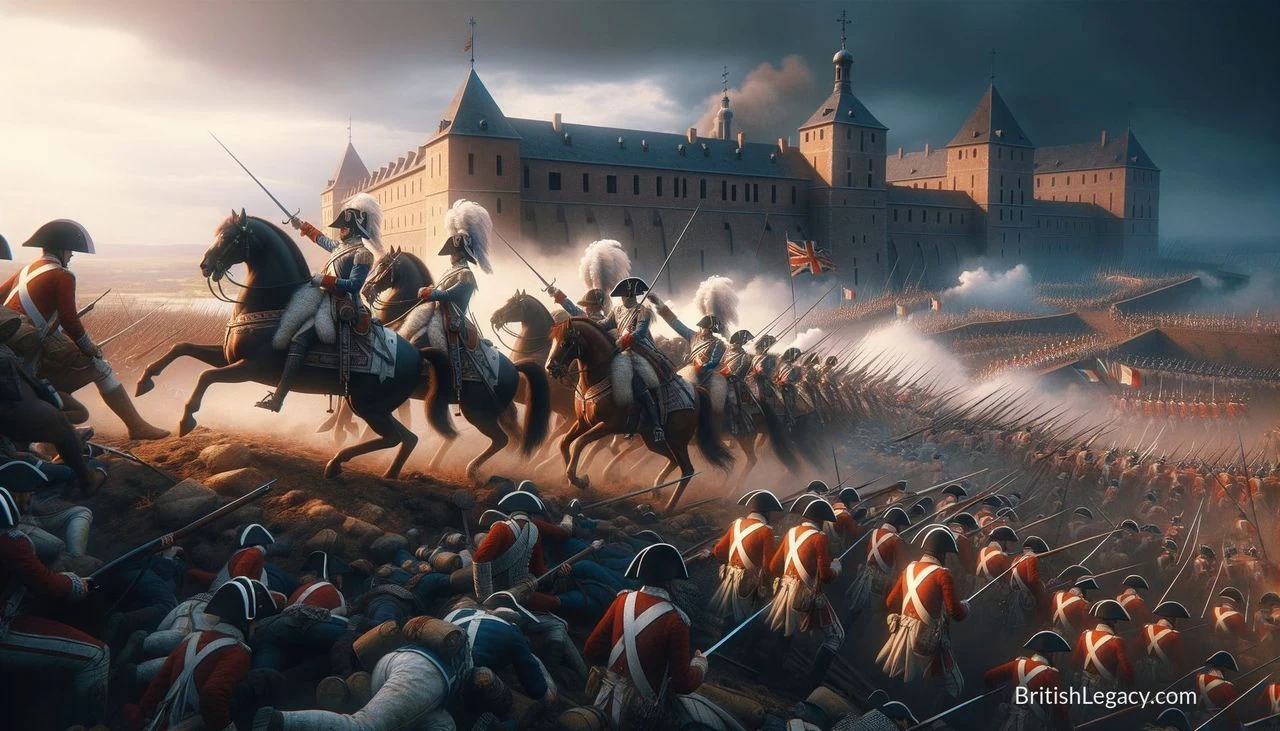
On 23 May 1706, near the village of Ramillies in the Spanish Netherlands, an Allied army led by John Churchill, the Duke of Marlborough, defeated French troops commanded by Marshal Villeroi. The victory shifted the momentum of the campaign. In its aftermath, the Allies captured important towns, including Antwerp, Bruges and Brussels. Ramillies was a significant British-led success, but not a British victory alone: the Grand Alliance brought together forces from several nations.
A war over the Spanish succession
The War of the Spanish Succession began in 1701 after the death of Charles II of Spain. Charles had named Philip of Anjou, a grandson of Louis XIV of France, as his successor. Other European powers feared that the French and Spanish thrones might be united under a Bourbon monarch, changing the balance of power. England, the Dutch Republic and the Holy Roman Empire joined in the Grand Alliance to oppose that prospect.
The conflict extended across Europe, and the Spanish Netherlands became one of its principal areas of contention. The region was strategically and economically important; control there mattered to the opposing powers. By early 1706, French forces under Villeroi faced the Allied army led by Marlborough. The French held positions around Ramillies, with their line anchored on the villages of Taviers and Ramillies. The existing account describes manoeuvres before the battle intended to stretch the French line, but gives no detail of a preceding siege.
Marlborough’s manoeuvres and the battle
The engagement took place on the plains near Ramillies. Marlborough’s army combined infantry and cavalry in its attack on the French position. The account of the battle describes a feigned retreat by Allied cavalry as a turning point: the apparent withdrawal drew French forces into a compromised position. Marlborough then had an opportunity to press the attack.
The ensuing assault broke the French centre and flanks. French troops abandoned their positions, and the battle became a rout rather than the prolonged confrontation initially anticipated in the account. The result was a decisive Allied victory over Villeroi’s forces. Its importance was both immediate and practical: the defeat weakened the French position and gave the Allies an opportunity to advance through the Spanish Netherlands.
What the victory changed
After Ramillies, the Allies captured a series of towns, including Antwerp, Bruges and Brussels. These gains reduced French influence in the region and strengthened the Alliance’s strategic position and morale. The defeat also damaged the standing of Louis XIV, whose ambitions were at the heart of the wider contest. Ramillies shifted momentum towards the Grand Alliance, though it remained one engagement in a European war, not a settlement of the conflict.
The battle also illustrates the coalition character of the campaign. Marlborough commanded an army made up of forces from different nations; the result cannot accurately be presented as the achievement of a British army acting alone. The alliance’s success at Ramillies brought concrete territorial gains, while its broader significance lay in changing the balance of the campaign in the Spanish Netherlands. Claims that the victory by itself expanded British trade or naval power, or laid the groundwork for the later British Empire, go beyond what this account establishes.
Why the Battle of Ramillies deserves a place in British Legacy
Ramillies deserves a place in British Legacy because it records a major victory led by John Churchill, an English commander, during a war in which England was a member of the Grand Alliance. Marlborough’s command connects the battle to Britain’s military history, while the identity of the army makes the story more than a national triumph. Dutch and Holy Roman Empire forces were among the coalition partners identified in the account. Recognising that partnership gives a clearer picture of how the victory was achieved and avoids assigning the work of an alliance to one country.
The consequences were substantial and specific. The French defeat was followed by the capture of Antwerp, Bruges and Brussels, weakening French influence in the Spanish Netherlands and improving the Alliance’s strategic position. The battle also shifted momentum in a war fought over the European balance of power. Its British legacy lies in Marlborough’s leadership within that coalition and in the campaign consequences that followed, not in unsupported claims that Ramillies alone created an empire or settled the war. Remembering the battle in those terms preserves both its importance to British history and the essential contribution of its allies.