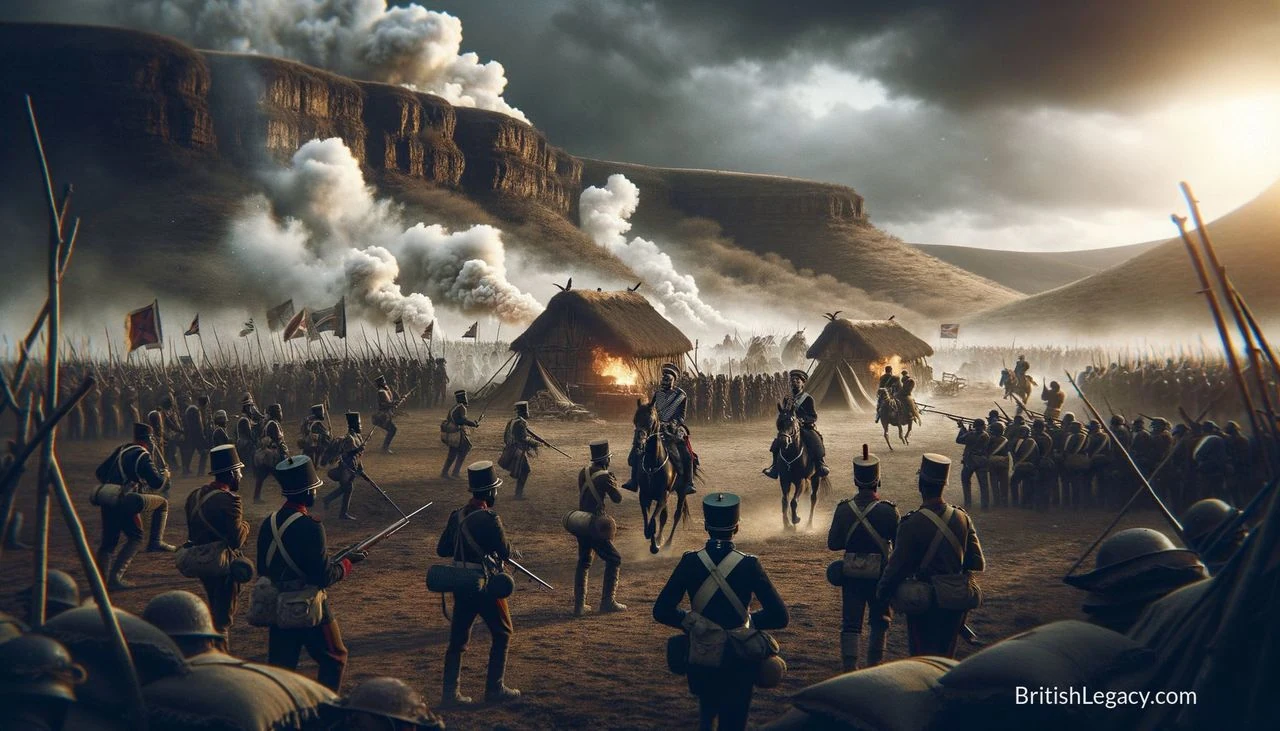
The defence of Rorke’s Drift took place on 22 January 1879, during the Anglo-Zulu War. A garrison of British and colonial troops held a mission station through a series of attacks by Zulu forces, after the British defeat at Isandlwana earlier that day. The stand became famous for the Victoria Crosses awarded to its defenders and, decades later, for the film Zulu. Its place in British memory sits within a wider history of imperial conflict, not apart from it.
A station in the aftermath of Isandlwana
The Anglo-Zulu War was fought between the British Empire and the Zulu Kingdom in 1879. The account of Rorke’s Drift places the defence in the immediate aftermath of the British defeat at Isandlwana, where a large British force had been routed. At the mission station, about 150 British and colonial troops prepared to defend themselves against an approaching Zulu force. The estimate given for that force is about 4,000; it should be understood as an estimate rather than a precise count.
The garrison consisted mainly of B Company, 2nd Battalion, 24th Regiment of Foot. Its officers included Lieutenant John Chard of the Royal Engineers and Lieutenant Gonville Bromhead, an infantry officer. With an attack expected, the defenders used the materials available to strengthen their position. Mealie bags and biscuit boxes formed makeshift barriers around the hospital and storeroom. These fortifications were hurriedly assembled, but gave the garrison a defensive perimeter around the station’s most important buildings.
Fighting around the hospital
Attacks continued through the day and into the night. The defenders fired from behind their improvised barricades, and the fighting included close encounters as the Zulu forces pressed against the position. The station’s buildings and perimeter shaped the defence: the barricades offered protection, but the hospital became a particularly vulnerable focus of the battle.
Patients inside the hospital, including men unable to walk, had to be moved towards safer positions while the fighting was under way. The building caught fire. Some defenders withdrew under fire as they moved people out and continued to hold their position. The hospital’s burning and the efforts to move patients give the battle a human dimension often lost when the episode is described only as a contest between a small garrison and a larger force.
By dawn on 23 January, the Zulu force had withdrawn. The account gives British garrison losses of about 17 killed and 15 wounded. Those figures, like the estimate of the attacking force, are presented as approximate. The defenders had survived a prolonged assault, but the outcome belongs to the wider and violent campaign between the British Empire and the Zulu Kingdom. It was not an isolated test of courage detached from that conflict.
Medals, memory and the film Zulu
Eleven defenders received the Victoria Cross for their actions at Rorke’s Drift, including Chard and Bromhead. The episode’s concentration of awards helped make it a notable story of military recognition. The account describes the eleven crosses as the largest number awarded for a single action in British military history; the figure is a striking part of the battle’s later reputation.
That reputation reached a wide popular audience through Zulu, the 1964 film starring Michael Caine and Stanley Baker. The film dramatised the defence and helped embed it in popular culture. A screen version, however, is a representation of events, not a substitute for their historical setting. The battle’s fame can coexist with recognition that it occurred during a colonial war, following a British defeat and amid a conflict involving the Zulu Kingdom.
Why Rorke’s Drift deserves a place in British Legacy
Rorke’s Drift belongs in British Legacy because the defence became a defining episode in Britain’s military memory. Its story is specific: a garrison drawn largely from B Company, 2nd Battalion, 24th Regiment of Foot, defended a mission station using mealie bags and biscuit boxes; patients were moved through a burning hospital; and eleven defenders received the Victoria Cross. Those details show how a local battle acquired a national afterlife through military honours and repeated retelling.
That afterlife also makes the episode a useful subject for a broader account of British history. The popularity of Zulu helped bring the battle to audiences far beyond accounts of the campaign, while the circumstances of the Anglo-Zulu War keep imperial conflict central to its meaning. Remembering the defence need not turn the battle into uncomplicated celebration: its reputation for endurance and courage belongs alongside the colonial setting, the British defeat at Isandlwana and the violence of the war. Holding those elements together offers a more complete legacy than either uncritical praise or a story reduced to its later film fame.