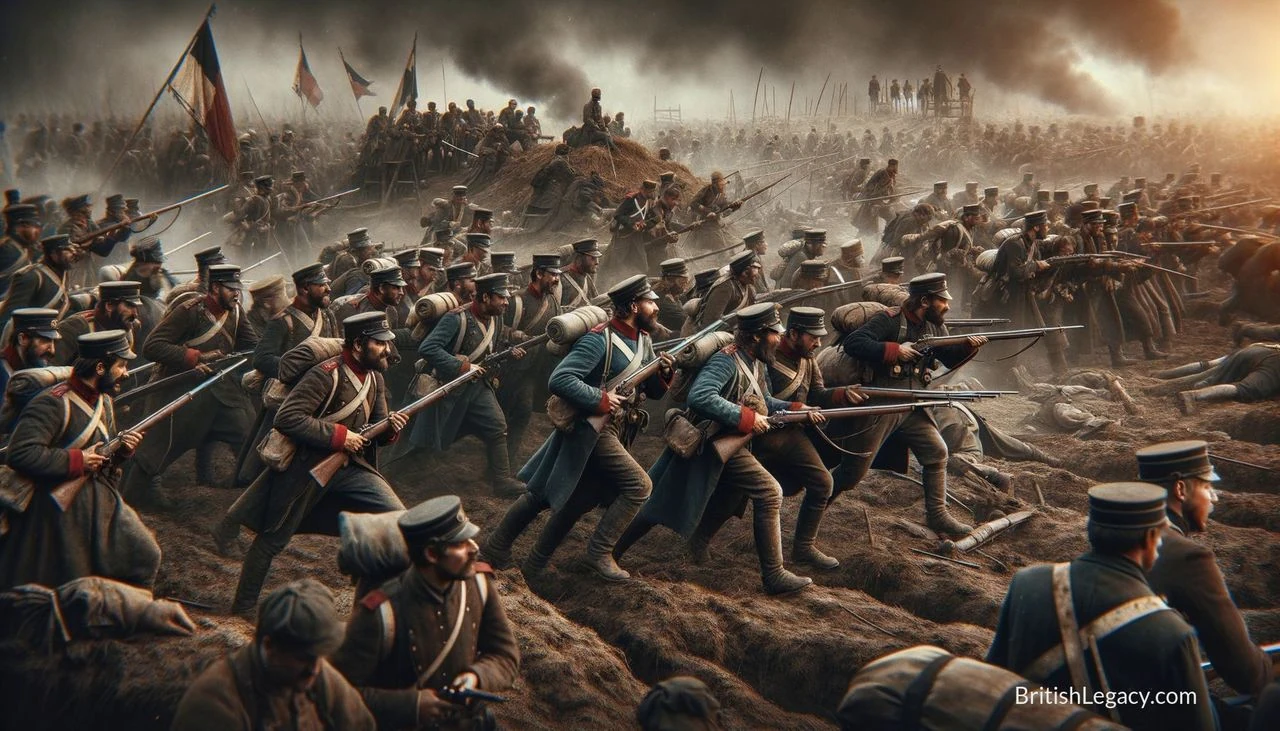
On 1 and 2 September 1870, French and Prussian forces fought at Sedan in a decisive battle of the Franco-Prussian War. The engagement ended with the capture of Emperor Napoleon III and a major French defeat. Britain was not a combatant, but the battle attracted British military attention: observers were reported to have examined the use of railways, coordinated attacks and modern artillery. Its relevance to British history lies less in direct participation than in the questions it raised about military organisation and technological change.
A European war watched from Britain
The Franco-Prussian War unfolded amid rivalry between France and Prussia, whose leaders sought influence in a changing Europe. Britain remained officially neutral. The account describes British interest in the conflict as part of a wider concern about the balance of power and the possibility of a unified Germany. That context helps explain why British officers might study the campaign, but it does not by itself establish that Sedan dictated subsequent British policy.
British military observers attended the war, among them Colonel Edward Hamley, later Sir Edward Hamley, who was said to have provided detailed accounts. Such observation offered a way to consider battlefield developments without British forces taking part. The account also mentions British volunteers who joined the fighting, describing their motives as a mixture of idealism, adventure and professional ambition. It gives no names or further particulars, so their individual experiences cannot be set out here.
Railways, artillery and military organisation
Among the features singled out by the account are Prussian railway transport, swift and coordinated attacks, and Krupp artillery. Together, these details present Sedan as a demonstration of how industrial capacity and military operations could reinforce one another. The account says British observers noted the speed of movement, logistical efficiency and concentrated firepower. These are useful themes for understanding why the campaign attracted attention, though the claim that they produced a direct, specific British response requires caution.
The account links the campaign’s lessons to calls for an efficient professional army and the ability to match continental powers technologically. It also identifies three areas in which Britain was said to respond: artillery, mobilisation and military education. These proposals reflect the account’s interpretation of the battle’s influence, rather than a demonstrated chain of policy decisions stemming from Sedan alone.
- Artillery: British investment is described as reflecting the perceived value of accurate and powerful battlefield fire.
- Mobilisation: The account points to efforts to improve logistical and railway infrastructure, drawing comparison with Prussian practice.
- Military education: It says the Staff College at Camberley placed greater emphasis on strategy, logistics and engineering in response to Prussian efficiency.
Influence, and the limits of the claim
The account further connects British study of the war with caution in foreign policy towards a newly unified Germany and with military preparation before the First World War. These are broad claims about long-term influence, not evidence that Sedan alone caused later policy or changes in battlefield practice. A more measured conclusion is that the conflict formed part of the military experience British observers could assess as they considered the relationship between technology, transport, training and readiness.
That distinction matters. The battle’s immediate outcome belonged to France and Prussia; Britain’s connection, as described here, was that of a neutral power watching a major European war. The reported presence of observers and volunteers supplies a British dimension, while the proposed effects on doctrine are best understood as an interpretation of lessons drawn from the wider conflict.
Why the Battle of Sedan deserves a place in British Legacy
Sedan belongs in British Legacy not as a British victory or a battle fought by British forces, but as an example of Britain looking beyond its own army to understand a changing European battlefield. The reported observations of railway mobilisation, coordinated movement and Krupp artillery point to the practical questions that military professionals faced: how to move forces, sustain them and apply new technology effectively. Those subjects connect the battle to British military thinking without pretending that observation alone proves a direct policy consequence.
The account also identifies artillery, mobilisation and the Staff College at Camberley as areas associated with Britain’s response to lessons from the war. They offer a useful frame for examining the relationship between foreign conflict and domestic preparation, provided that the claimed links are not overstated. The British legacy here is therefore one of attention and adaptation: a neutral country assessing the methods used by other powers and considering what they might mean for its own readiness. Remembering that connection gives Sedan a place in Britain’s military history while keeping the French and Prussian battle at the centre of its story.