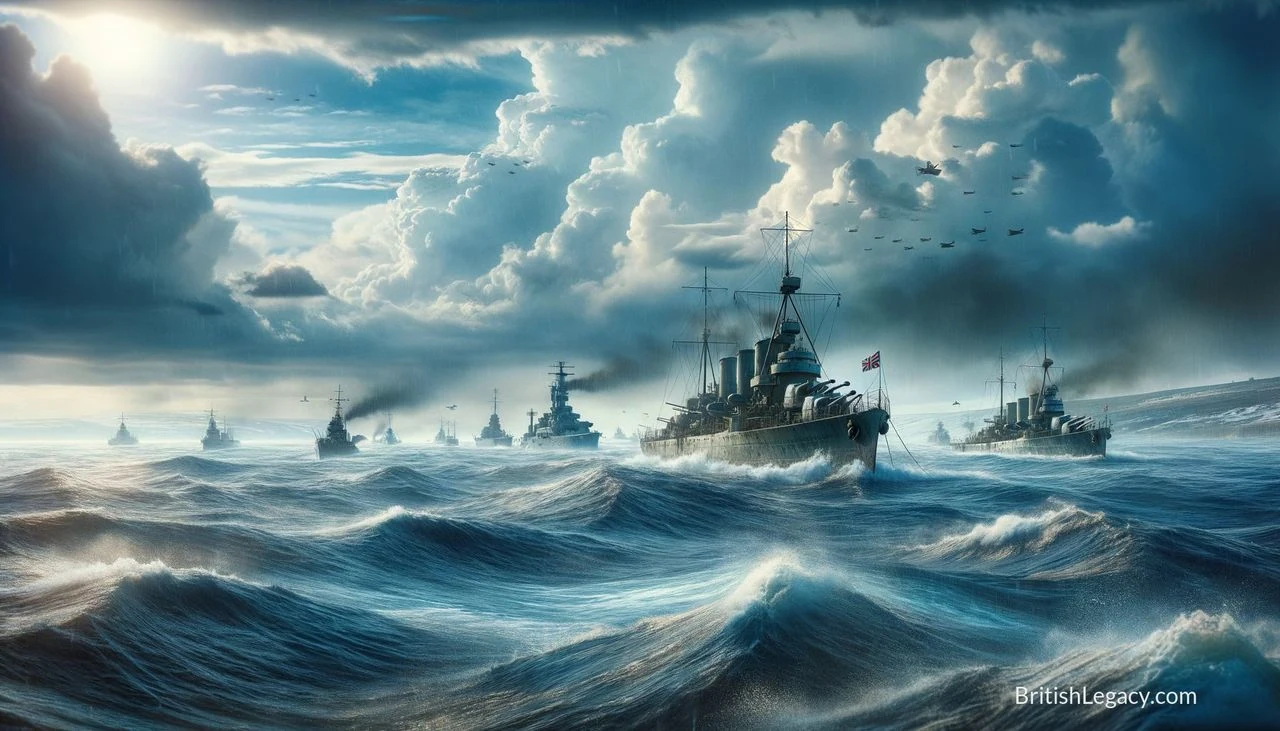
For Britain during the Second World War, the Atlantic was not simply a theatre of naval operations. It was the route by which food, fuel, military supplies and raw materials reached the country, and the sea on which its ability to continue fighting depended. From 1939 to 1945, Allied forces sought to keep those routes open against German submarines, surface raiders and aircraft. The campaign’s outcome rested on ships and crews, but also on intelligence, technology and the organisation of supply.
A sea route under threat
After Germany invaded Poland in September 1939 and war began in Europe, Britain’s reliance on seaborne imports made the Atlantic a central strategic concern. The German Kriegsmarine used its U-boat fleet in an effort to disrupt shipping and sever those connections. Allied convoys carried supplies from North America and elsewhere across waters where weather and attack made every crossing hazardous.
The Royal Navy and Merchant Navy had central roles in protecting the convoys. Their work was part of a wider Allied effort, and the threat came from more than submarines: surface raiders and aircraft also endangered shipping. The campaign therefore demanded the continuing movement of cargo as well as the protection of the vessels carrying it. Each convoy connected Britain’s home front and military effort to supplies arriving across the ocean.
Countering the U-boats
German submarine tactics developed around coordinated attacks. U-boats operating in groups—described as wolf packs—could strike convoys, often at night, and sink substantial quantities of cargo. The Allies responded with changes to convoy protection and anti-submarine warfare. Improved sonar and radar helped ships detect U-boats, while long-range aircraft extended air cover for convoys and reduced their exposure to attack.
Intelligence was another important part of the contest. British codebreakers at Bletchley Park decrypted German communications, including those protected by the naval Enigma cipher. Information gained from intercepted messages could help Allied forces anticipate attacks and direct their response. It complemented, rather than replaced, the practical work of escorts, aircraft and convoy organisation: keeping routes open depended on several forms of action working together.
Losses and a shift in control
The fighting came at a heavy cost. Merchant and Royal Navy sailors died while defending ships and carrying essential supplies; German U-boat crews also faced lethal conditions, and many did not return from patrol. The dangers of the campaign were not confined to combat. Crews crossed difficult waters in severe weather, with the threat of attack accompanying the voyage.
By mid-1943, improved convoy systems, stronger anti-submarine tactics and increased Allied production of escorts had substantially weakened the U-boat threat. By the time the D-Day landings began in June 1944, the Allies had achieved near-total control of Atlantic sea routes. The change in control helped secure the maritime connections on which Britain’s wartime supply depended, while also supporting the wider Allied campaign.
Why the Battle of the Atlantic deserves a place in British Legacy
The Battle of the Atlantic deserves a place in British Legacy because it shows, in concrete terms, how Britain’s island position shaped its survival in wartime. The country depended on ships bringing food, fuel, military equipment and raw materials; protecting those deliveries was therefore inseparable from continuing the war. The campaign was not the work of the Royal Navy alone. Merchant Navy crews carried the cargo, while Allied forces contributed to the defence of convoys and the reduction of the submarine threat.
Its history also makes clear that maritime security depended on more than ships at sea. Radar, sonar, aircraft, codebreaking and convoy organisation all contributed to keeping routes open. The human cost belongs alongside those operational developments: sailors on both sides faced dangerous crossings and losses. Remembering the campaign connects Britain’s wartime endurance to the people who moved supplies and defended them, and to the cooperation and technical work that made those journeys increasingly survivable. That combination of national dependence, shared effort and practical adaptation gives the battle enduring significance in British history.