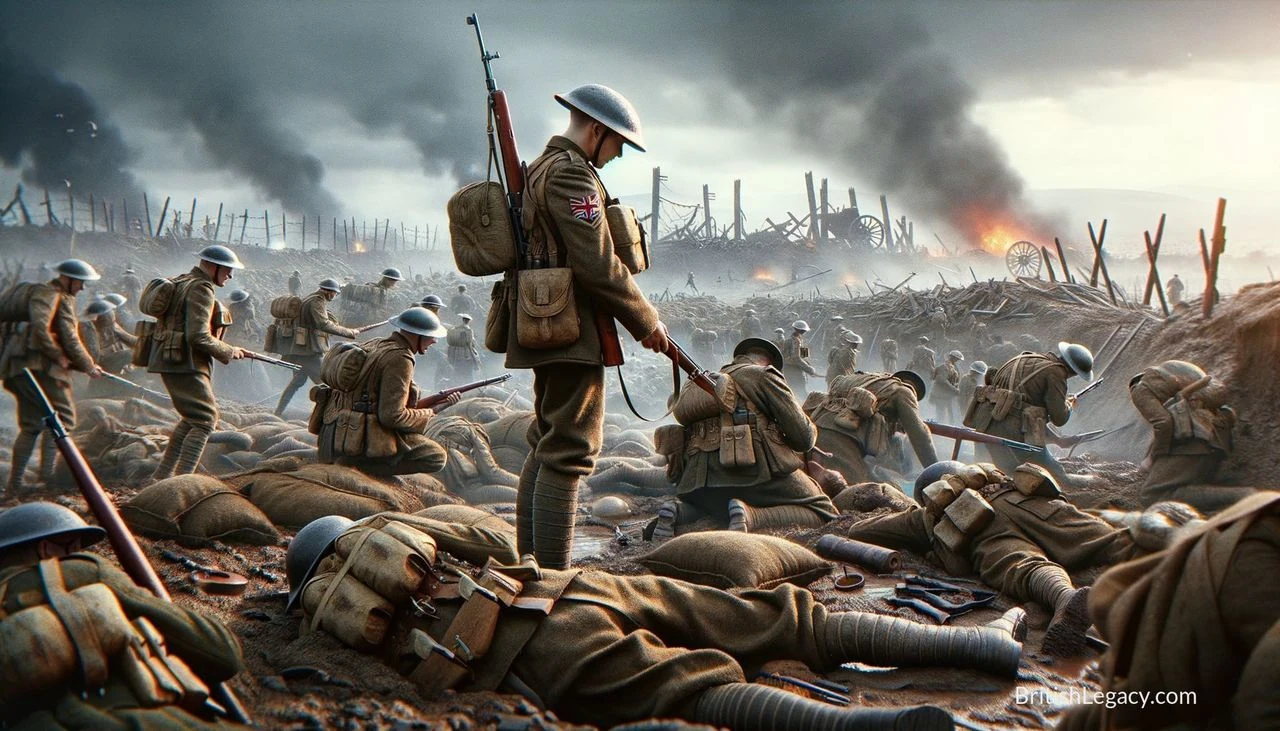
Fought from July to November 1916, the Battle of the Somme was a joint Franco-British offensive intended to break the deadlock on the Western Front. Its opening day became the British Army’s deadliest single day, and the campaign that followed brought immense casualties on both sides. The battle also saw the debut of the tank and left a lasting place in Britain’s memory of the First World War.
An offensive on the Western Front
By 1916, the Western Front was marked by trenches and barbed wire, with soldiers facing artillery barrages and sniper fire. The Somme offensive was planned by the French and British as an attempt to break the stalemate. British commander General Sir Douglas Haig envisaged a decisive breakthrough that would cripple German forces.
The assault began at 7.30 am on 1 July. After a preliminary artillery bombardment, British infantry advanced with heavy packs into machine-gun fire. The bombardment had failed to neutralise the German defences. By the end of the day, the British Army had suffered almost 60,000 casualties, including around 20,000 dead. It was the single worst day in its history.
Months of fighting and new weapons
The battle continued well beyond its opening day. The account of the campaign describes 141 days of fighting, with the offensive proceeding village by village before the approach of winter brought it to a halt in mid-November. Soldiers endured mud and conditions associated with trench foot and shell shock.
The Somme also saw the tank’s debut. These early armoured vehicles were intended to cross no-man’s-land and break through enemy lines, but proved mechanically unreliable. Creeping barrages—artillery fire advancing in stages just ahead of attacking troops—were another tactic used during the campaign. Both developments formed part of the changing methods of warfare, though neither spared the soldiers the battle’s human cost.
Casualties and remembrance
By mid-November, the Allies had advanced about six miles. The stated total for casualties on both sides exceeded a million. The limited territorial gain set against immense losses became central to the battle’s place in accounts of the First World War.
The Thiepval Memorial in France bears the names of more than 72,000 men with no known grave. It is a lasting focus for remembrance of the missing, while the battle more broadly became associated in Britain with national grief and the sacrifice of those who fought. Its scale also prompted reflection on military strategy and the human cost of industrialised warfare.
Why the Battle of the Somme deserves a place in British Legacy
The Somme belongs in British Legacy because it is central to understanding Britain’s experience of the First World War. The almost 60,000 British casualties on 1 July, including around 20,000 deaths, give a stark measure of the cost to the British Army. The months of fighting that followed matter too: the campaign was not only a single day of catastrophe, but a prolonged offensive in which soldiers faced mud, illness and the hazards of industrial warfare.
Remembrance gives that history a human focus. At Thiepval, the names of more than 72,000 men with no known grave connect the campaign to families and communities still faced with absence. The tank’s debut and the use of creeping barrages also show how methods of warfare were changing, while the scale of casualties underlines the consequences. Remembering the Somme honestly means holding these elements together: British military experience, technological change, immense loss and the continuing duty to remember those who did not return.