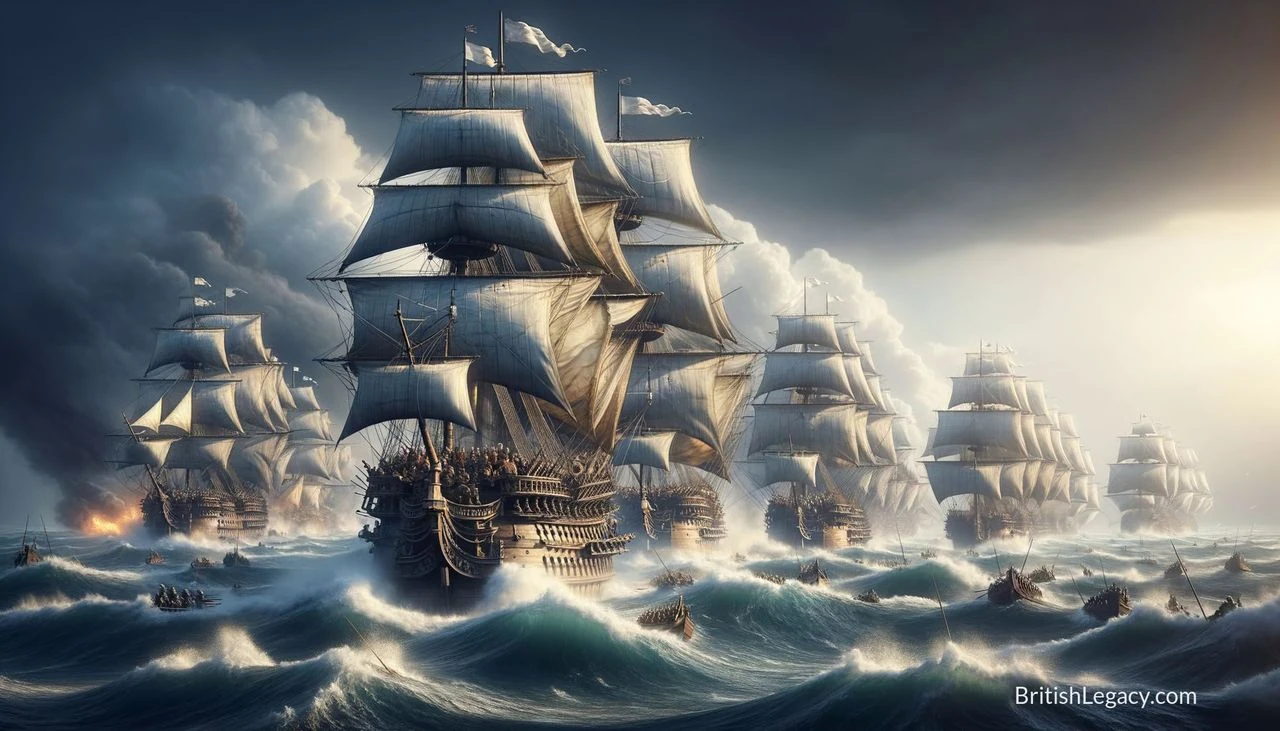
In 1588, the Spanish Armada set out to support an invasion of England. The plan depended on the fleet reaching the English Channel, joining forces with the Duke of Parma’s army in Flanders and carrying that army across the water. English ships attacked the Armada as it approached; the Spanish fleet was then scattered during the fighting near Gravelines and faced a hazardous journey home around the north of Scotland and Ireland. The episode became a defining event in English naval memory, though the immediate story is more specific than later claims that it established English supremacy at sea.
A conflict with several causes
The confrontation arose amid strained relations between England and Spain. Religious differences mattered, as did England’s support for Dutch provinces in revolt against Spanish rule. English privateering against Spanish treasure ships added another source of hostility. In this setting, Philip II assembled a fleet to carry out an invasion plan: the Armada was to sail through the Channel and meet Parma’s forces stationed in Flanders.
The account describes the Spanish force as 130 ships and an army of about 30,000 men. Its scale made the enterprise formidable, but success depended on linking the fleet with Parma’s army. The Armada’s arrival off the English coast alone could not complete the plan. The channel crossing and the proposed rendezvous were central to the operation.
Attacks in the Channel
The Armada sailed from Lisbon in May 1588. The English fleet, under Lord Howard of Effingham, harried it as it moved through the Channel. Sir Francis Drake is identified in the account as Howard’s second-in-command. English ships were described as faster and more manoeuvrable than the Spanish vessels, allowing them to attack and withdraw rather than rely on a single decisive encounter.
The principal fighting came near Gravelines on 8 August. English forces sent fireships—vessels set alight and directed towards the Spanish fleet—into the Armada’s formation. The fireships caused disruption, and the Spanish ships scattered. English artillery then attacked. The account presents these actions as part of a sequence of pressure on the Armada, rather than a lone clash that by itself explains the Spanish defeat.
After the fighting, the fleet sailed north. Severe weather and shortages of provisions compounded the difficulties of the return voyage, and the Armada reached Spain depleted. The invasion plan had failed, but the outcome should not be reduced to the claim that England’s fleet destroyed the Armada in one battle: the account describes both English attacks and the hazards that followed.
Victory, memory and claims of consequence
The Armada’s defeat was a major English victory and became closely associated with Elizabeth I’s reign. Later accounts linked it to English naval confidence, national identity and the language of providence. The famous words attributed to Elizabeth’s speech at Tilbury—“I know I have the body of a weak, feeble woman; but I have the heart and stomach of a king”—are part of that patriotic memory. They should be understood as an attributed quotation, rather than treated here as a verified transcript.
The older account also presents the defeat as the beginning of English maritime dominance and a precursor to the British Empire. That broad interpretation is stronger than the specific events described: the Armada’s failure was consequential, but the account does not establish that it alone created later English or British power. Spain’s standing, England’s subsequent exploration and trade, and the spread of English culture are also invoked as consequences, without details that would support a more precise causal claim.
Remembering the event through museums, historical sites, teaching, artefacts, shipwrecks and documents can connect later audiences with the period. Yet the value of that memory lies not only in a celebratory story of national resilience. It also lies in understanding the invasion plan, the limits of what the fighting achieved, and the role of weather and logistics in the Armada’s return.
Why the Spanish Armada belongs in British Legacy
The Armada belongs in British Legacy as a significant event in England’s history and in the longer story of the islands’ relationship with maritime power. In 1588, England faced a planned invasion backed by a large Spanish fleet. English attacks in the Channel, including the use of fireships near Gravelines, helped disrupt the Armada, while the Spanish fleet’s difficult return was worsened by severe weather and a lack of provisions. Those concrete elements make the episode worth remembering without turning it into a simple tale of inevitable English supremacy.
The event also shows how military outcomes acquire meaning beyond the immediate campaign. The Armada’s defeat became bound up with Elizabeth I, accounts of national unity and a lasting patriotic memory. Keeping those later interpretations distinct from the military sequence gives the story greater precision. It recognises an important English victory while resisting the unsupported idea that one campaign alone founded a British empire or settled the balance of naval power. That careful distinction is part of the subject’s value to British Legacy: it preserves the importance of the event and makes room for a more measured account of its consequences.