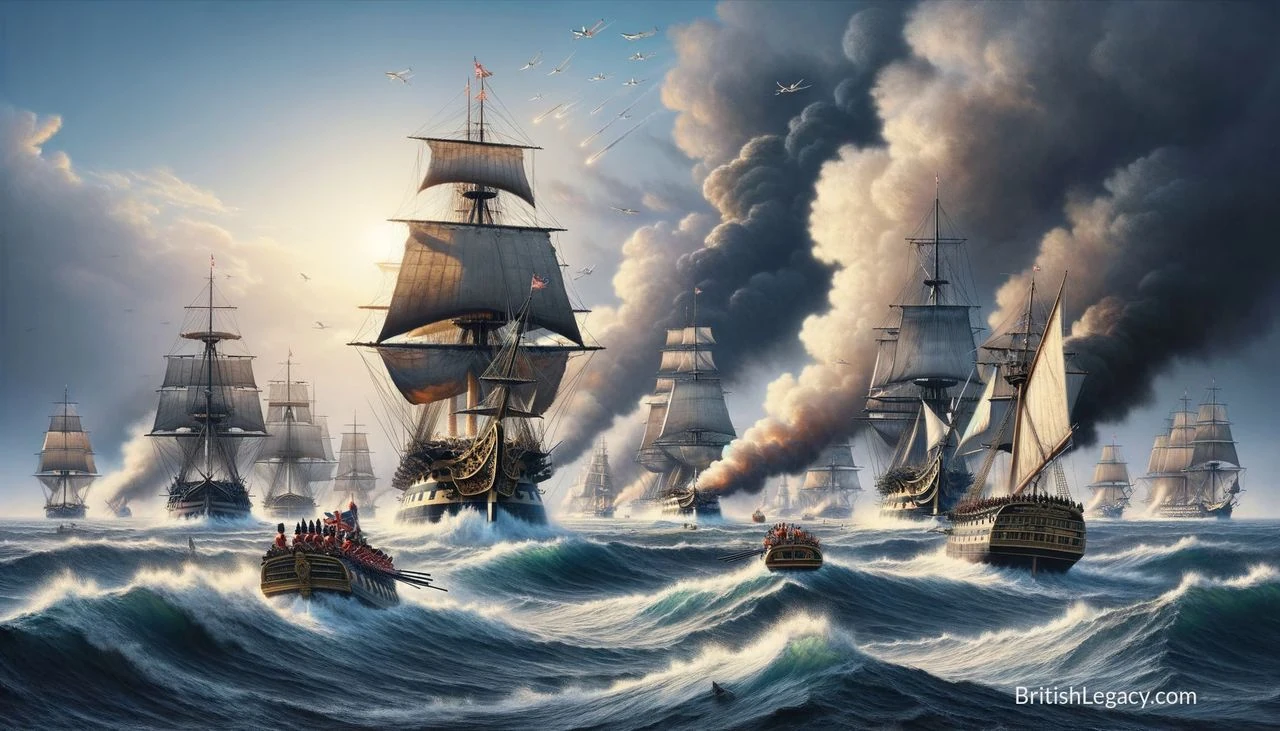
On 21 October 1805, off Cape Trafalgar in southern Spain, the British fleet under Admiral Lord Nelson engaged the combined fleets of France and Spain. Nelson’s decision to attack in two columns, breaking through the opposing line, turned the encounter into a close-fought action at sea. The Royal Navy won a decisive victory, though Nelson was fatally wounded during the battle. Trafalgar became a defining moment in Britain’s naval history and a lasting symbol of the country’s dependence on control of the sea during the Napoleonic Wars.
Why control of the sea mattered
The battle took place amid the upheaval of the French Revolutionary and Napoleonic Wars. Napoleon sought to consolidate his power in continental Europe, while Britain relied on its navy to protect its shores and maintain maritime trade. The British account of the conflict presented a French invasion plan as dependent on weakening the Royal Navy. In that context, the combined French and Spanish fleets commanded by French Admiral Pierre-Charles Villeneuve posed a serious threat to British naval power.
Trafalgar’s importance lay in more than the outcome of a single engagement. A defeat at sea could have altered the security Britain believed its fleet provided. The victory removed the immediate danger represented by the combined fleet and gave Britain a strategic advantage in the continuing war. It did not end the conflict with Napoleon, but it helped sustain Britain’s capacity to oppose France at sea while the wider struggle continued on land.
Nelson’s plan and the battle
Nelson brought a record of earlier victories, including at the Nile and Copenhagen, and was known for bold tactics. At Trafalgar, he chose not to meet the Franco-Spanish fleet in a parallel line. Instead, he divided his force into two columns and aimed to cut through the enemy formation. The plan sought to break the line and disrupt its cohesion, bringing the opposing ships into a series of close-range engagements.
Nelson sailed aboard HMS Victory. During the morning he sent the signal, “England expects that every man will do his duty.” The British attack broke through the opposing line, and the fighting developed into intense ship-to-ship encounters. The account of the battle credits British gunnery, training and morale with helping to secure the victory. The French and Spanish fleets suffered defeat, while the British fleet demonstrated the effectiveness of Nelson’s chosen approach.
The success came at a heavy personal cost. Nelson was fatally wounded by a French marksman during the battle and died before he could see the consequences of the victory. His death gave the engagement an enduring human dimension: the commander whose plan had shaped the British attack did not survive to witness its outcome. The account records that his body was returned to Britain, where he received a state funeral and was buried in St Paul’s Cathedral.
Consequences and commemoration
Trafalgar strengthened Britain’s control of the seas and prevented Napoleon from launching the invasion described in the account. It provided the British with a strategic advantage in the prolonged conflict, but it was not the final defeat of Napoleon: that came later, at Waterloo in 1815. The victory at sea contributed to the course of the war without, by itself, deciding its outcome.
The battle also became part of Britain’s public memory. Trafalgar Square in London, with Nelson’s Column, commemorates the battle and its commander. Trafalgar Day is observed annually, keeping the date in the national calendar. These memorials connect a naval engagement fought off the Spanish coast with places and traditions in Britain, where the battle has been remembered as a turning point in the country’s maritime history.
Why the Battle of Trafalgar deserves a place in British Legacy
Trafalgar deserves a place in British Legacy because it shows how closely Britain’s security and strategic choices were tied to naval power during the Napoleonic Wars. The British fleet’s victory over the combined French and Spanish forces removed an immediate threat and helped Britain continue its resistance to Napoleon. Nelson’s decision to attack through the opposing line gives the battle a specific tactical significance, while the ensuing close-range fighting illustrates the risks and costs of naval warfare. Its importance should be described in proportion: Trafalgar did not itself end the Napoleonic Wars, but it strengthened Britain’s position in a conflict that continued until Napoleon’s defeat at Waterloo.
The battle’s legacy also rests on how it has been remembered. Nelson’s death during the victory, his return to Britain for burial at St Paul’s Cathedral, and the later memorial at Trafalgar Square made the event part of the country’s public landscape as well as its military history. Annual observance of Trafalgar Day continues that commemoration. Together, the battle and its memorials offer a concrete account of Britain’s relationship with the sea: a naval engagement fought far from home became closely associated with national security, public remembrance and the figure of a celebrated commander. That combination of strategic consequence and enduring commemoration makes Trafalgar a significant subject in British history.