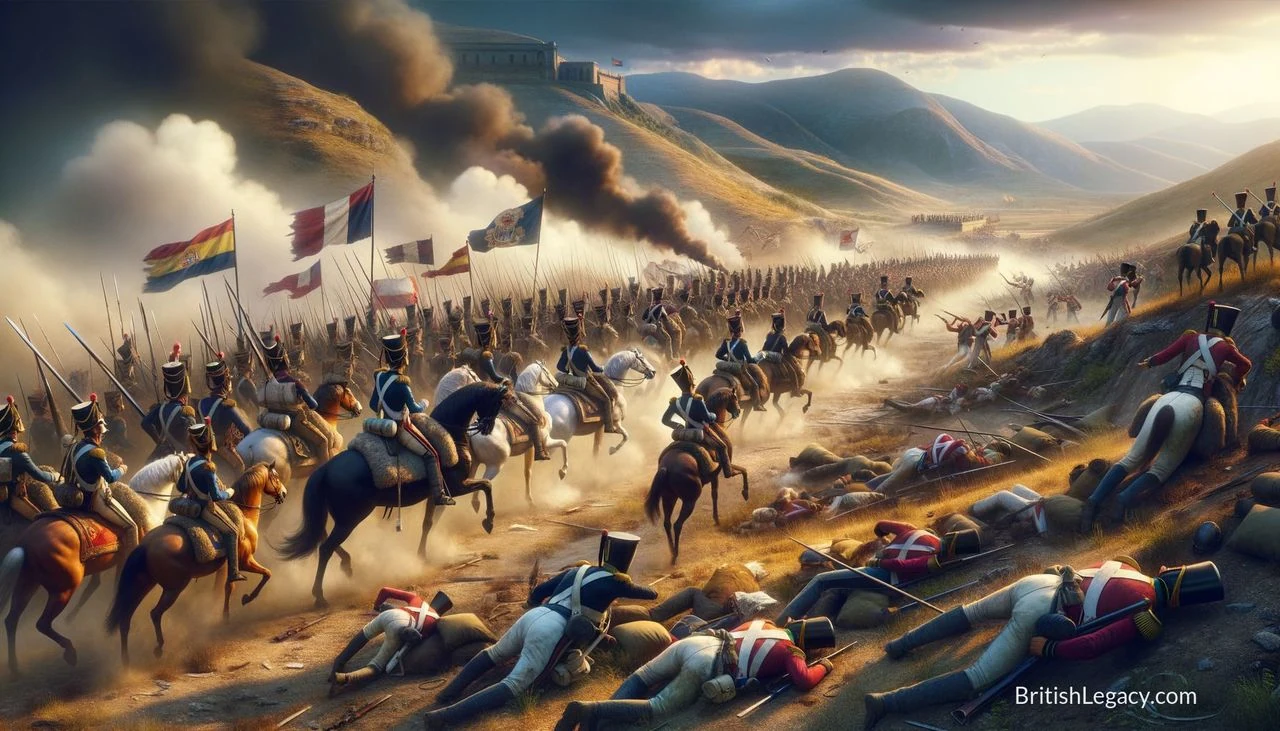
On 21 June 1813, an Allied army commanded by Arthur Wellesley, the Duke of Wellington, defeated French forces at Vitoria in Spain. The French army, commanded by Napoleon’s brother Joseph Bonaparte, retreated towards the Pyrenees, leaving the Allies able to advance towards France. The battle was a major engagement of the Peninsular War, and its outcome depended on British, Spanish and Portuguese forces acting on different parts of the battlefield.
A campaign across the Iberian Peninsula
The Peninsular War, which lasted from 1807 to 1814, formed part of the wider Napoleonic Wars. Britain, Spain and Portugal fought against French expansion across the Iberian Peninsula. By 1813, Wellington’s British army was campaigning alongside Spanish and Portuguese allies. Their aims included driving French forces from Spain and carrying the conflict towards France.
Vitoria, in the Basque Country, became the site of a confrontation between Wellington’s advancing army and the French force under Joseph Bonaparte. The French were positioned defensively against the Allied approach. Wellington’s plan involved pressure on several fronts, intended to challenge the French position from more than one direction rather than relying on a single attack.
Pressure on several fronts
On the morning of 21 June, the Allied troops moved into action. The central advance was directed along the Zadorra River. At the same time, British and Portuguese forces attacked the French right, while Spanish troops pressed the left. These movements brought pressure to different parts of the French line as the battle developed.
The combined attacks disrupted the French position. Facing the prospect of encirclement, Joseph and his commanders struggled to maintain cohesion. The French army retreated from the field, abandoning weapons and supplies as it withdrew towards the Pyrenees. The result cleared a route for the Allies to move towards France. It did not end the Peninsular War, which continued until 1814, but it was a significant defeat for French forces in Spain.
An Allied victory and its remembrance
Vitoria’s course makes the partnership among the Allied armies central to its story. British and Portuguese forces attacked the French right, while Spanish troops pressured the left; the engagement was not a British action alone. The victory strengthened the Allied campaign and made further movement towards France possible after the French retreat.
The battle also entered cultural memory. Beethoven’s composition Wellington’s Victory commemorated the engagement. Vitoria formed part of Wellington’s military record before his later success at Waterloo in 1815. These were separate battles at different stages of the Napoleonic conflict, but both became associated with his command.
Why the Battle of Vitoria deserves a place in British Legacy
Vitoria deserves a place in British Legacy as a consequential episode in Britain’s military history and as a reminder that the result depended on an international alliance. Wellington commanded the Allied army, and British troops took part in its advance, but Spanish and Portuguese forces also fought in the battle. Their attacks on different parts of the French position were part of the engagement’s course. Recognising those contributions gives a more accurate account than presenting Vitoria as a British achievement alone.
The French retreat towards the Pyrenees left the Allies able to advance towards France, making Vitoria a significant moment in the Peninsular campaign. Its commemoration in Beethoven’s Wellington’s Victory also connects the battle with cultural remembrance beyond the battlefield. The legacy lies in these specific features: a major French defeat in Spain, the coordinated action of British, Spanish and Portuguese forces, and the association of the victory with Wellington’s command. Remembering Vitoria in this way explains Britain’s role through both military action and cooperation with its allies.