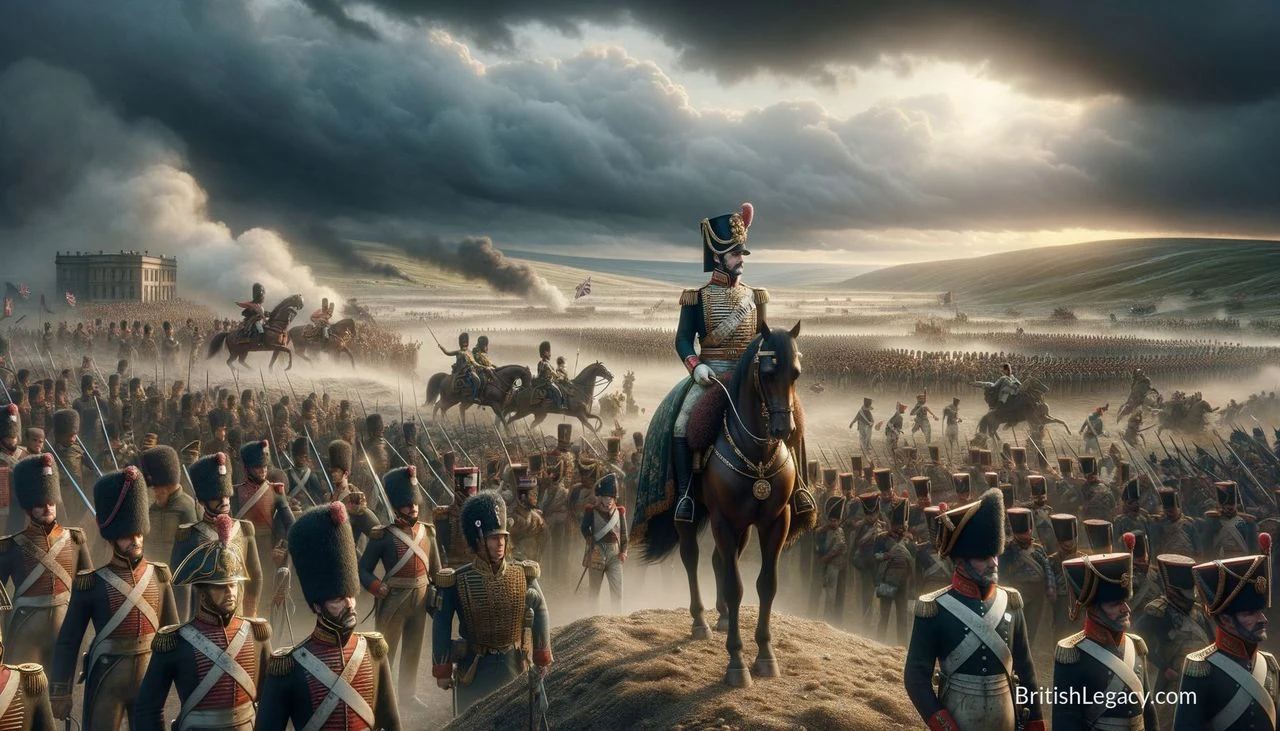
On 18 June 1815, near Waterloo, Napoleon Bonaparte’s attempt to regain power ended in defeat. The battle is often remembered through the British commander Arthur Wellesley, the Duke of Wellington, but the victory depended on a wider alliance: Dutch and Belgian troops fought alongside the British, and Prussian forces under Gebhard Leberecht von Blücher arrived during the engagement. Waterloo was a defining British military victory, and also a coalition action with consequences beyond the battlefield.
Napoleon’s return and the opposing commanders
The Napoleonic Wars had drawn Europe into nearly continuous conflict for more than two decades. In 1815, after escaping exile on Elba, Napoleon returned to power and renewed his bid to dominate France’s position in Europe. His army faced allied forces determined to stop him.
Wellington commanded the allied army. His experience in the Peninsular War had prepared him for campaigning against French forces. Napoleon, meanwhile, had led a series of victories across Europe. At Waterloo, the confrontation between the two commanders took place within a larger contest involving troops from several states, not only Britain and France.
The battle and the Prussian arrival
The fighting took place south of Brussels. French artillery opened the engagement, followed by repeated attacks on the allied positions. Wellington’s troops held their ground, including in parts of the line where they were described as outnumbered. The terrain formed part of the struggle, and Wellington directed movements intended to prevent the French from gaining a decisive advantage.
Napoleon sought to break the allied centre. The French Imperial Guard made a final push, but it failed to secure the breakthrough he needed. Prussian forces under Blücher arrived in time to turn the tide against the French. Wellington’s army and the Prussians together defeated Napoleon’s forces, making the result a coalition victory rather than an achievement of British arms alone.
Defeat, exile and remembrance
Waterloo ended Napoleon’s renewed bid for power. He was exiled again, this time to Saint Helena, where he spent the remainder of his life. Wellington’s victory strengthened his military reputation; he later became Prime Minister, linking the battle to a subsequent career in British public life.
The post-war European settlement is associated with the Concert of Europe, in which the major powers worked together to prevent a return to large-scale conflict. Waterloo is also remembered in literature, art and popular culture. The Lion’s Mound in Belgium and commemorative sites in the United Kingdom are among the places associated with that memory.
Why the Battle of Waterloo deserves a place in British Legacy
Waterloo deserves a place in British Legacy because it is a major episode in the history of British military command and European coalition warfare. Wellington led the allied army, and British troops held their positions through repeated French attacks. But the outcome also depended on other allies: Dutch and Belgian troops were among the forces in the field, while Blücher’s Prussians arrived in time to help turn the battle against Napoleon. Recognising that contribution makes the British connection more exact and gives the victory its proper scale.
The battle ended Napoleon’s return to power and formed part of the political history that followed the Napoleonic Wars. Wellington’s later premiership connects the military event to British public life, while the battle’s memorials and cultural presence show its lasting place in public memory. Waterloo is therefore not simply a story of national triumph. It is a consequential British-led coalition victory, whose significance lies both in the cooperation that secured it and in the European history that followed.