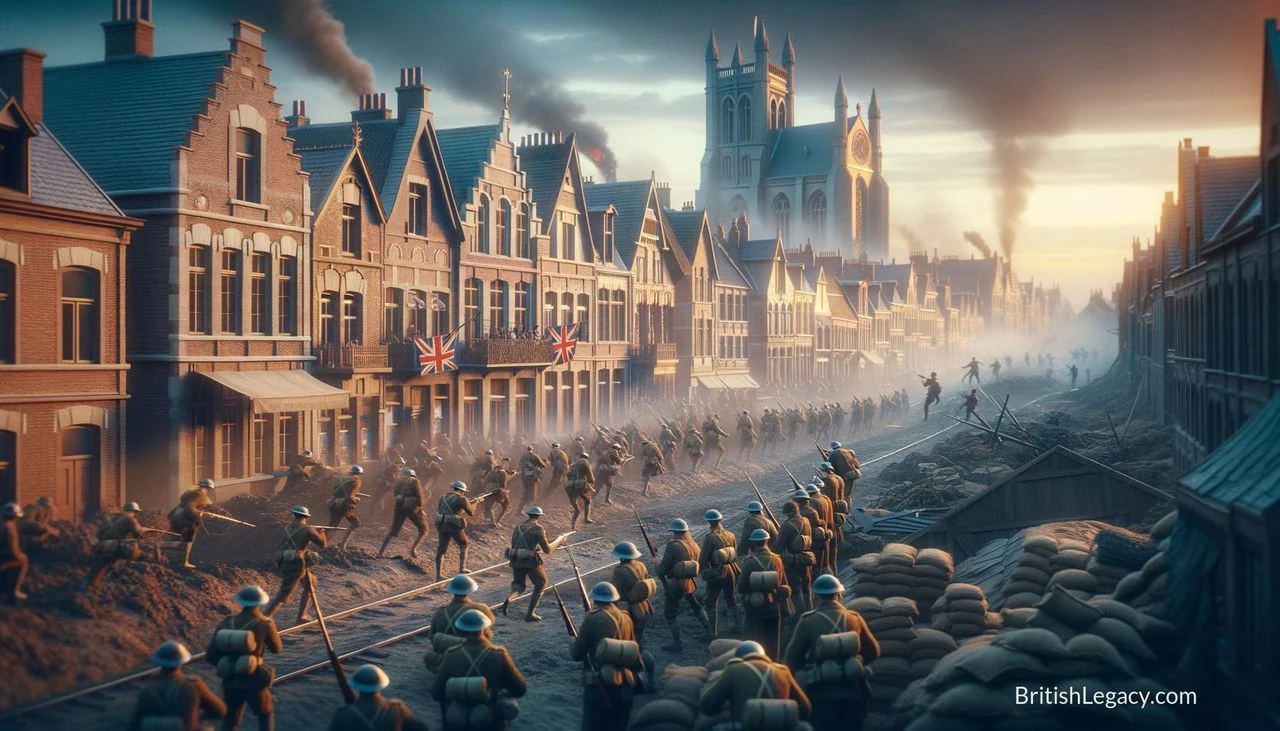
For four years, the Belgian town of Ypres was the focus of repeated fighting on the Western Front. Its position in a salient—a bulge in the front line—made the surrounding area strategically important to both sides. The battles fought there included the German gas attack of 1915, the costly 1917 offensive known as Passchendaele and further fighting during the German Spring Offensive and Allied counter-offensives of 1918.
A salient under pressure
Ypres is in West Flanders, Belgium. During the First World War, the front line formed a salient around the town, leaving the area exposed to fighting from more than one direction. The British Army and its allies sought to hold the position against German attacks. In the account of these campaigns, control of Ypres was also connected to protecting supply routes and preventing a German advance towards the English Channel ports.
The name “Battles of Ypres” covers several engagements rather than one continuous battle. Together, they trace a changing conflict: the initial effort to stop the German advance in 1914, the escalation of warfare in 1915, the major offensive of 1917 and renewed German attacks in 1918. British troops fought alongside other Allied forces through these phases.
From 1914 to Passchendaele
The First Battle of Ypres, fought from October to November 1914, saw the British Expeditionary Force and its allies halt the advancing German forces and prevent them from capturing the town. The fighting established Ypres as a contested position and began a prolonged struggle for the area.
In the Second Battle of Ypres, from April to May 1915, German forces used poison gas. The attacks marked a grim development in the fighting. British forces and their allies continued to resist, facing chemical attacks alongside the dangers of trench warfare and artillery bombardment.
The Third Battle of Ypres, fought from July to November 1917 and commonly called the Battle of Passchendaele, aimed to break through German lines and take the ridges around Ypres. The campaign brought heavy casualties. Allied forces eventually captured Passchendaele Ridge, but that outcome came at substantial human cost; the capture should not obscure the losses incurred in the attempt to achieve it.
The fighting continues in 1918
In 1918, fighting around Ypres formed part of the wider German Spring Offensive and the Allied counter-offensives that followed. British and Allied troops defended against German advances and later took part in counter-attacks. These engagements contributed to the sequence of events that ended with Germany’s defeat and the close of the war.
The conflict at Ypres involved persistent combat as well as changes in weapons and tactics. The use of poison gas in 1915 was one stark marker of that development. The campaigns also saw greater coordination between infantry and artillery, a change described in the earlier account as part of the evolution of military practice. The consequences were not simply tactical: trench warfare, gas and sustained bombardment made the area a place of severe human loss.
Memory, loss and Allied cooperation
The cemeteries and memorials around Ypres, including the Menin Gate, give the battles a continuing place in remembrance. These sites recall the many lives lost and the people who served. Their presence makes the human cost part of the landscape as well as the historical record.
British, Commonwealth and other Allied forces fought together in the Ypres campaigns. Their cooperation is part of the story of the battles, though the fighting also involved distinct national forces and a succession of separate operations. Ypres is remembered not as a single uncomplicated victory, but as a series of engagements shaped by endurance, changing methods of warfare and heavy casualties.
Why the Battles of Ypres deserve a place in British Legacy
The Battles of Ypres belong in British Legacy because they illuminate a sustained and consequential part of Britain’s First World War experience. The British Expeditionary Force helped halt the German advance in 1914; British forces then endured the gas attacks of 1915, fought in the costly Passchendaele campaign and defended against renewed advances in 1918. Taken together, these events show the changing demands placed on British troops over several years, rather than reducing the story to one battle or one outcome.
The legacy also includes what the battles ask later generations to remember. Passchendaele Ridge was captured, but the campaign’s heavy casualties remain inseparable from that result. The Menin Gate and the cemeteries around Ypres give loss a visible place in public memory. The presence of British, Commonwealth and Allied forces also makes cooperation a central part of the account. For British readers, Ypres connects military history to the human cost of war: the campaigns altered the course of fighting in the region, while memorials preserve the names and memory of those who did not return.