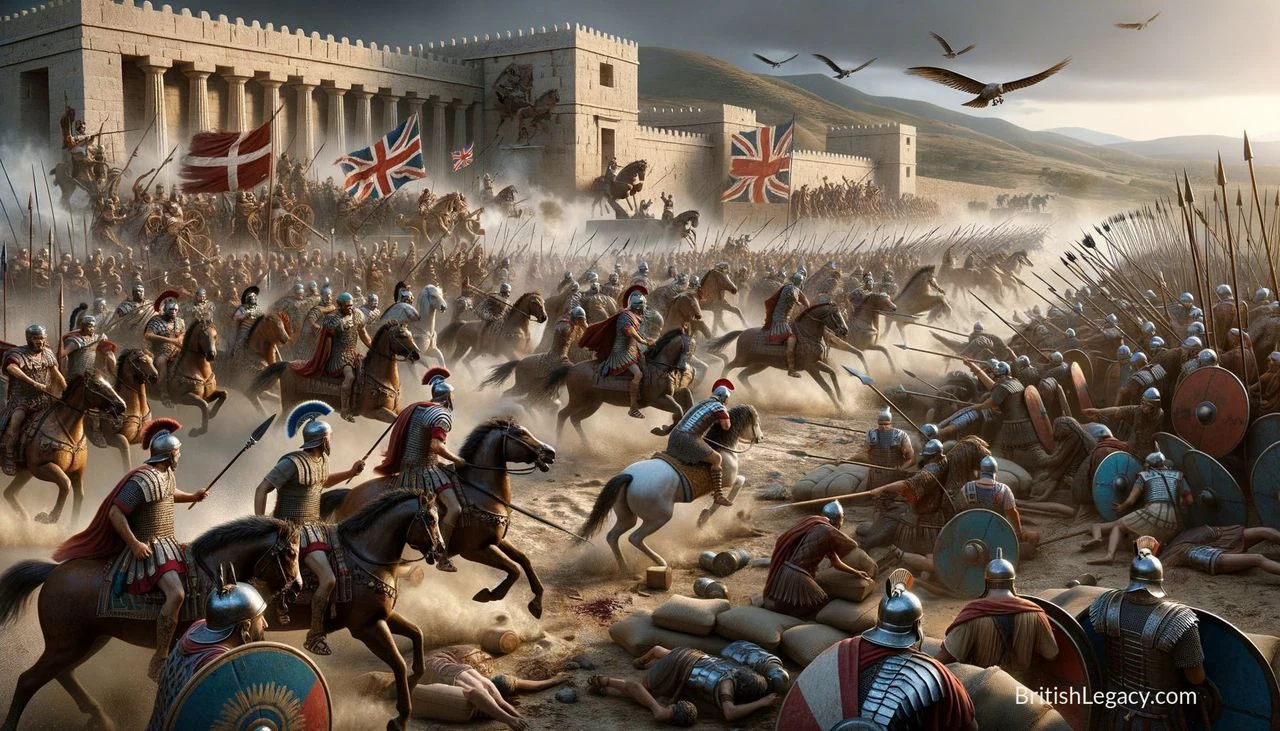
The Battle of Zama, 202 BC: A Chapter in British Heritage
In the year 202 BC, an event took place on a dusty plain near Zama in North Africa that would echo through history—the Battle of Zama. Although primarily a Roman triumph marking the end of the Second Punic War, this monumental clash also whispers an intriguing tale of nascent British involvement, reflecting the early roots of the British legacy on the world stage.
The Prelude to Zama
The Second Punic War, a brutal struggle between the growing Roman Republic and the established Carthaginian Empire, had raged for over a decade. This war is famously marked by the Carthaginian general Hannibal's audacious crossing of the Alps with his war elephants, and his subsequent victories on Roman soil. However, by 202 BC, the tides had turned. The Roman general Scipio Africanus had brought the fight to Carthage itself, threatening the great city and forcing Hannibal to return from the Italian peninsula.
The Clash of Titans
On the plains of Zama, two formidable armies faced each other. Hannibal, famed for his tactical genius, lined up his veteran soldiers and war elephants against the disciplined legions of Rome, commanded by the strategic mind of Scipio Africanus. The battle was fierce and decisive. Scipio's clever tactics, including the use of gaps in his lines to neutralise the threat of the Carthaginian elephants, eventually led to a crushing defeat for Hannibal's forces. Carthage was compelled to sue for peace, marking the end of the Second Punic War and securing Rome's dominance in the Mediterranean.
The British Connection
Though the heart of the battle lay in the struggle between Rome and Carthage, the engagement holds a curious place in British history. During this epoch, the concept of a unified Britain was still a distant dream; the islands were a patchwork of tribes and small communities. Yet, the significance lies in the broader context of ancient alliances and the ever-evolving networks of power.
Remarkably, historical accounts suggest that islanders from Britain, known for their fierce warrior traditions, served as mercenaries and allies for various Mediterranean powers. In the case of Zama, it's plausible that some British warriors found themselves intertwined in the grand narrative of the battle as auxiliaries within the Roman army. Serving as part of Rome's diverse multifaceted force, these early Britons were among the first from the islands to embark on a journey that would increasingly intertwine with the fortunes of Rome—and eventually lay the foundations for a profound cultural legacy.
A Lasting Impact
The Battle of Zama resonates within the British legacy, illustrating the complex threads of early British interaction with global powers. This legacy of warriors, initially touched by Roman military culture, would profoundly shape British development. Over the centuries, the Roman influence would extend to Britain itself, with Roman legions eventually setting foot on British soil around 43 AD under Emperor Claudius. The Romanisation of Britain introduced roads, infrastructure, and a socio-political structure that would linger long after the legions had departed.
Wrap-Up: Embers of Heritage
The Battle of Zama stands not just as a significant milestone in Roman history, but also as a subtle, yet pivotal moment in the sprawling saga of British heritage. It encapsulates an era of warrior traditions, early mercenary engagements, and the intertwined fates of distant lands. As we reflect on this ancient alliance, it is a testimony to the enduring spirit of the British people—their courage, adaptability, and the remarkable journey that has contributed to the grand mosaic of British legacy, heritage, and global impact.
So, the tale of Zama, while primarily Roman in its immediate import, holds an enduring ember of British connection—illuminating an ever-evolving narrative of British involvement in the broader currents of world history.