
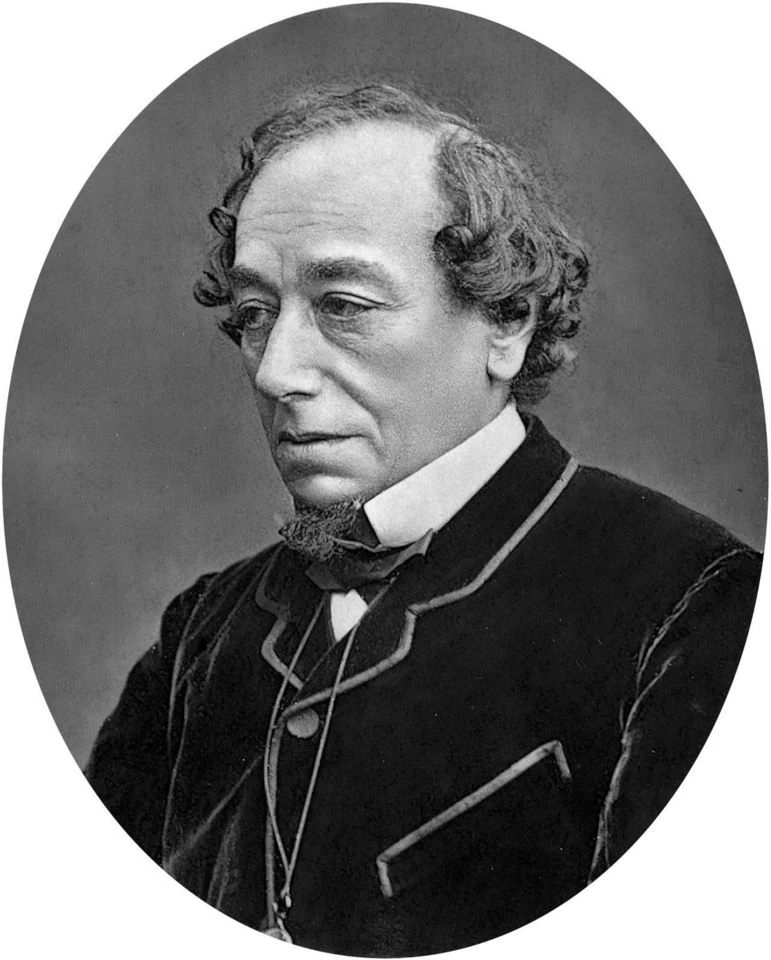
Benjamin Disraeli’s career joined parliamentary combat, fiction and imperial policy. Born into a Jewish family in London, he entered the House of Commons in 1837 and rose to lead the Conservatives, serving as Prime Minister briefly in 1868 and again from 1874 to 1880. His governments extended the vote, passed a cluster of social and workplace laws, and pursued a more assertive role for Britain abroad. Disraeli’s achievements were substantial, but so were the conflicts and political costs that accompanied them.
A writer enters Parliament
Disraeli was born Benjamin D’Israeli in Bloomsbury on 21 December 1804, the son of literary critic and historian Isaac D’Israeli and Maria Basevi. His family was of Sephardic Jewish mercantile background. Following a dispute between his father and their synagogue, Benjamin was baptised into the Church of England in 1817, aged 12. He later changed the spelling of his surname to Disraeli; the reasons are not known.
Before winning a parliamentary seat, he tried several paths. He was articled to a firm of solicitors, studied at Lincoln’s Inn and pursued speculative investments in South American mining companies. The collapse of the mining boom left him deeply in debt. He turned increasingly to writing, publishing Vivian Grey in 1826–27. The novel attracted attention but offended influential literary figures when his authorship became known. Writing would remain part of his public life: his novels included Coningsby, Sybil and Tancred, works that addressed political ideas and divisions in society.
Disraeli stood unsuccessfully for Parliament several times before winning Maidstone in 1837. His early career was not a straight ascent. He struggled to establish himself in the Commons, and his politics developed through arguments over reform, the protection of British agriculture and the future of the Conservative Party. His opposition to the repeal of the Corn Laws in 1846 helped make him a leading figure among the Conservatives who remained after the party split. When Lord Derby formed governments, Disraeli served as Chancellor of the Exchequer and Leader of the House of Commons.
He married Mary Anne Lewis, the widow of a former parliamentary colleague, in 1839. Their marriage lasted until her death in 1872. In Parliament, Disraeli’s rivalry with Liberal leader William Ewart Gladstone became one of the defining contests of Victorian politics, pitting two leaders with sharply different political instincts against one another.
Reform and the first premiership
As Chancellor in Lord Derby’s third government, Disraeli helped steer the Reform Act 1867 through Parliament. It extended the vote to many urban men, adding more than 900,000 to the electorate, and redistributed seats. Disraeli persuaded Conservative colleagues to support a major extension of the franchise, despite resistance within his own party. The measure altered the political landscape, though it did not grant the vote to all adults or establish universal suffrage.
When Derby resigned in February 1868, Disraeli became Prime Minister for the first time. His minority government lasted until the general election in December, which returned the Liberals under Gladstone. During its short term, it passed measures including the Corrupt Practices Act and ended public executions. The government also authorised the Post Office to acquire telegraph companies. Its brief tenure makes a poor fit for any simple claim that Disraeli’s first premiership transformed the country; its record included specific changes, but the Liberals soon took office.
Disraeli spent the following years leading the Conservatives in opposition. He refused to form a minority government in 1873, preferring to wait for the opportunity to win power with a parliamentary majority. In the 1874 general election, the Conservatives secured a majority for the first time since 1841. Disraeli returned as Prime Minister, now able to pursue a fuller legislative and foreign-policy programme.
Laws at home, influence abroad
Disraeli’s second government passed legislation affecting public health, housing, education and employment. The Public Health Act 1875 modernised sanitary codes. The Artisans’ and Labourers’ Dwellings Improvement Act of the same year provided loans to towns and cities for working-class housing. Other measures included the Sale of Food and Drugs Act, the Elementary Education Act 1876, and laws concerning factory work, trade disputes and the legal position of employers and workers. Together, these acts made his government’s domestic record broader than the imported article’s emphasis on sanitation and slum clearance alone.
The reforms are sometimes presented as the expression of a settled philosophy called “One Nation Conservatism”. That label needs care: the supplied account notes that Disraeli did not use the phrase, and that historians have questioned how far he pursued a coherent programme of social legislation. His government did enact reforms with practical effects, but a later political tradition should not be mistaken for a term he himself coined or for proof of a single, unchanging policy.
Abroad, Disraeli sought to strengthen Britain’s standing amid competition among European powers and the weakening Ottoman Empire. In November 1875, Egypt’s ruler, the Khedive Isma’il Pasha, offered his shares in the Suez Canal Company for sale. Disraeli arranged a loan from Lionel de Rothschild and bought the shares for the British government. The transaction secured Britain a major interest in the company; it did not itself give Britain control of the canal. The route mattered to British communications with India, and the purchase became a prominent demonstration of Disraeli’s willingness to act quickly in pursuit of imperial interests.
In 1876, Queen Victoria elevated Disraeli to the peerage as Earl of Beaconsfield. Two years later, he and Foreign Secretary Lord Salisbury represented Britain at the Congress of Berlin, convened after the Russo-Turkish War. The resulting treaty revised the settlement proposed at San Stefano and aimed to protect British interests in the eastern Mediterranean and the Balkans. Britain also secured Cyprus under a separate agreement with the Ottoman Empire. The congress enhanced Disraeli’s standing at home, but the foreign-policy record was not uniformly successful: wars in Afghanistan and southern Africa damaged the government’s popularity.
Defeat, death and the afterlife of a political name
Disraeli’s Conservatives lost the 1880 general election after a period of falling support. Economic difficulties and poor harvests unsettled farmers; Disraeli refused to restore the Corn Laws, which would have raised the cost of imported grain. Gladstone’s energetic campaigning added to the government’s difficulties. Disraeli resigned as Prime Minister in April and led the Conservatives in the House of Lords during his final year.
He continued to write, completing Endymion, published in 1880. Disraeli died in London on 19 April 1881, aged 76, and was buried with his wife at Hughenden. Queen Victoria sent primroses to his funeral and later visited the burial vault. A national memorial to him was erected in Westminster Abbey, with Gladstone moving the proposal in the House of Commons.
His literary reputation has remained mixed. His novels were influential in connecting fiction with political argument, but critics have differed over their artistic merits. Politically, his later reputation was also shaped by the Conservatives’ use of his name and ideas. The supplied account cautions against treating “One Nation” as a straightforward summary of his beliefs: interpretations of his social programme and political outlook have changed over time.
Why Benjamin Disraeli deserves a place in British Legacy
Disraeli’s place in British history rests on achievements that altered both the political system and the country’s public role. As a Conservative leader, he helped pass the Reform Act 1867, extending the vote to hundreds of thousands of men and changing the conditions in which parties sought support. His second government enacted laws on sanitation, housing, food standards, education and employment. These measures addressed everyday conditions and the relationship between workers, employers and local government, giving his domestic record substance beyond the rhetoric of social concern.
His foreign policy also left visible marks. The purchase of the Suez Canal Company shares gave the British government a major financial interest in a route central to communications with India, while the Congress of Berlin and the Cyprus agreement reflected Disraeli’s effort to influence the European settlement after war between Russia and the Ottoman Empire. Those actions were part of an imperial policy, not an uncomplicated story of national progress: the wars of his second term also weakened his government, and his choices remain open to historical scrutiny.
Disraeli’s legacy is therefore not simply that of a celebrated Prime Minister or novelist. His career shows how parliamentary skill, party strategy, legislation and imperial ambition could reinforce one another—and where their limits lay. His rise from a Jewish family in London to the leadership of the Conservative Party, alongside his lasting rivalry with Gladstone, makes him a distinctive figure in the history of British public life.
Sources
Benjamin Disraeli — Wikipedia, revision 1379423180
Adapted in part from Benjamin Disraeli by Wikipedia contributors, under CC BY-SA 4.0. Text has been edited and combined with the existing article; this adapted text is shared under the same licence. Contributor history.
_cropped.png)