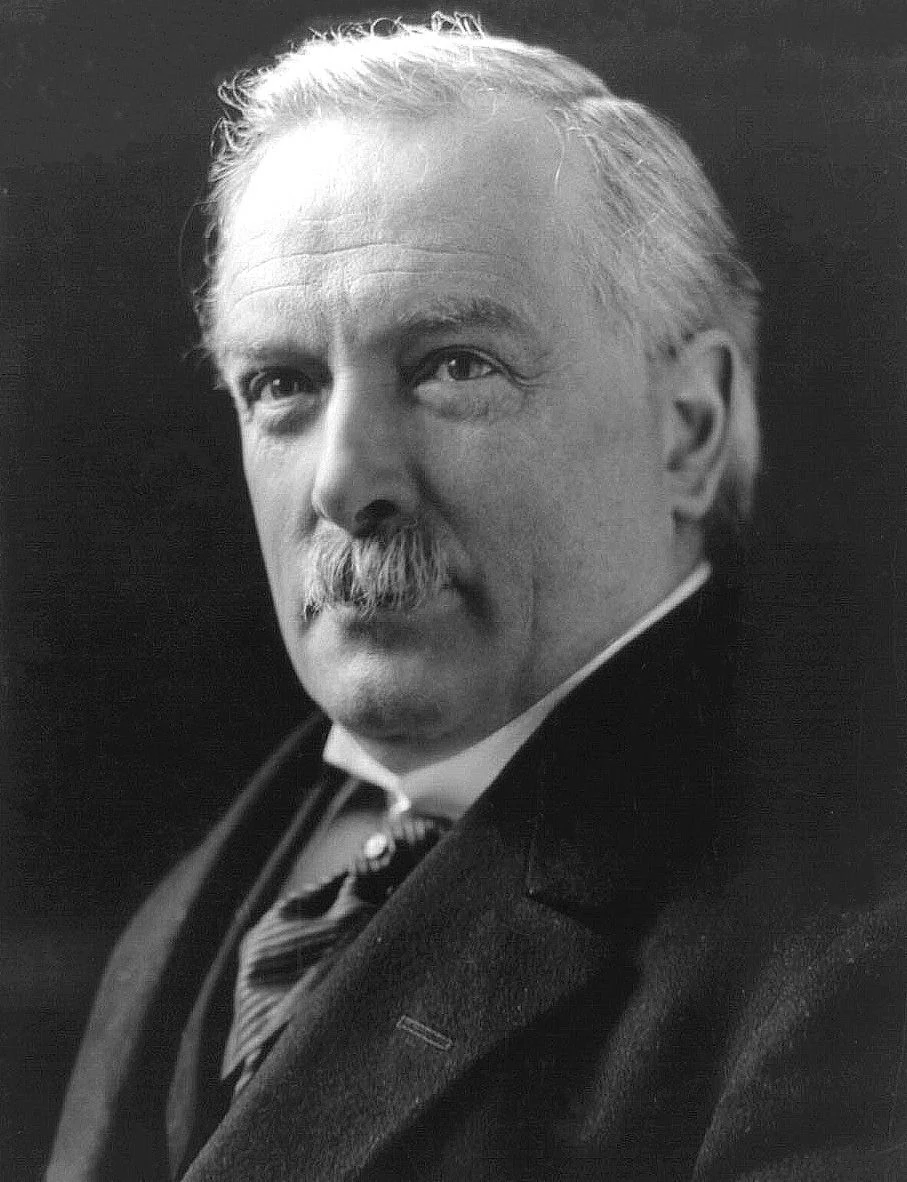
David Lloyd George’s political career joined two kinds of change: reforms intended to alter life at home and an interventionist style of leadership under the pressure of war. A Welsh-speaking solicitor who entered Parliament in 1890, he became Chancellor of the Exchequer, Minister of Munitions and, in December 1916, prime minister. His government helped expand social provision and directed Britain through the closing years of the First World War. It also confronted the unsettled questions of peace, Ireland and post-war hardship. His achievements were substantial, but neither his wartime decisions nor his legacy can be reduced to a story of uncomplicated success.
A Welsh upbringing and a political education
Born David Lloyd George on 17 January 1863 in Chorlton-on-Medlock, Manchester, he was the son of Welsh parents. After his father died, his mother moved with her children to Llanystumdwy in Caernarfonshire, where he was raised speaking Welsh. His uncle Richard Lloyd, a shoemaker and lay minister, was an important influence. Lloyd George qualified as a solicitor in 1884 and established a legal practice the following year.
His legal work and politics soon converged. In the Llanfrothen burial case, he advised Nonconformists who had been prevented from using a parish burial ground according to their own rites. Their successful appeal became a widely noted victory in Wales. In 1890, Lloyd George won a by-election to represent Caernarfon Boroughs, a seat he held for the rest of his parliamentary career. He campaigned on Welsh concerns including religious equality, land and greater self-government, while increasingly taking up questions affecting Britain as a whole.
He gained national attention as an opponent of the Second Boer War and of the Education Act 1902, which he argued threatened Nonconformist interests in Wales. These campaigns established him as a forceful Liberal speaker. In 1905 he joined Henry Campbell-Bannerman’s government as President of the Board of Trade. There he helped broker an agreement between railway companies and unions: elected workers’ representatives would meet company representatives in conciliation boards, with arbitration available if agreement failed.
The People’s Budget and social provision
In 1908 Lloyd George became Chancellor of the Exchequer under H. H. Asquith. His 1909 People’s Budget proposed higher taxes on land values, unearned income, large incomes, inheritances and some goods, with revenue intended in part to support social measures. The House of Lords rejected it, precipitating a constitutional struggle. After elections in 1910, the budget passed, and the Parliament Act 1911 curtailed the Lords’ ability to block legislation.
As Chancellor, Lloyd George was closely associated with the National Insurance Act 1911, which provided for sickness and invalidity insurance and introduced unemployment insurance for certain workers. The measure was enacted before he became prime minister; it should not be confused with the later extension of unemployment insurance under his coalition government. Old-age pensions had also been introduced under Asquith’s government. Together, these pre-war Liberal reforms marked an expansion of state responsibility for people facing poverty, illness and unemployment.
His Welsh programme also advanced. The Welsh Church (Temporalities) Act 1919 enabled the disestablishment of the Church of England in Wales to take effect in 1920, following delays during the war. These measures reflected a career shaped by Welsh political demands and a broader Liberal argument about taxation, social security and the powers of established institutions.
From munitions minister to prime minister
When the First World War began in 1914, Lloyd George remained Chancellor. In May 1915, after public concern over shortages of artillery shells, he became the first Minister of Munitions. The new department addressed production and supply, and munitions output rose substantially. The rise also reflected reforms already under way, so it cannot be credited to Lloyd George alone. In 1916 he served briefly as Secretary of State for War, where his disagreements with senior commanders over strategy grew.
In December 1916, after Asquith’s government fell, Lloyd George became prime minister. He formed a coalition and placed a smaller War Cabinet at the centre of decision-making, strengthening the prime minister’s role in directing government. The Allies eventually brought their forces under a single command in 1918. That year, after a German offensive threatened the Western Front, Lloyd George sought reinforcements and supported the appointment of Ferdinand Foch as Allied commander-in-chief. The Allies won the war in November.
His approach to the conflict was not a record of assured judgement. He clashed repeatedly with military commanders, and the 1917 Nivelle offensive, which he supported, failed to deliver the promised breakthrough. He reluctantly approved the continuation of the Passchendaele offensive, which brought heavy casualties for limited strategic gain. His government’s wartime leadership was energetic and centralising, but its strategy and relationship with the generals remain contested.
Peace, Ireland and the end of the coalition
After the 1918 election, Lloyd George led a coalition of Conservatives and his own Liberal faction. At the 1919 Paris Peace Conference, he was a leading British participant and sought terms that would secure British interests without destroying Germany’s capacity to function. He negotiated amid serious differences with other Allied leaders. The settlement, including the Treaty of Versailles, was disputed at the time and has remained part of the debate over how a durable peace might have been made.
His government also faced the struggle over Ireland. After the Anglo-Irish War, negotiations led to the Anglo-Irish Treaty of December 1921 and the establishment of the Irish Free State. The settlement allowed Northern Ireland to opt out, and partition became a lasting and deeply consequential part of the island’s political history. Lloyd George’s government also passed housing, education and unemployment measures after the war, but recession and unemployment brought hardship, and spending cuts followed.
By 1922, the coalition was under strain. The Chanak Crisis, disagreements within the Conservative Party and the honours-for-cash scandal all contributed to the loss of support. At the Carlton Club meeting on 19 October, Conservative MPs voted to contest the coming election independently. Lloyd George resigned as prime minister that day.
Politics after Downing Street
Lloyd George remained active in politics. He reunited the Liberal factions briefly with Asquith before becoming Liberal leader in 1926, a position he held until 1931. He promoted public-works proposals to reduce unemployment and helped develop policy papers including Britain’s Industrial Future and We Can Conquer Unemployment. The Liberals made only modest gains in the 1929 election, and the party’s influence continued to decline.
His later public record also contained serious misjudgements. During the 1930s he expressed admiration for aspects of Hitler’s Germany and praised Hitler after visiting the country in 1936. In 1940, Lloyd George made a forceful intervention in the Norway Debate, which helped weaken Neville Chamberlain’s position, but declined a place in Winston Churchill’s government. He was made an earl in 1945 but died before taking his seat in the House of Lords. He died of cancer on 26 March 1945 and was buried beside the River Dwyfor at Llanystumdwy.
Why David Lloyd George deserves a place in British Legacy
Lloyd George deserves a place in British Legacy because his career shows how British government changed under pressure from reform movements, war and the demands of peace. As Chancellor, he helped drive through the People’s Budget and the National Insurance Act, measures that extended public responsibility for people facing financial insecurity. These were not a complete welfare state, nor were they his work alone, but they helped establish social provision as a central matter of national politics. His Welsh campaigning, including his support for disestablishment, also connects his national career to the specific political and religious concerns of Wales.
His wartime premiership demonstrates both the reach and the risks of concentrated executive power. Lloyd George reorganised government, led Britain through the final years of the First World War and represented it at the Paris peace negotiations. Yet his strategic disputes, the grave costs of offensives such as Passchendaele, the fraught Irish settlement and his later praise of Hitler complicate any celebratory account. Remembering him in British Legacy means holding those elements together: a reforming politician whose decisions altered institutions and public expectations, and a leader whose record invites scrutiny as well as recognition. His life offers a specific British story of Welsh identity, Liberal reform, coalition government and the consequences of political power.
Sources
David Lloyd George — Wikipedia revision 1379489807 · David Lloyd George — Wikipedia
Adapted in part from David Lloyd George by Wikipedia contributors, under CC BY-SA 4.0. Text has been edited and combined with the existing article; this adapted text is shared under the same licence. Contributor history.