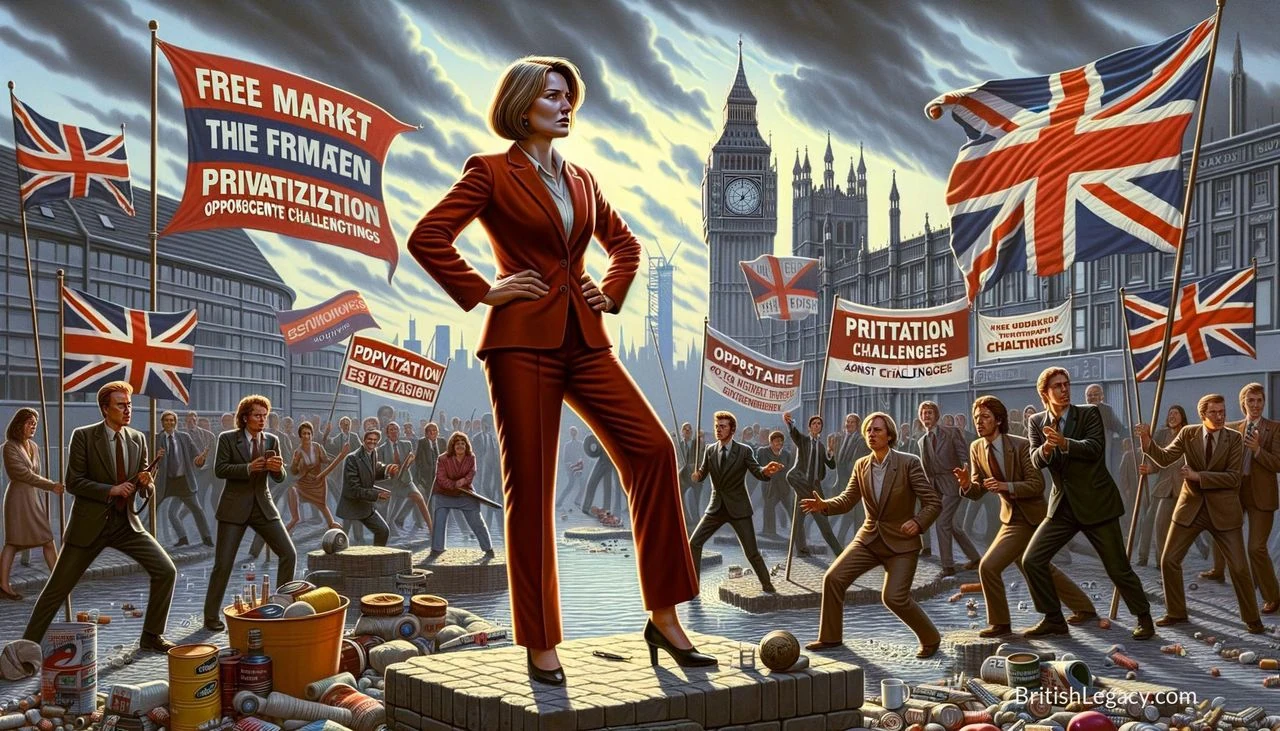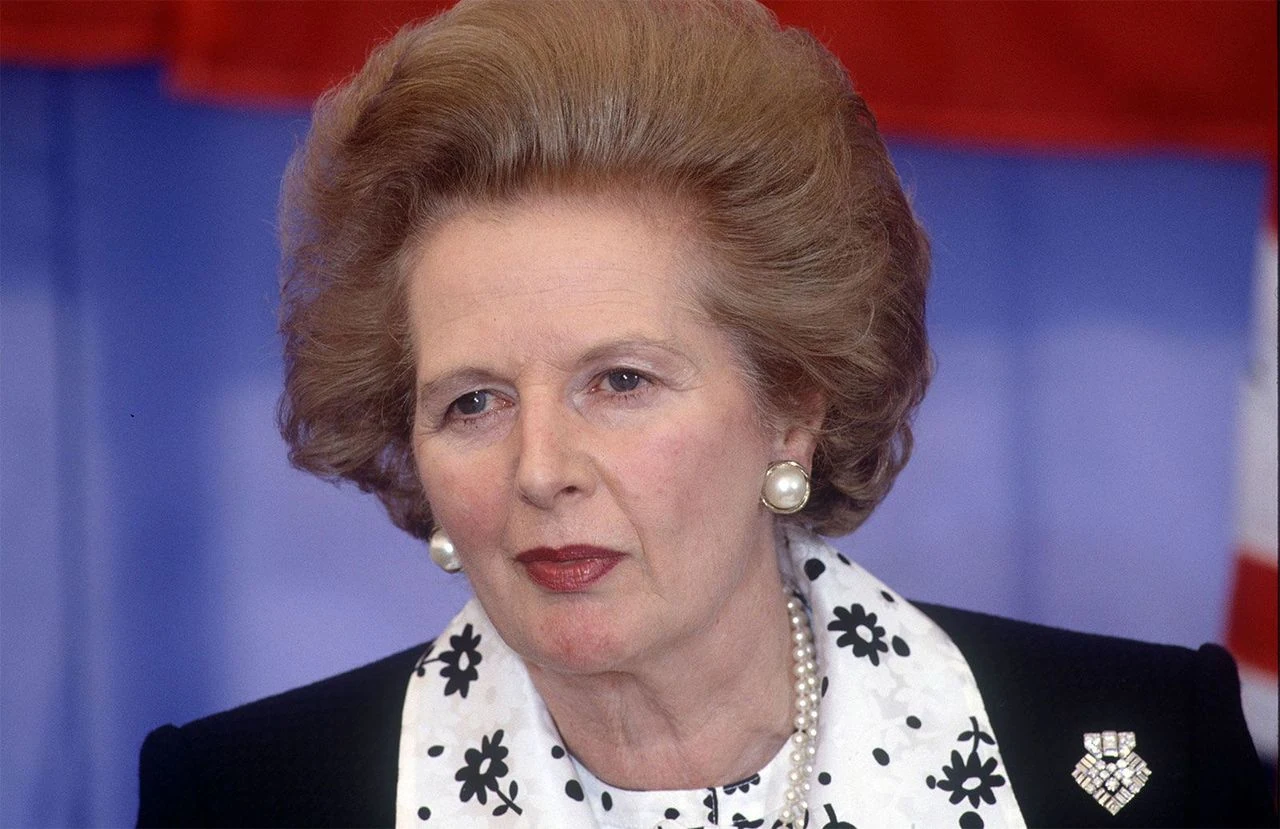
Margaret Thatcher’s years as prime minister changed the terms of British political debate. Her governments sold state-owned businesses, confronted trade unions and sought to reduce the state’s role in the economy. They also fought the Falklands War, faced the miners’ strike and introduced the Community Charge, or poll tax, whose unpopularity contributed to the end of her premiership. The scale of these changes made her a defining figure in modern British politics; their consequences remain disputed.
From Grantham to the Conservative leadership
Thatcher was born Margaret Hilda Roberts in Grantham, Lincolnshire, on 13 October 1925. Her father, Alfred Roberts, owned a grocery and tobacconist’s shop and served as a local councillor and Grantham’s mayor. She won a scholarship to Kesteven and Grantham Girls’ School and studied chemistry at Somerville College, Oxford. After graduating, she worked as a research chemist, then trained as a barrister, specialising in taxation.
Roberts stood unsuccessfully for the Conservatives in Dartford in the 1950 and 1951 general elections. In 1959 she was elected MP for Finchley. Her early parliamentary work included a successful private member’s bill requiring local authority meetings to be held in public. In Edward Heath’s government she served as Secretary of State for Education and Science from 1970 to 1974. Her decision to end free milk for most children aged seven to eleven prompted intense criticism and the nickname “Milk Snatcher”.
After the Conservatives lost power in 1974, Thatcher challenged Heath for the party leadership. She defeated him in 1975, becoming the first woman to lead a major British political party and Leader of the Opposition. The Conservatives won the 1979 general election, and she became prime minister on 4 May. She remained in office until November 1990, leading her party to three consecutive general-election victories.
Economic change and its costs
Thatcher’s governments aimed to curb inflation and reduce state control of the economy. Influenced by monetarist thinking, they raised interest rates, lowered direct taxes while increasing indirect taxes, and restricted public spending. The early 1980s brought recession and rising unemployment. Inflation later fell and the economy recovered, but unemployment remained high for much of her premiership, and manufacturing employment declined. The effects of this economic shift were uneven, and its long-term costs remain debated.
Privatisation became a central policy after the 1983 election. The government sold nationalised industries and utilities, among them British Airways, British Telecom and British Gas. It also sold council houses to tenants. These measures expanded private ownership and altered the relationship between the state, consumers and businesses. Their results were mixed: some privatised industries improved their performance, but the introduction of competition and regulation varied, and selling public assets did not itself guarantee better services or lasting commercial success.
Financial deregulation formed another part of the programme. The removal of exchange controls in 1979 enabled more capital to move overseas, while the 1986 “Big Bang” loosened restrictions on the London Stock Exchange. Together, these changes contributed to London’s growth as an international financial centre. Thatcher’s economic approach, later known as Thatcherism, also sought to reduce union power. Critics point to unemployment and damage to industrial communities; supporters emphasise lower inflation, wider share ownership and a larger role for private enterprise.
Conflict at home, war overseas
The miners’ strike of 1984–85 became the most consequential confrontation between Thatcher’s government and the trade unions. The National Coal Board proposed pit closures and job cuts; the National Union of Mineworkers opposed them. After a year on strike, the union returned to work without a settlement. The dispute weakened union power, but subsequent mine closures cost tens of thousands of jobs and devastated many communities. Its human and economic consequences remain central to arguments about Thatcher’s domestic record.
In April 1982, Argentina invaded the Falkland Islands. Thatcher’s government sent a naval task force to retake them, and Argentine forces surrendered in June. The victory strengthened her standing at home and helped the Conservatives win a landslide in 1983. It came at a high cost: 255 British service personnel and three Falkland Islanders died. The conflict became a defining episode of her premiership, and her handling of it was criticised as well as praised.
Her foreign policy also combined close relations with the United States and firm support for NATO with public opposition to Soviet communism. She developed a working relationship with Soviet leader Mikhail Gorbachev as political change gathered pace, later saying the Cold War had given way to a “new relationship”. In Europe, her opposition to deeper political integration became increasingly pronounced. Her 1988 Bruges speech set out a vision of cooperation centred on trade rather than a more centralised European structure.
The poll tax, resignation and later years
The Community Charge replaced domestic rates with a flat charge on each adult resident. Introduced in Scotland in 1989 and in England and Wales the following year, it provoked widespread opposition. A large London demonstration in March 1990 ended in rioting. The tax was among the least popular policies of Thatcher’s premiership and contributed to growing discontent with her leadership.
Her position was also weakened by divisions within her party, particularly over Europe. After Michael Heseltine challenged her for the Conservative leadership in November 1990, Thatcher withdrew from the contest. She resigned as prime minister and party leader, and John Major succeeded her. In 1992 she retired from the House of Commons and entered the House of Lords as Baroness Thatcher of Kesteven.
Thatcher wrote two volumes of memoirs and continued to comment on public affairs. She died in London on 8 April 2013, aged 87, after a stroke. A ceremonial funeral with full military honours was held at St Paul’s Cathedral. Public responses to her death, as to her political career, were divided.
Why Margaret Thatcher deserves a place in British Legacy
Thatcher’s place in British Legacy rests on the scale and specificity of the change she led. As Britain’s first woman prime minister, she broke a barrier in the country’s political leadership; as Conservative leader, she won three successive general elections. Her governments transferred major industries and utilities into private ownership, changed the system of local taxation, reduced trade-union power and deregulated financial markets. Those policies altered the roles of government, business and organised labour, and helped set the terms on which later political parties debated the economy. Remembering her requires more than repeating the claim that she transformed Britain: the changes she pursued had consequences that differed between communities and remain contested.
Her record also connects domestic policy to events beyond Westminster. The Falklands War tested the government’s response to an invasion and ended with the islands returned to British control, at a grave cost in lives. Her dealings with the United States, NATO and Gorbachev placed her at the centre of Cold War diplomacy, while her objections to European political integration exposed a lasting division within her own party. At home, the miners’ strike and the poll tax showed how forceful reform could intensify conflict and undermine political support. These achievements and disputes give readers a concrete way to examine modern Britain: not as a settled story of progress or decline, but as a country shaped by consequential choices whose benefits and burdens are still argued over.
Sources
Margaret Thatcher — supplied Wikipedia revision · Margaret Thatcher
Adapted in part from Margaret Thatcher by Wikipedia contributors, under CC BY-SA 4.0. Text has been edited and combined with the existing article; this adapted text is shared under the same licence. Contributor history.