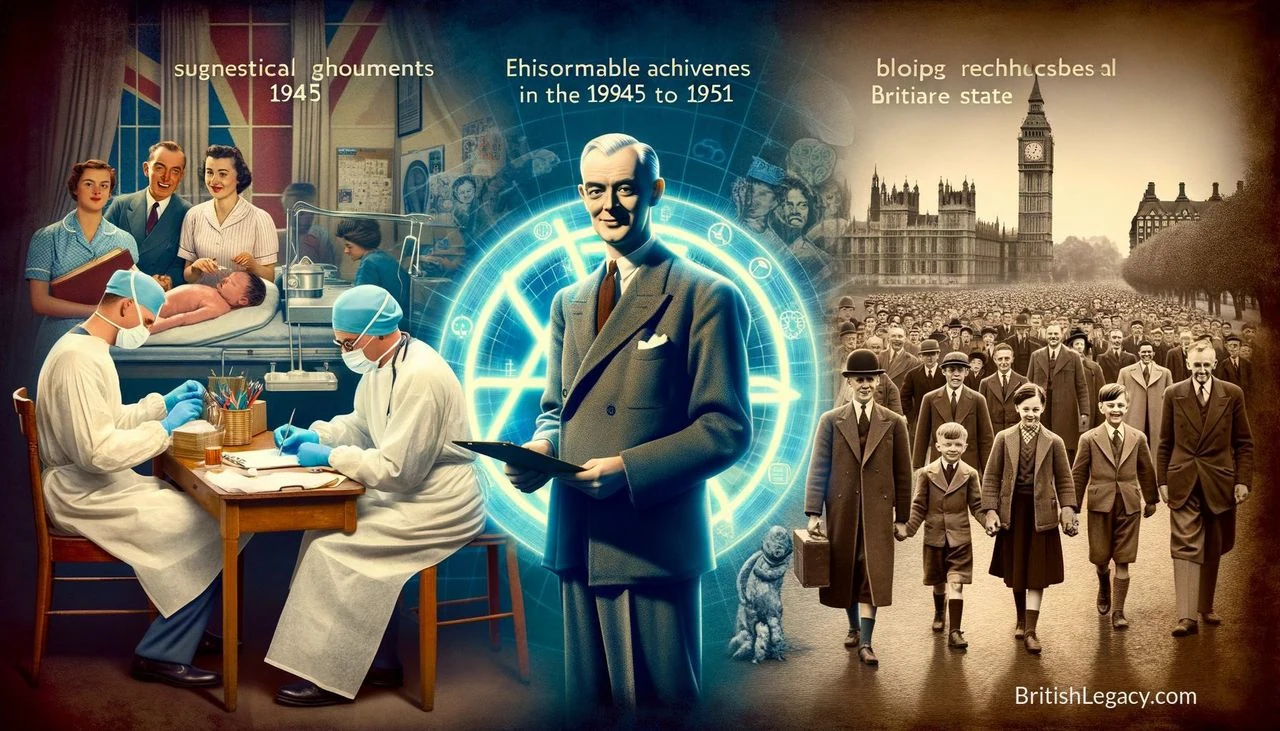
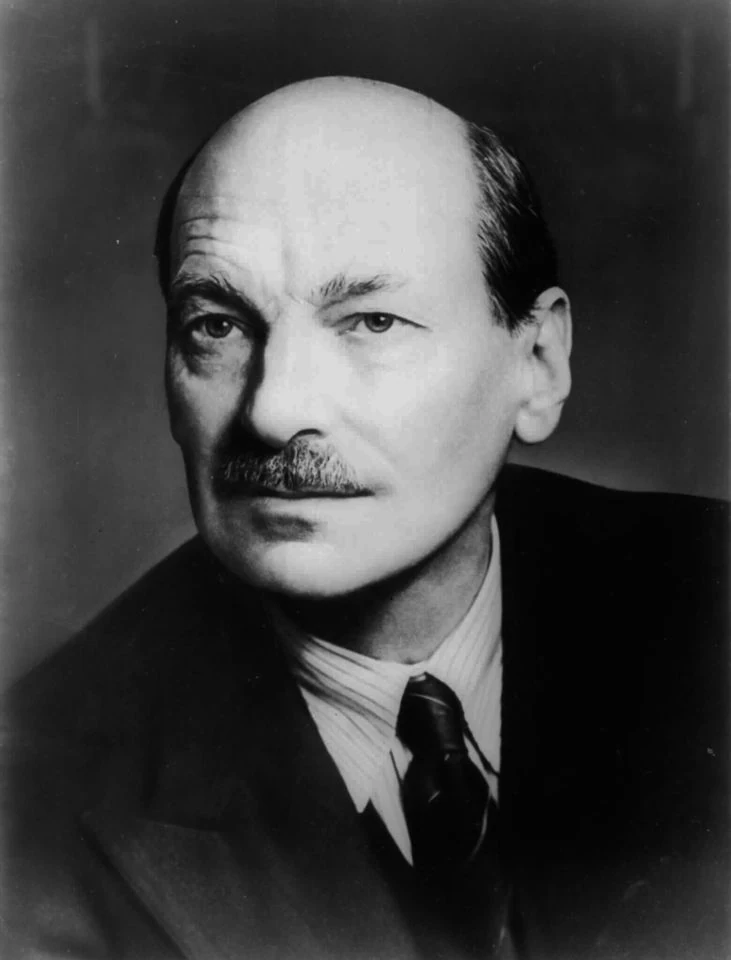
Clement Attlee became Prime Minister in July 1945, when Britain was emerging from war with its economy badly strained and shortages of food, housing and resources still acute. His Labour government set out to rebuild the country through full employment, a mixed economy and a greatly enlarged system of social services. It established the National Health Service, extended social security and transferred major industries into public ownership. The results were not without difficulty or dispute, but the reforms helped define the relationship between the British state and its citizens for decades.
From social work to political leadership
Attlee was born in Putney, then in Surrey, on 3 January 1883, into an upper-middle-class family. He attended Haileybury College and University College, Oxford, where he studied modern history, before training as a barrister. He was called to the bar in 1906, but legal practice did not suit him. That year he began volunteering at Haileybury House, a charitable club for working-class boys in Stepney. The poverty he encountered there shifted his political outlook: he concluded that private charity alone could not address deprivation and that the state needed to act. He joined the Independent Labour Party in 1908, gave up his legal career and worked in social services and political education, including as a lecturer at the London School of Economics.
During the First World War, Attlee served as an officer in the British Army. He fought at Gallipoli and in Mesopotamia, where he was wounded, and later served on the Western Front. After the war he returned to Stepney and social work. In 1919 he became mayor of the borough. His council enforced repairs on poorly maintained housing, appointed health visitors and sanitary inspectors, and sought work for unemployed former servicemen. The experience of local government gave practical form to his view that public institutions had a responsibility to protect people from hardship.
Attlee entered Parliament as MP for Limehouse in 1922. He served in the first Labour government in 1924 and later held ministerial posts in Ramsay MacDonald’s second government. After Labour’s severe defeat in 1931, he became deputy leader; in 1935 he was elected leader. He led the party through a difficult period in opposition, including the years before the Second World War, when Labour shifted from opposing rearmament to criticising Neville Chamberlain’s policy of appeasement.
Wartime work and the 1945 mandate
When Winston Churchill formed a coalition government in 1940, Attlee joined it as Lord Privy Seal. From 1942 he served as deputy prime minister, as well as taking on other senior responsibilities. His work was often behind the scenes: he helped organise the machinery of government, chaired committees dealing with domestic affairs and acted as a conciliator between Labour and Conservative ministers. He and Churchill remained in the War Cabinet throughout the coalition. Their working relationship brought together very different public styles, with Attlee contributing to the running of government while Churchill focused heavily on the war effort.
When the war in Europe ended, Labour would not continue in the coalition until the defeat of Japan. Churchill resigned and a general election followed. Labour campaigned on post-war reconstruction and social reform, promising to build a fairer society. The election result, announced on 26 July 1945, surprised many observers: Labour won 393 seats and a working majority of 146, its first parliamentary majority. Britain’s immediate circumstances remained difficult. Food and housing were scarce, and the country faced serious financial pressures. The government’s programme therefore combined social reform with the practical demands of recovery.
Health, security and public ownership
The establishment of the National Health Service in 1948 was among the most consequential changes of Attlee’s premiership. Health Minister Aneurin Bevan led its creation as a publicly funded service offering treatment free at the point of use. In its first year, it treated about 8.5 million dental patients and provided more than five million pairs of spectacles. The scale of early demand reflected how much medical need had previously gone unmet. The new service also required continuing work on staffing, hospitals and the organisation of care; it was a major institutional change, not a reform completed in a single announcement.
Social security was also recast. The National Insurance Act 1946 established a system of contributions and benefits that included pensions, sickness and unemployment payments, maternity support and other forms of assistance. The National Assistance Act followed in 1948, providing support for people without another source of income. Together with other measures, these laws expanded the state’s role in protecting people from poverty and insecurity. Education reform was also taken forward: although the Education Act had been passed in 1944, before Attlee became Prime Minister, his government implemented it.
Attlee’s government nationalised major industries and public utilities, including the Bank of England, coal, railways, electricity and gas. The steel industry followed in 1951. By that year, about a fifth of the British economy was in public ownership. The policy aimed to manage essential services and industries in the public interest, though nationalisation did not give workers the greater say in management that some had hoped for. In coal, the change brought improvements including better pay, shorter working hours and new safety measures.
Economic recovery remained constrained by the cost of war and reliance on overseas support. Rationing and shortages persisted, and Britain faced repeated balance-of-payments and currency pressures. The government nevertheless maintained near-full employment, while new housing was built at a substantial scale: more than a million homes were completed in England, Scotland and Wales between August 1945 and December 1951. Housing construction fell short of the government’s annual target, a reminder of the limits imposed by shortages of labour and materials.
Independence abroad and the end of office
Attlee’s government oversaw major changes in Britain’s imperial relationships. India and Pakistan became independent in 1947, amid the upheaval and violence of partition. Burma and Ceylon followed in 1948. These transitions began a decisive shift away from colonial rule in South Asia, although the process was shaped by complex political negotiations and, in India and Pakistan, a painful division of territory and population. The government also referred the future of Palestine to the United Nations as the British mandate became increasingly difficult to maintain.
In Europe and the wider international arena, Attlee’s government supported the Marshall Plan for economic recovery and helped establish NATO in 1949. The Labour government also began work on an independent British nuclear deterrent. These decisions sat alongside the domestic reconstruction programme: post-war Britain sought to rebuild its economy while adjusting to a changing international order.
Labour won a reduced majority at the 1950 election. By 1951, shortages and austerity remained, and divisions within the party had grown. Attlee called an election that October, but Labour lost office to the Conservatives despite winning more votes. He remained Labour leader until 1955, then retired from the Commons and entered the House of Lords as Earl Attlee. He died in Westminster on 8 October 1967, aged 84, and was buried at Westminster Abbey.
Why Clement Attlee deserves a place in British Legacy
Attlee’s place in British Legacy rests on the reach and durability of the changes made by his government. The NHS turned the principle of publicly funded treatment free at the point of use into a national institution. The expansion of insurance and assistance provided a wider framework of support for people facing unemployment, sickness, old age or poverty. These reforms altered what citizens could expect from public services and what governments were expected to provide. They were not Attlee’s work alone: ministers, officials and Parliament shaped their design and implementation. But they were central to the programme he led, and their consequences extended far beyond his years in office.
His record also shows the breadth and limits of post-war reconstruction. Public ownership, housing construction and the maintenance of high employment formed part of an effort to repair a country facing severe economic constraints. Progress came with continuing shortages, financial crises and shortfalls against some targets; acknowledging those pressures makes the achievements more comprehensible, not less significant. Abroad, the independence of India, Pakistan, Burma and Ceylon marked a profound change in Britain’s position in the world, with partition bringing grave human costs. Attlee’s legacy is therefore not simply one of idealised reform. It is the record of a government that reshaped public healthcare and social security while confronting the difficult realities of economic recovery and imperial retreat. Those specific, lasting changes give his premiership its importance in the story of modern Britain.
Sources
Clement Attlee — Wikipedia revision 1379615126
Adapted in part from Clement Attlee by Wikipedia contributors, under CC BY-SA 4.0. Text has been edited and combined with the existing article; this adapted text is shared under the same licence. Contributor history.