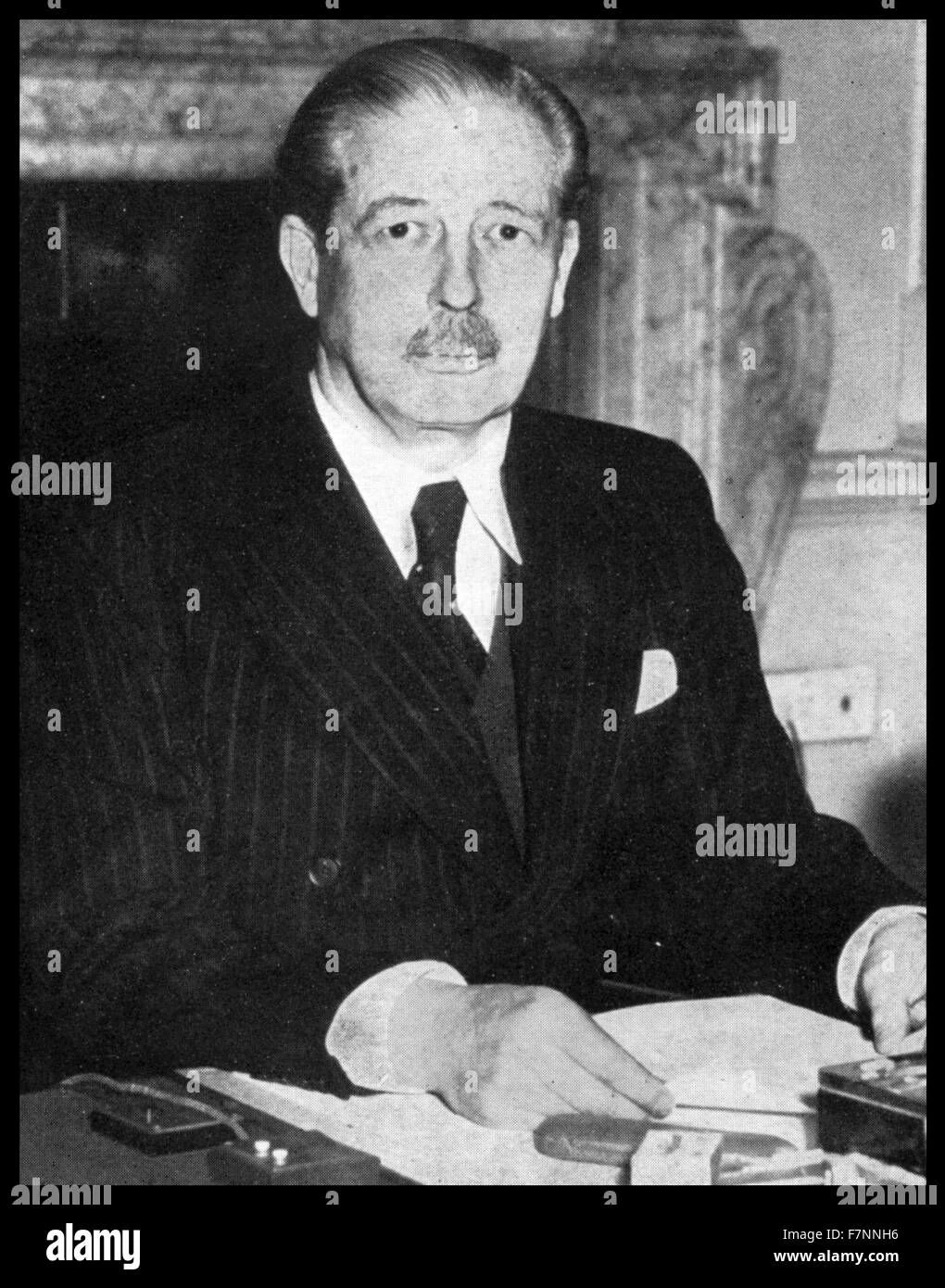
Harold Macmillan became Prime Minister in January 1957, in the aftermath of the Suez Crisis and the resignation of Anthony Eden. His government inherited a country shaken by the failed invasion of Egypt, yet he would lead the Conservatives to an increased majority at the 1959 general election. His years in office brought rising living standards and social reforms, but also bitter arguments over economic management, the future of Britain’s overseas role and the conduct of his government. The phrase “you’ve never had it so good” captured the confidence of the period; it could not conceal its uneven prosperity or the strains that eventually ended his premiership.
From the trenches to the Commons
Maurice Harold Macmillan was born in London on 10 February 1894. His father, Maurice Crawford Macmillan, was a publisher; his mother, Helen, was American. The family publishing business would shape his working life before and after politics. Educated at Eton and Balliol College, Oxford, he had begun his studies when the First World War intervened. He served in the Grenadier Guards, was wounded three times and suffered lasting effects from his injuries. His experience of the war remained part of his identity, as did the long recovery that followed severe wounds sustained on the Somme.
After joining Macmillan Publishers, he entered Parliament for Stockton-on-Tees in 1924. He lost the seat in 1929 and returned in 1931. During the 1930s he criticised unemployment and appeasement, and wrote in support of economic planning and a political “Middle Way”. He entered government during the Second World War, first in the Ministry of Supply and then in senior wartime roles in the Mediterranean. His work brought him into close contact with American officials and General Dwight D. Eisenhower, experience that informed his later approach to transatlantic diplomacy.
Macmillan served as Minister of Housing and Local Government, Defence Secretary, Foreign Secretary and Chancellor of the Exchequer before becoming Prime Minister. As housing minister, he was charged with delivering a Conservative pledge to build 300,000 homes a year and reached the target by the end of 1953, a year ahead of schedule. He became Chancellor in 1955. In 1956 he was closely involved in the secret planning of the Suez invasion, initially arguing for the use of force. When American opposition and financial pressure made Britain’s position untenable, he supported withdrawal. The episode exposed the limits of Britain’s freedom to act and damaged the country’s standing with the United States.
“The wind of change”
Macmillan succeeded Eden on 10 January 1957. His first task abroad was to repair relations with Washington, and his wartime friendship with President Eisenhower helped him begin that work. The two leaders met in Bermuda in March 1957. Macmillan later built a close working relationship with President John F. Kennedy, though the partnership was never equal in practice and their governments disagreed over issues including Laos, Cuba and the Congo.
His most enduringly recognised speech on empire came during an African tour. On 3 February 1960, in Cape Town, he told South Africa’s Parliament that a “wind of change” was blowing through the continent. The speech gave a public expression to a retreat from imperial rule already being driven by events, political choices and rising opposition to colonial government. Macmillan appointed Iain Macleod as Colonial Secretary after the 1959 election, and the pace of independence increased. Nigeria and British Somaliland became independent in 1960; Sierra Leone and Tanganyika followed in 1961, Uganda in 1962, and Kenya in 1963. Tanganyika later joined with Zanzibar to form Tanzania.
This was not a simple or uncontested transition. The British government had faced criticism over its conduct in Kenya and Nyasaland, while the future of the Central African Federation remained deeply contentious. Macmillan accepted its dissolution by the end of 1963. In Southeast Asia, his government backed the formation of Malaysia in 1963 and resisted Indonesian opposition, which developed into the undeclared conflict known as Confrontation. His record therefore combines the transfer of power to new states with efforts to preserve British influence and military positions after formal empire receded.
Prosperity, reform and economic tension
At home, Macmillan’s government presided over an era of growing affluence, although it did not create all the conditions behind it. In a speech in July 1957 he said that most people had “never had it so good”, while warning about inflation. The line became an enduring shorthand for the decade and a Conservative campaign asset in 1959, when the party increased its majority. The period brought rising average living standards, but the gains were not uniform and the economy remained vulnerable to pressures on the balance of payments and sterling.
Macmillan favoured high employment and a mixed economy, using Keynesian ideas to support demand. In 1958, three Treasury ministers resigned after a dispute over economic policy and spending. Later, Chancellor Selwyn Lloyd imposed a seven-month wage freeze in 1961 amid balance-of-payments difficulties. The government also created the National Economic Development Council, intended to foster economic growth, and a National Incomes Commission to help control incomes. These efforts did not resolve Britain’s difficulties or settle the argument over how to combine growth, price stability and employment.
Social legislation formed another part of the record. During Macmillan’s premiership, Parliament passed measures covering housing, offices, noise abatement and factories. The government introduced a graduated pension scheme, established a special allowance for certain orphaned children and reduced the standard working week from 48 hours to 42. Before his premiership, as housing minister, Macmillan had already overseen the rapid expansion of housebuilding towards the 300,000-a-year target. The distinction matters: that achievement belonged to his earlier ministerial service, not to a building rate first initiated by his government as Prime Minister.
Cold War diplomacy and the end of office
Macmillan sought to maintain Britain’s influence through diplomacy and nuclear cooperation. His government worked with the United States on the 1963 Partial Nuclear Test Ban Treaty, which prohibited above-ground nuclear tests. He also pursued closer European economic ties. Britain applied to join the European Economic Community in 1961, but President Charles de Gaulle vetoed the application in January 1963. The decision underlined the gap between Macmillan’s ambitions for Britain’s international position and the choices available to his government.
His final years in office were beset by political trouble. In 1962, the “Night of the Long Knives” reshuffle removed eight ministers and was widely interpreted as a sign of panic. The Vassall espionage affair weakened confidence in the government; in 1963, the Profumo affair further damaged its credibility. Macmillan resigned on 18 October 1963, after illness provided a route out of office. His departure came after almost seven years as Prime Minister, a period that had begun in the shadow of Suez and ended amid questions about the government’s judgement and authority.
Retirement and remembrance
After leaving the Commons in 1964, Macmillan returned to the family publishing business, serving as its chairman until 1974. He was Chancellor of the University of Oxford from 1960 to 1986 and later became an active member of the House of Lords. In 1984 he was created Earl of Stockton, taking the title from his former parliamentary constituency. In the Lords he criticised Margaret Thatcher’s handling of the miners’ strike and warned against treating the proceeds from selling state assets as ordinary income. His remarks were often reduced to the phrase “selling the family silver”; his argument was more specific, questioning the use of one-off sale proceeds as though they were recurring revenue.
Macmillan died at Birch Grove, his home in West Sussex, on 29 December 1986, aged 92. His career resists a single verdict. He had challenged conventional policy in the 1930s, managed a demanding housing programme, helped oversee the end of British rule across much of Africa and tried to preserve influence through alliances and diplomacy. He also misjudged the consequences of Suez, presided over persistent economic difficulties and left office under the weight of scandal. The combination of achievement, compromise and failure is central to understanding his place in post-war British history.
Why Harold Macmillan deserves a place in British Legacy
Harold Macmillan deserves a place in British Legacy because his premiership illuminates how Britain adjusted to diminished imperial power without surrendering its ambition to shape international affairs. His Cape Town speech of 1960 became the best-known public marker of a changing policy, while the independence of Nigeria, Sierra Leone, Tanganyika, Uganda and Kenya made that change concrete. These transfers were not uncomplicated gestures of benevolence: they took place amid colonial resistance, political pressure and disputes about the pace and terms of independence. Remembering both the change and its context gives a more truthful account of Britain’s departure from empire.
His domestic record also connects policy to everyday life. As housing minister he reached the annual target of 300,000 homes ahead of schedule; as Prime Minister he oversaw legislation on housing, workplaces and public health, alongside pension and working-hours changes. Meanwhile, his government’s economic choices exposed the difficulty of sustaining employment and rising living standards in a country facing pressure on its finances. His diplomacy—from the repair of relations with Washington to the test-ban negotiations—shows a leader seeking influence through partnership, even when Britain’s bargaining power was limited. Macmillan’s legacy is not a simple story of triumph. It is a useful record of social change, decolonisation, political judgement and the constraints facing a country redefining its role in the world.
Sources
Harold Macmillan — revision 1378024418 · Harold Macmillan
Adapted in part from Harold Macmillan by Wikipedia contributors, under CC BY-SA 4.0. Text has been edited and combined with the existing article; this adapted text is shared under the same licence. Contributor history.