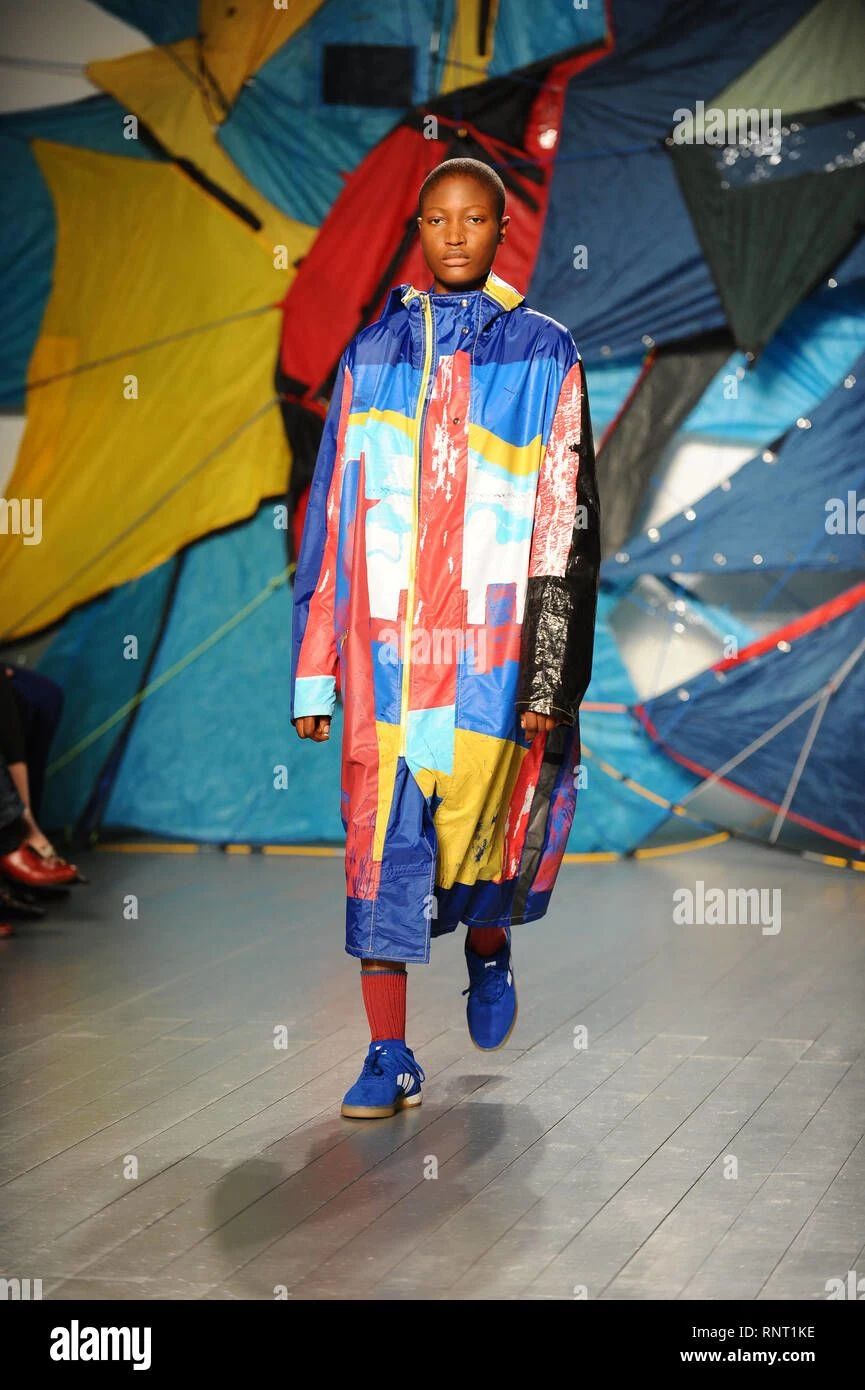
Bethany Williams’s fashion practice connects two questions often treated separately: what materials clothes are made from, and whose lives and work they represent. Since establishing her label, she has used recycled and sourced materials while developing collections with organisations including the Quaker Mobile Library and the Magpie Project. The result is work that brings environmental concerns and social partnerships into the design process rather than treating them as decoration added afterwards.
From the Isle of Man to fashion
Williams was born on 14 December 1989 in Birkenhead, England, to Scouse parents, and grew up on the Isle of Man. Her mother worked as a pattern cutter in a Liverpool factory, an early connection to the practical work behind clothing. Williams attended Murray’s Road School and completed her A levels at St Ninian’s High School. She first considered studying geography, then took an art foundation course at University College Isle of Man.
She went on to study Fine Art Critical Practice at the University of Brighton, graduating in 2012, before completing an MA in Menswear at the London College of Fashion. Her final collection, Breadline, marked the beginning of a design career that would bring together clothing, material choices and wider social themes. After her MA, she showed her AW16 collection at Vancouver Fashion Week. In 2017 she founded her eponymous sustainable fashion label.
Building a label through collections
Williams’s work has included recycled and upcycled materials, as well as materials sourced from San Patrignano. Her approach makes the selection and reuse of materials part of the collection’s design story. It offers an alternative to treating the garment as a finished object detached from the resources and labour that made it.
At London Fashion Week in 2018, Williams presented Women of Change, the label’s first collection, in collaboration with illustrator Aaron Skipper. Her next collection, No Address Needed to Join, combined a bookish theme with collaborations involving the Quaker Mobile Library and Hachette UK. It was later included in the exhibition Sustainable Thinking at the Salvatore Ferragamo Museum in Florence. These projects gave the collections a subject and a context beyond seasonal fashion presentation.
Williams returned to London Fashion Week in 2019 with Adelaide House, a ready-to-wear collection named after a Liverpool women’s shelter. The collection incorporated newspaper and artwork by Giorgia Chiarion. It brought her the Queen Elizabeth II Award for British Design, the second time the award had been made. That year she also won British Emerging Talent in the Menswear category at the Fashion Awards, was a finalist for the LVMH Prize and appeared in the Yoox x Vogue Italia Next Green Talents showcase at Milan Fashion Week.
Partnerships with a social purpose
Collaboration became a continuing part of Williams’s practice. For her SS20 collection, Butterfly Café, she worked with Adidas Originals, the charity Spires and Chiarion. The partnerships connect a collection’s presentation and production with organisations and people beyond the fashion label itself.
For AW20, No Recourse to Public Funds, Williams began working with Melissa Kitty Jarram and the Magpie Project. The project supports mothers and children living in temporary accommodation. Williams and Jarram also made a sculptural sofa for the Adidas Originals flagship shop on Carnaby Street in autumn 2020. The collaboration with the Magpie Project continued through the SS21, SS22 and AW22 collections: All Our Children, All Our Stories and The Hands That Heal Us.
In summer 2021, Williams presented her first public art installation to accompany All Our Stories. The following year, she presented The Hands That Heal Us at London Fashion Week to open her exhibition Bethany Williams: Alternative Systems at the Design Museum, curated by Priya Khanchandani. The exhibition placed her work within a wider consideration of how fashion systems might be approached differently.
Recognition and work beyond the runway
Williams’s honours have recognised both her design work and its environmental concerns. She won the BFC Vogue Designer Fashion Fund in 2021 and was a finalist for the International Woolmark Prize that year. At the Fashion Awards she received the Leaders of Change: Environment Award in both 2021 and 2022. In 2024 she won the Fabric of Life Award for Designer of the Year.
Her work has also moved into painting. In autumn 2025, her first painting exhibition, This Wild, Achingly Beautiful Place, was held at Bethlem Gallery in south-east London. This exhibition extends the record of her practice beyond clothing, while remaining part of a career that has already brought together fashion, illustration, public installation and exhibition-making.
Williams has also spoken publicly about living with chronic illness. She was diagnosed with New Daily Persistent Headache in 2013, and a severe flare-up in 2022 led her to move back to the Isle of Man. The account is part of the available biographical record, but her work does not need to be reduced to it: her collections, partnerships and public projects provide their own substantial account of her contribution.
Why Bethany Williams deserves a place in British Legacy
Bethany Williams deserves a place in British Legacy because her career provides a specific example of a British designer making material choices and social relationships central to fashion. Her use of recycled and sourced materials gives resource use a visible place in the work. Collections such as Adelaide House and No Recourse to Public Funds also take their names and themes from social contexts, while her collaborations with the Quaker Mobile Library, Spires and the Magpie Project connect design activity with organisations outside the label. These are documented parts of her practice, not merely broad claims about fashion being a force for good.
Her contribution is also evident in the variety of settings in which the work has appeared: London Fashion Week, the Salvatore Ferragamo Museum, the Design Museum and a public art installation. Awards from the Queen Elizabeth II Award for British Design to the BFC Vogue Designer Fashion Fund and the Leaders of Change: Environment Award mark recognition across design and environmental concerns. Together, the collections, collaborations and exhibitions show how a contemporary British fashion practice can engage with materials and community partnerships while still operating through the established platforms of the industry. Williams’s legacy lies in making those connections an identifiable part of her work.
Sources
Bethany Williams · Bethany Williams
Adapted in part from Bethany Williams by Wikipedia contributors, under CC BY-SA 4.0. Text has been edited and combined with the existing article; this adapted text is shared under the same licence. Contributor history.