Zandra Rhodes made textile design the starting point for a distinctive fashion language. Her vivid prints, unconventional construction and dramatic use of colour carried her from art college in Kent to international fashion, while her work beyond clothing extended into interiors, opera and a London museum devoted to fashion and textiles. Across a career spanning more than five decades, she has combined the work of a designer with a sustained interest in how design is made, exhibited and studied.
Learning to work with pattern
Rhodes was born in Chatham, Kent, on 19 September 1940. Her mother worked as a fitter at the House of Worth in Paris before becoming a professor at Medway College of Art. Rhodes later described her mother as one of her greatest influences. Her father served in the air force in Egypt and later worked as a lorry driver; her sister Beverley was born three years after her. Growing up with her mother’s connection to fashion helped put the subject within reach, but Rhodes’s own training gave her the tools to make it her profession.
She studied printed textile design at Medway College of Art and went on to the Royal College of Art on a scholarship, graduating in 1964 in home-furnishing textile design. Her early influences included the artists Roy Lichtenstein and Andy Warhol, the designer Emilio Pucci, and her textile instructor Barbara Brown. Rhodes first trained to design patterns for interiors. She turned that knowledge towards garments, treating fabric not as a finishing detail but as the organising idea of a design.
A distinctive fashion practice
Rhodes’s early textile designs were considered too unconventional by traditional British manufacturers, making it difficult for her to find work. In 1968 she and fashion designer Sylvia Ayton opened Fulham Road Clothes Shop. Ayton designed the garments, while Rhodes applied her textile designs to them. Rhodes showed her first collection of loose, romantic clothes through the business. The partnership ended the following year, and she established a studio in Paddington, west London, where she released her first solo collection as a freelance designer.
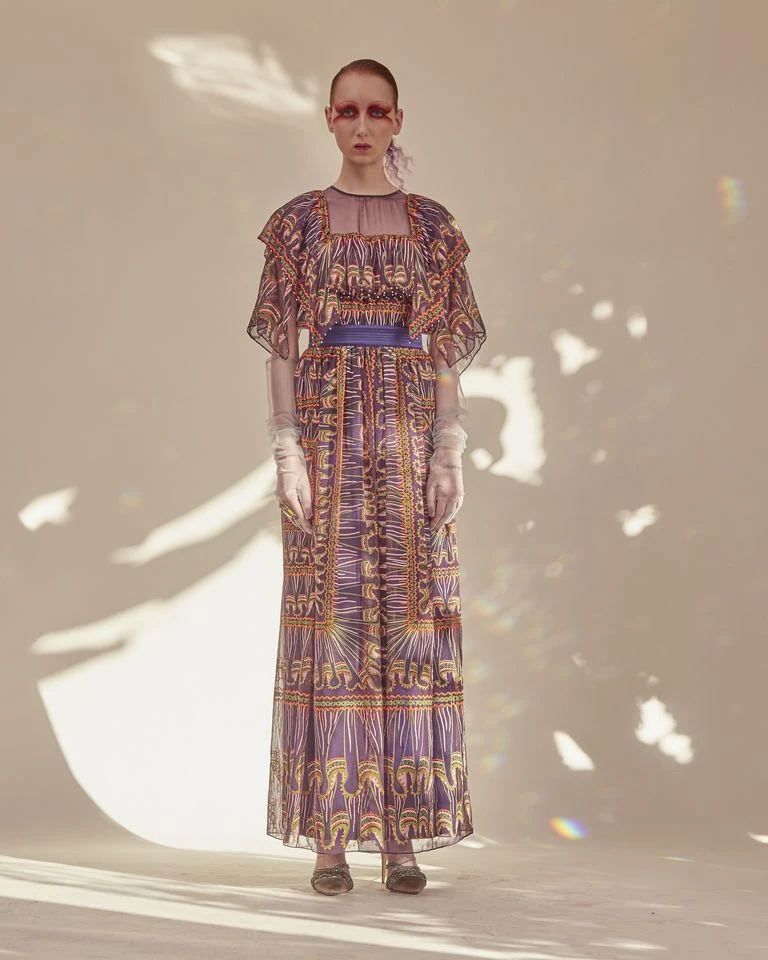
That collection attracted attention in Britain and the United States. Marit Allen, then an editor at American Vogue, featured pieces in the magazine, helping bring orders from retailers including Henri Bendel, Fortnum and Mason, Neiman Marcus and Saks. Rhodes became part of a new generation of British designers who helped put London at the forefront of international fashion in the 1970s. Her clothes combined dramatic prints with graceful, often feminine forms. Travel and the natural world informed her patterns: among their sources were Ukrainian chevrons, Japanese flowers, calligraphy, shells and symbols of North American Indigenous peoples.
Construction mattered as much as the surface design. Rhodes used exposed seams, layering, smocking and shirring, often building a garment around the print. In 1977 she presented her take on punk as “Conceptual Chic”: dresses punctured with holes and decorated with beaded safety pins, alongside screen-printed imagery on silk jersey or Ultrasuede. The effect was not simply a bright pattern laid over a conventional dress. Shape, fabric and print were developed together, making the clothing recognisable as Rhodes’s work.
Her clients included Diana, Princess of Wales, and musicians Marc Bolan, Freddie Mercury and Brian May. The range of commissions shows how her designs moved between fashion and performance, and between royal and popular culture. Rhodes also took her textiles into home furnishings. In 1976 she designed a collection of household linens, glassware, cushions, throws and rugs, and later extended her work to accessories and other licensed products.
Beyond the fashion collection
Rhodes’s work in costume design gave her practice another public stage. The San Diego Opera commissioned her to design costumes for Mozart’s The Magic Flute in 2001. She later designed the set and costumes for Bizet’s Les pêcheurs de perles there, and worked on productions of Verdi’s Aida for Houston Grand Opera and English National Opera. In 2002, she designed a Transport for London poster that represented the River Thames as a woman wearing London landmarks as jewellery.
Her largest institutional undertaking was the Fashion and Textile Museum in London, which she founded in 2003. The museum was conceived as a place for exhibitions and education, with facilities including a library and lecture room. Its opening exhibition, “My Favourite Dress”, invited designers including Oscar de la Renta, Donna Karan, Valentino and Giorgio Armani to select a favourite dress. Rhodes also contributed thousands of garments from her own collection, alongside sketchbooks and silk screens. The museum’s purpose was not limited to presenting her own work: its programme placed fashion and textiles in a wider cultural and historical context.
Rhodes continued to connect her archive with teaching. In 2013, a digital study collection made 500 garments, drawings, interviews and tutorials available online for students. The project was led by the University for the Creative Arts and funded by Jisc. Rhodes became chancellor of the University for the Creative Arts in 2010. These roles extended her contribution from making designs to helping preserve and circulate knowledge about design.
Recognition and continuing work
Rhodes’s honours include the 1972 Designer of the Year award and appointment as a Royal Designer for Industry by the Royal Society of Arts. She received a Daytime Emmy in 1979 for costume design. In 1997 she was appointed a Commander of the Order of the British Empire for services to the fashion industry; in 2014 she was made a Dame Commander for services to British fashion and textiles. The distinctions recognise different aspects of a career that has joined textile innovation, clothing and wider cultural work.
Her designs have continued to reach new audiences. A Rhodes dress appeared on a Royal Mail commemorative stamp in 2012 celebrating Great British Fashion. In 2019 she received the Walpole British Luxury Legend Award, and in 2021 launched a 26-piece homeware collection with Ikea of Sweden. These later projects brought her prints into different settings, while the museum and digital archive kept attention on the material and history of fashion itself.
Why Zandra Rhodes deserves a place in British Legacy
Zandra Rhodes deserves a place in British Legacy because her career shows how a British designer can build a distinctive body of work from technical knowledge of textiles. Her education in printed textile design was not incidental to her fashion: it shaped how she approached the garment, from the arrangement of a print to the seams, layers and fabric that carried it. Her work helped make London a visible centre of international fashion in the 1970s, and her designs moved between clothing for individual clients, performance costume and interiors. The result is a practice with a clear visual identity and a reach beyond a single collection or market.
Her contribution also includes the institutions and resources she helped create. By founding the Fashion and Textile Museum, Rhodes established a London venue for exhibitions and education, and its opening show brought the work of many designers into conversation rather than making it a monument to one name. The museum’s collections and changing exhibitions help audiences encounter fashion as design and cultural history. Her digital study project made garments and working materials available to students worldwide, while her role at the University for the Creative Arts linked her experience to an arts and design institution. Together, these achievements make her British legacy both creative and practical: she designed textiles and clothes, but also helped preserve, teach and share the knowledge behind them.
Sources
Zandra Rhodes — Wikipedia revision 1379024847
Adapted in part from Zandra Rhodes by Wikipedia contributors, under CC BY-SA 4.0. Text has been edited and combined with the existing article; this adapted text is shared under the same licence. Contributor history.