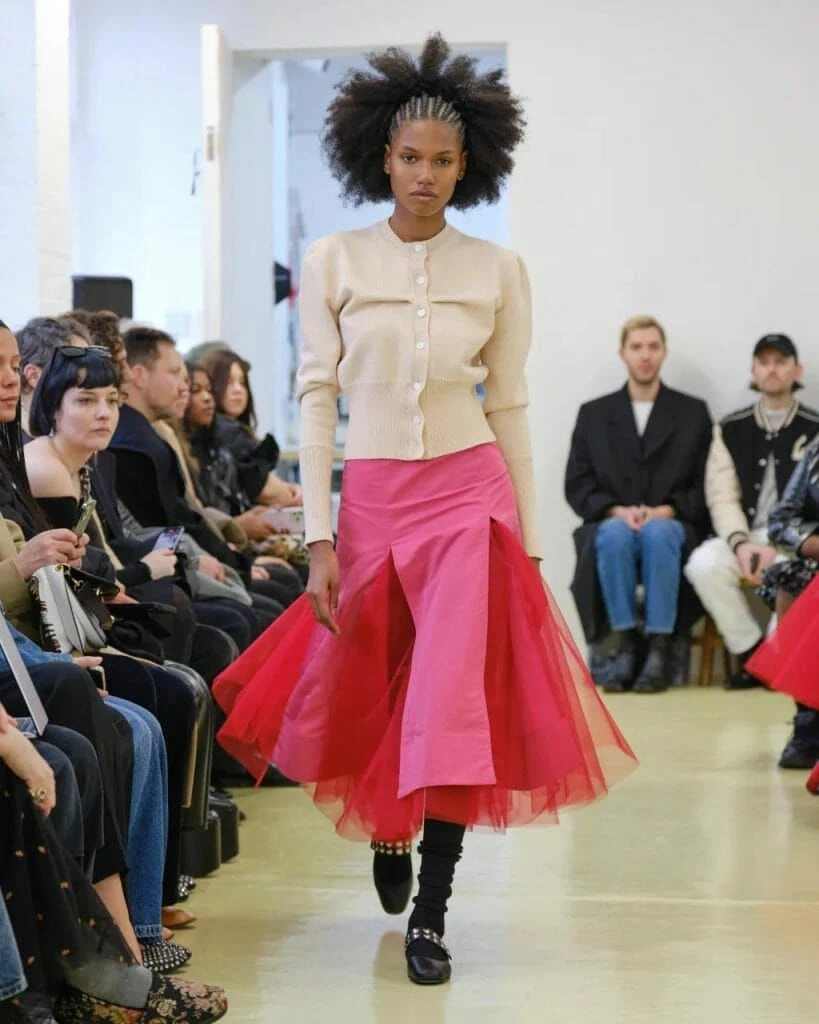
Molly Goddard’s designs make a familiar fabric feel anything but restrained. Tulle, often associated with ballet tutus and bridal veils, becomes a material for vivid colour and generous volume in her work. The contrast has become a recognisable feature of the London designer’s practice, which moved from study at Central Saint Martins to a debut with the Fashion East platform and recognition in British fashion.
London roots and design training
Goddard was born in London in 1989. Her father was an artist and her mother a dressmaker. The supplied account connects this family background with her early interest in textiles and design. She studied fashion design at Central Saint Martins, completing a BA in 2012 and an MA in 2014. This formal training preceded her presentation of work through Fashion East, a platform for emerging designers.
Goddard made her Fashion East debut in 2014. Her first collection featured oversized tulle dresses in bright colours. Rather than treating the fabric’s associations with delicacy as a limit, the designs used its lightness to create pronounced silhouettes. Scale and colour were already central to the collection, establishing elements of an approach that would remain prominent in her public profile.
Making tulle her own
Tulle is a recurring element in Goddard’s work, but its significance lies in how she handles it. Its familiar connection with ballet tutus and bridal veils sits alongside volume, saturated hues and contemporary shapes. That meeting of traditional femininity and a more assertive silhouette gives the clothes their tension: the fabric may appear airy, while the overall form is conspicuous and expansive.
The original account describes her designs as playful and expressive, and presents them as clothes that can function as statements as well as garments. The contrast between tulle’s associations and Goddard’s use of it is central to that description. Instead of relying only on conventional ideas of prettiness, her designs make colour and scale part of their effect. Her work has been featured in Vogue and Harper’s Bazaar; the supplied article also names Rihanna and Adwoa Aboah among the figures she has dressed.
Recognition and British fashion
In 2018, Goddard received the British Emerging Talent Womenswear award at the Fashion Awards. The accolade recognised her work in a British fashion context, while her use of tulle and colour gives the clothes a recognisable identity beyond the award itself. The original account also says her pieces are sought after in fashion centres including New York and Paris. Without further supplied evidence, the scale of that international demand cannot be assessed here.
Her story connects a London-based design practice with British fashion education and platforms. Central Saint Martins was the setting for her formal training; Fashion East provided a place to present her early collection; and the Fashion Awards recognised her work in a British womenswear category. These concrete points make a more specific account of her British connection than general claims about national creativity or influence.
Why Molly Goddard deserves a place in British Legacy
Molly Goddard deserves a place in British Legacy for developing a distinctive design language from a familiar material. Her use of tulle does not depend on treating it as delicate decoration: volume, bright colour and scale make it central to the character of her clothes. The result plays with the fabric’s associations with ballet and bridal wear while giving it an expressive role. Her 2014 Fashion East debut and 2018 British Emerging Talent Womenswear award are concrete milestones in that development.
Her career also illustrates a route from British fashion education to public presentation and recognition. Goddard studied at Central Saint Martins, showed an early collection through Fashion East and received recognition at the Fashion Awards. Together, those details place her within a British design context without relying on claims that she transformed the industry or inspired a generation. Her contribution is more particular: a recognisable approach to colour, material and silhouette, alongside coverage in major fashion magazines and named clients in the supplied account. That is a specific, evidenced basis for remembering her in a British fashion story.