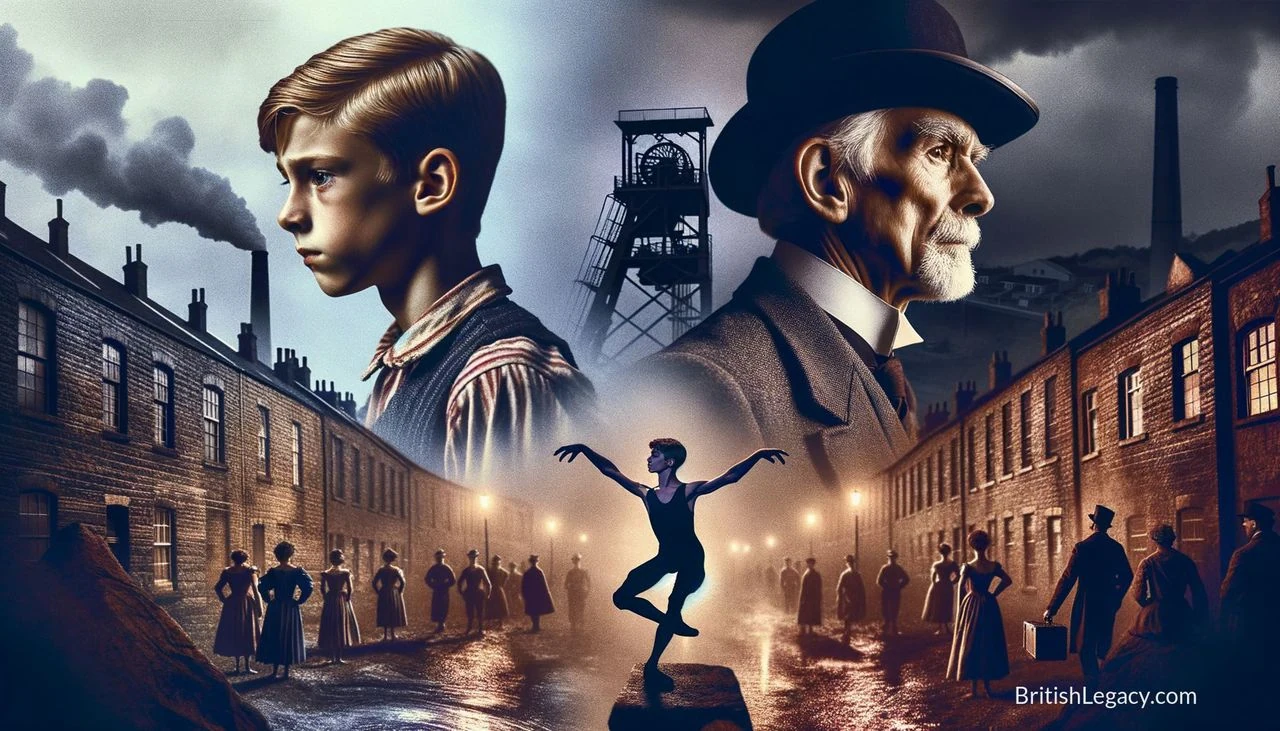
In Billy Elliot, a boy’s discovery of ballet unfolds during the 1984–85 miners’ strike. Set in County Durham, Stephen Daldry’s 2000 film brings together a family’s struggle, a divided community and an 11-year-old’s determination to dance. Billy’s ambition challenges what his father and brother expect of him, but the story does not treat his progress as a solitary triumph: when an audition becomes possible, help comes from the people around him.
A different kind of lesson at the gym
Billy lives with his widowed father, Jackie, his older brother Tony and his maternal grandmother, who has Alzheimer’s disease. Jackie and Tony are coal miners on strike, and Tony is a union delegate. Jackie sends Billy to the gym to learn boxing. Billy dislikes it. When a ballet class starts using the gym because its usual basement studio has temporarily become a soup kitchen for striking miners, he watches and then joins in without telling his father.
The contrast between boxing and ballet gives the film a direct way to examine expectations about boys and men. Jackie’s opposition is partly shaped by concern about how other people will judge his son. Billy’s teacher, Sandra Wilkinson, sees promise in him and believes he could study at the Royal Ballet School in London. But after Tony is arrested in a clash between police and striking miners, Billy misses his audition. The industrial dispute presses into the family’s private life, disrupting an opportunity that might otherwise have seemed straightforward.
At first, Jackie and Tony are angry at the prospect of Billy becoming a professional dancer. Their response is bound up with fear that others will regard him as gay. Billy’s friendship with Michael, who is gay, makes another aspect of the story explicit: when Billy learns about Michael, he supports him. Later, Jackie catches the boys dancing in the gym. He begins to recognise that dance is not a passing diversion for his son and decides to help him try again.
Sandra offers to pay for the audition, but Jackie refuses charity. He attempts to cross the picket line to earn the money, until Tony stops him. Fellow miners and neighbours raise funds instead, while Jackie pawns Billy’s mother’s jewellery. The effort is collective, shaped by a community under pressure that nevertheless makes space for one boy’s ambition.
At the audition, Billy is nervous. After punching another boy, he fears he has spoiled his chance. Asked what dancing feels like, he struggles to answer, then says it is “like electricity”. The Royal Ballet School later accepts him. In the film’s final sequence, set in 1998, the adult Billy performs as the Swan in Matthew Bourne’s Swan Lake, with Jackie, Tony and Michael in the audience.
From a North East play to a film
Lee Hall developed the film from his play Dancer, first presented as a rehearsed reading at Newcastle upon Tyne’s Live Theatre in 1998. His work was influenced by Sirkka-Liisa Konttinen’s photographic book Step by Step, about a dancing school in nearby North Shields. The story’s connection to north-east England thus reaches beyond its setting: the region also informed the material that helped shape the film’s visual world.
Filming began in August 1999, with principal photography lasting seven weeks. Much of the film was made in the Easington Colliery area, where more than 400 local people appeared as extras. Mining scenes were filmed at Ellington and Lynemouth collieries in Northumberland; other locations included Dawdon, Middlesbrough and Newcastle upon Tyne. The production also used Langley Park Primary School for school scenes. The locations give the family’s circumstances a particular industrial and geographical context, rather than leaving the mining community as an unnamed backdrop.
Thousands of boys were considered for the title role before Jamie Bell was chosen; he went through about seven auditions. Choreographer Peter Darling worked with him for eight hours a day over three months during preparation. Julie Walters played Sandra Wilkinson, Gary Lewis played Jackie and Jamie Draven played Tony. Stephen Warbeck composed the score. The soundtrack also included punk and glam-rock songs, among them music by The Clash and T. Rex, placing familiar popular music alongside the film’s dance sequences.
Reception, awards and adaptations
The film premiered at the 2000 Cannes Film Festival under the title Dancer. It was retitled Billy Elliot to avoid confusion with another Cannes film, Dancer in the Dark, and received a wider UK theatrical release on 29 September 2000. Its reported worldwide box-office total was about $109.3 million, against a budget of $5 million. Critical responses included praise for the performances and storytelling, alongside objections from some reviewers to the mixture of social realism and theatrical dance.
At the 54th British Academy Film Awards, the film won three awards from 13 nominations: Outstanding British Film, Best Actor in a Leading Role for Bell, and Best Actress in a Supporting Role for Walters. Bell became the youngest winner of the leading-actor award. The film also received three Academy Award nominations: Best Director for Daldry, Best Original Screenplay for Hall and Best Actress in a Supporting Role for Walters. Warbeck’s music was nominated for a BAFTA award.
The story moved into other forms soon after its cinema release. Melvin Burgess adapted it as a novel in 2001. Hall and Elton John collaborated on Billy Elliot the Musical, which opened at London’s Victoria Palace Theatre in 2005. Director Daldry and choreographer Darling were among the film’s team who also worked on the stage production. It ran for more than 4,000 performances in London before closing in April 2016. The Broadway production ran from 2008 to 2012; in 2009 it won ten Tony Awards, including Best Musical. The adaptations carried Hall’s story from its North East setting to audiences on both sides of the Atlantic.
Why Billy Elliot deserves a place in British Legacy
Billy Elliot deserves a place in British Legacy because its British setting is integral to its drama. The miners’ strike shapes the Elliot family’s daily life: Jackie and Tony are miners on strike, Tony’s arrest interrupts Billy’s first chance at an audition, and the financial pressures around the family make the eventual journey to London a shared effort. The film places a story about a child’s ambition within a specific working-class community in County Durham, where industrial conflict affects both public events and private choices.
Its legacy is also visible in the path from Hall’s play to Daldry’s film and then to a novel and a long-running stage musical. The film was made in the North East, used local people as extras and drew on a regional photographic work during its development. Its story challenges the assumption that ballet is not for boys, while the relationship between Billy and Michael gives room to friendship and acceptance. Those ideas are grounded in the film’s events: Billy joins the class despite his father’s objections, loses an opportunity amid the strike, and finally reaches his audition with financial help from miners and neighbours. The musical’s West End run and its Broadway awards demonstrate how a story rooted in one family and one industrial setting travelled into new forms. That combination of local detail, social tension and cultural reach gives the film a distinctive place in British cinema and theatre.
Sources
Billy Elliot — Wikipedia, revision 1378242203
Adapted in part from Billy Elliot by Wikipedia contributors, under CC BY-SA 4.0. Text has been edited and combined with the existing article; this adapted text is shared under the same licence. Contributor history.