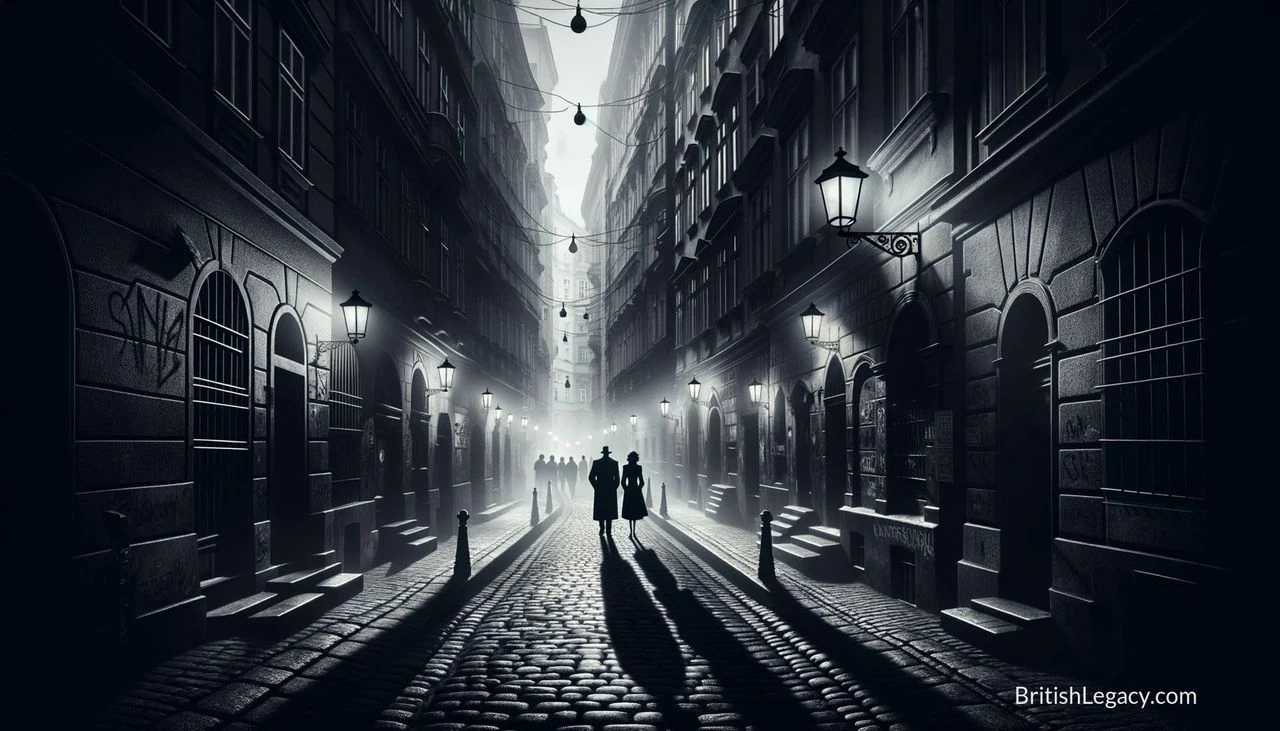
In The Third Man, the streets of post-war Vienna are not simply a backdrop. They shape a story in which every account of a death is suspect, loyalties are tested and the city’s divisions offer Harry Lime a way to disappear. Carol Reed’s 1949 film brings together Graham Greene’s screenplay, Robert Krasker’s black-and-white cinematography and Anton Karas’s distinctive zither music. The result is a British-made thriller whose setting, style and moral unease are inseparable.
A friend who has died — and a story that will not add up
Joseph Cotten plays Holly Martins, an American writer of Western novels who arrives in the British sector of Allied-occupied Vienna expecting work from his childhood friend Harry Lime. Instead, he is told that Lime has died in a road accident. At the funeral, Martins meets Major Calloway, played by Trevor Howard, and Sergeant Paine, played by Bernard Lee. Another of Lime’s associates, Kurtz, gives him an account of the accident, but the details do not settle the matter.
As Martins and Lime’s girlfriend, Anna Schmidt, investigate, the witnesses disagree about whether Lime spoke before dying and how many men carried his body. The porter at Lime’s apartment mentions a third man, then is murdered before he can tell Martins more. Calloway offers an explanation for why the truth has been concealed: Lime was stealing penicillin from military hospitals, diluting it and selling it on the black market. The treatment harmed or killed patients. Martins is prepared to leave, until he discovers that Lime may still be alive.
The film’s central relationship is not a simple contest between a hero and a villain. Martins must decide what friendship is worth when the friend he remembers has profited from other people’s suffering. Anna, played by Alida Valli, has her own precarious position: she is Czech, and her forged Austrian passport means that the authorities intend to send her to the Soviet sector. The political geography of Vienna becomes part of the personal danger facing its characters.
Vienna in slanting light
Krasker’s cinematography gives the city an unsettled visual grammar. Harsh contrasts, deep shadows and Dutch angles make streets and rooms seem unstable, while the use of ruined locations connects the story to a city still marked by war. The camera’s slant is not merely decorative: it helps create the sense that Martins has entered a world in which normal bearings no longer hold.
The production used Vienna locations for six weeks of principal photography, which ended on 11 December 1948. Filming then continued at Worton Hall Studios in Isleworth and Shepperton Studios in Surrey, and was completed in March 1949. Some sewer scenes were made on location and others on sets at Shepperton; doubles were used for much of the location work involving Orson Welles. That movement between the damaged city and British studios reflects the film’s own construction: Vienna is specific and physical, but the story’s atmosphere was assembled through careful control of image and sound.
The pursuit through the sewers provides the film’s most concentrated encounter between place and plot. Lime’s escape route runs beneath the city and towards the Soviet sector. The network gives him a temporary advantage, but the chase eventually brings Martins face to face with him beneath a street grating. The sequence closes the gap between the mystery Martins has pursued and the decision he must make.
The face in the doorway, the voice on the wheel
Welles’s Harry Lime is absent for much of the film, but that absence is part of his presence. Martins hears about Lime, follows the traces he has left and gradually realises that the supposed victim may be directing events from the shadows. Lime’s appearance in a darkened doorway, caught by a brief flash of light, gives the investigation its turning point.
Later, on the Wiener Riesenrad in the Prater amusement park, Lime looks down at the people below and reduces them to dots. His famous speech about Italy under the Borgias and Switzerland’s cuckoo clock turns the film’s moral conflict into a provocation: does political order matter if individuals can be treated as expendable? The dialogue is associated with Welles, who contributed some of the film’s best-known lines, including the cuckoo-clock passage. Greene said that the line was written into the screenplay by Welles. Whatever its origins, the speech belongs to a character whose charm makes his cruelty harder, not easier, to ignore.
Reed’s ending refuses a comfortable reconciliation. After Lime’s second funeral, Martins waits by the road to speak to Anna. She walks past without looking at him. The choice contrasts with the more hopeful ending Greene had written for the novella: Greene later said Reed was right to reject it. The final walk leaves Martins without the reward of renewed friendship or romantic consolation.
A score that stepped out of the film
Karas composed and performed the score on the zither, an instrument Reed heard in Vienna. Before the film, Karas was an unknown player in local wine gardens. Reed brought him to London, where he worked on the music with the director for six weeks. Its bright, insistent sound avoids the heavily orchestrated waltzes Reed did not want and gives the film a musical identity distinct from conventional thriller scoring.
The title composition, known as “The Third Man Theme” and also as the “Harry Lime Theme”, became a hit beyond the cinema. By November 1949, 300,000 records had been sold in Britain. In the United States, the single spent 11 weeks at number one on the Billboard Best Sellers in Stores chart in 1950. The success made Karas internationally famous. A second composer, Hubert Clifford, also contributed music under the pseudonym Michael Sarsfield.
British production, international story
The Third Man was a British-American production from London Films, directed and produced by Reed, with Alexander Korda and David O. Selznick also producing. British Lion Film Corporation distributed it in the UK; Selznick Releasing Organization handled the US. Its principal cast crossed national boundaries, including American actors Cotten and Welles, Italian actress Valli, and British actors Howard and Lee. The film’s international setting and cast do not diminish its British connection: its director, production base, studio work and British release were central to how it was made and received.
The UK premiere took place at the Ritz Cinema in Hastings on 1 September 1949. The film was the most popular title at the British box office that year. Its original British opening used Reed’s uncredited voice-over to describe Vienna from a racketeer’s point of view. The American theatrical version cut eleven minutes and replaced that narration with Cotten as Martins. Later releases restored the British version and its footage, making the contrast between the two openings part of the film’s history.
Recognition followed in Britain and abroad. At the Academy Awards, Robert Krasker won for black-and-white cinematography; Reed was nominated for directing and Oswald Hafenrichter for editing. The film won the BAFTA for Best British Film and the top prize at Cannes, listed in the awards record as the Palme d’Or. In 1999, the British Film Institute voted it the greatest British film of all time. That ranking sits alongside continuing international attention: the film appeared in every decade of the Sight and Sound greatest-films poll from 1982 to 2022.
Why The Third Man deserves a place in British Legacy
The Third Man deserves a place in British Legacy because it shows how British filmmaking could turn an international story into a work with a distinctive artistic identity. Reed’s direction, Greene’s screenplay and Krasker’s cinematography make the divided, damaged city essential to the narrative rather than a picturesque setting. The film’s British studio work, production company, distribution and popular success at home provide concrete foundations for its place in the country’s cinema history. Its awards and the BFI’s 1999 ranking further mark its standing within British film culture.
Its achievement also lies in how its parts continue to work together. The sewer pursuit gives Vienna’s political divisions a physical route; Lime’s speech on the Ferris wheel exposes the moral arithmetic behind his crimes; and Anna’s final walk denies Martins an easy resolution. Karas’s theme became a hit in its own right, carrying the film’s sound beyond the screen, while the distinct British and American versions reveal how a film could be reshaped for different audiences. The Third Man therefore offers more than a celebrated thriller: it is a precise example of British production joining international talent, a singular visual style and an enduring musical signature to tell a story about loyalty and responsibility.
Sources
The Third Man — revision 1379086784
Adapted in part from The Third Man by Wikipedia contributors, under CC BY-SA 4.0. Text has been edited and combined with the existing article; this adapted text is shared under the same licence. Contributor history.