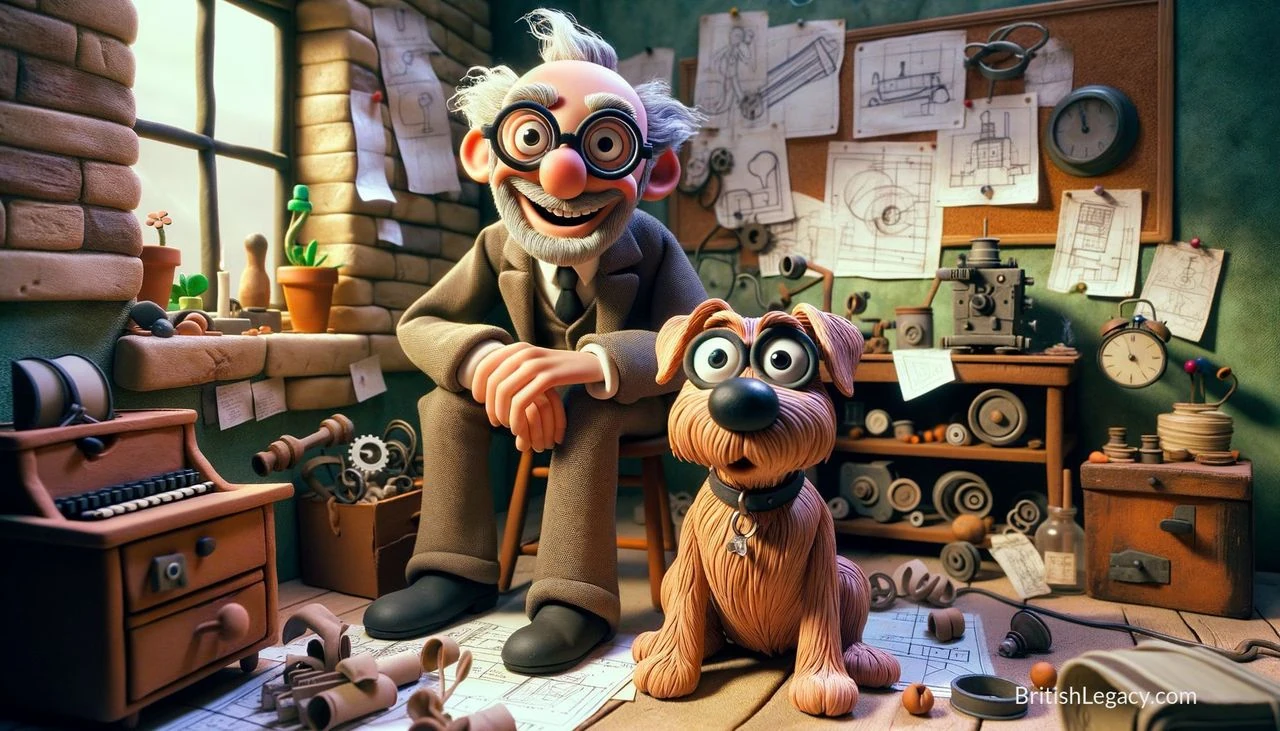
Wallace’s inventions rarely work quite as intended. His dog Gromit, who says nothing, often understands the problem first. That contrast has driven Wallace & Gromit from a student film into one of Britain’s best-known animation franchises: a comedy of improvised machinery, expressive silence and domestic adventures that have travelled well beyond their northern English setting.
A student project takes shape
Animator Nick Park created Wallace and Gromit while studying at the National Film and Television School. The first film, A Grand Day Out, was completed and released in 1989. It introduced Wallace, a cheese-loving inventor, and Gromit, his intelligent, largely silent dog. Their trip to the Moon in search of cheese established the series’ blend of ordinary appetites and improbable engineering.
Park’s childhood in Lancashire in the 1950s and 1960s informed the world of the films. The setting is not pinned down to one town, though Wigan appears in Wallace’s address and on the Anti-Pesto van in The Curse of the Were-Rabbit. The address itself is deliberately comic: its postcode does not correspond to a British street, and Wigan postcodes use different initial letters. Wallace’s accent, meanwhile, comes from the Holme Valley in West Yorkshire. These details give the fictional world a recognisable northern character without making it a documentary map.
In the first three short films, Wallace was voiced by Peter Sallis. Ben Whitehead took over after Sallis’s retirement in 2010. Gromit has no dialogue; his thoughts and reactions are carried by movement, expression and occasional dog-like sounds. The films make that silence an active part of the comedy: Gromit can register doubt, alarm or patient exasperation without a line of speech.
Making clay move
Wallace & Gromit is made using stop-motion animation. After storyboarding and building sets and plasticine models, animators adjust the characters in small increments and photograph each frame. At 24 frames per second, even a short film requires an immense number of individual images; published estimates put the filming pace at about 30 frames per animator per day. The tactile surfaces and minute changes in expression are the result of this methodical work, not an illusion produced by drawing alone.
The Wrong Trousers (1993) and A Close Shave (1995) followed the debut. Both won the Academy Award for Best Animated Short Film; A Grand Day Out had been nominated. In A Close Shave, the character Shaun appears, later becoming the centre of his own Aardman series. The first feature, Wallace & Gromit: The Curse of the Were-Rabbit, arrived in 2005 and won the Academy Award for Best Animated Feature.
Computer animation also had a supporting role in that feature. Some effects, including fire, smoke and floating rabbits, were difficult to create through stop motion alone. Specialist effects work was designed to match the film’s clay-like visual style, helping digital elements sit alongside the models and sets.
From shorts to a wider world
The series continued with the television short A Matter of Loaf and Death in 2008. It won the BAFTA for Best Short Animation and received an Academy Award nomination. In 2024, Wallace and Gromit returned in the feature-length Vengeance Most Fowl, which brought back Feathers McGraw, the penguin antagonist from The Wrong Trousers. Across the series, the films have received three Academy Awards, alongside other honours including BAFTAs and a Peabody Award.
The characters have also moved into other formats. Wallace & Gromit's Cracking Contraptions and Wallace & Gromit's World of Invention extended their television presence. Shaun the Sheep, introduced in A Close Shave, became a spin-off series in 2007, followed by television specials and feature films. The franchise has appeared in games, comics, stage productions and live shows, as well as advertisements and exhibitions.
Some of these projects brought the characters into direct contact with British public life. A Wallace and Gromit exhibition at London’s Science Museum in 2009 was designed to encourage children’s inventiveness. The duo appeared on Royal Mail Christmas stamps in 2010 and presented a BBC Proms programme in 2012. Their attraction at Blackpool Pleasure Beach, opened in 2013, turns scenes from the films into a ride. In Bristol, sculpture trails featuring Gromit and other Aardman characters have also raised money for children’s charities.
Why Wallace & Gromit deserves a place in British Legacy
Wallace & Gromit belongs in British Legacy because its achievement is both artistic and practical. Nick Park developed the characters through British animation training and Aardman’s model-based craft, then helped carry that painstaking form of storytelling from short films into features, television and other media. The results are not simply a set of celebrated characters: the series demonstrates how expressive performance can be made from tiny physical adjustments, a carefully built set and a carefully chosen pause.
Its British connection is specific. Park’s northern English influences inform a world that borrows details from Wigan and West Yorkshire while keeping its geography playfully uncertain. The films’ ingenuity is embodied in Wallace’s contraptions; their comic intelligence often lies in Gromit’s silent response. Beyond entertainment, exhibitions such as the Science Museum’s show presented the characters as a way to invite children into ideas about invention, while Bristol’s sculpture trails used their popularity to support children’s hospitals and hospices. Awards and international distribution mark the series’ reach, but its lasting value also lies in the craft, imagination and public engagement it has helped make visible. It is a distinctive contribution to British animation, made through a form of filmmaking that asks patience and precision of everyone involved.
Sources
Wallace & Gromit — Wikipedia revision 1378178548
Adapted in part from Wallace & Gromit by Wikipedia contributors, under CC BY-SA 4.0. Text has been edited and combined with the existing article; this adapted text is shared under the same licence. Contributor history.