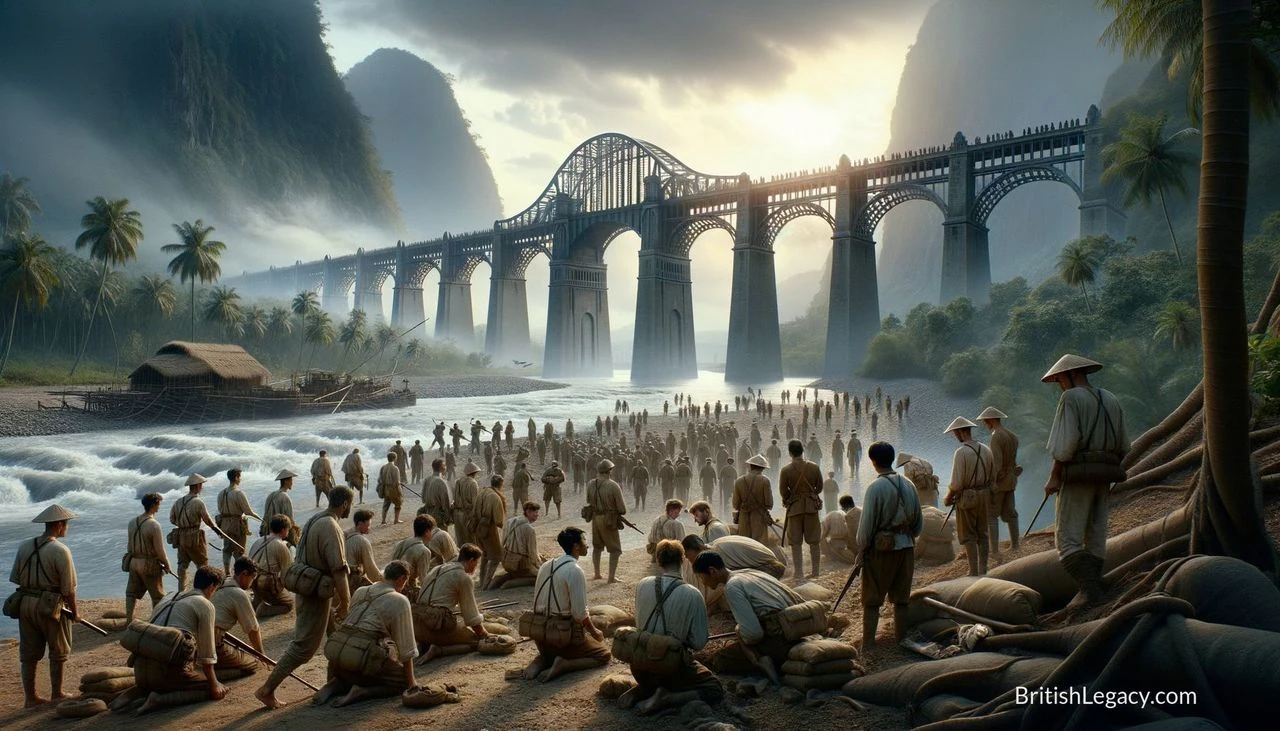
In David Lean’s The Bridge on the River Kwai, a British officer’s determination to build a bridge properly becomes inseparable from the question of whom his work serves. Released in 1957, the film follows prisoners of war compelled by their Japanese captors to labour on a railway bridge in Thailand. Its drama rests on a troubling reversal: Colonel Nicholson begins by resisting his captors, then insists on making their project a testament to British military competence.
A bridge built on a moral divide
In the film’s story, British prisoners arrive at a Japanese camp in February 1943. The camp’s commandant, Colonel Saito, orders them to build a bridge for the railway linking Thailand and Burma. Nicholson, the prisoners’ commanding officer, refuses to let his officers perform manual labour, invoking the Geneva Convention. Saito confines and punishes him, but eventually yields on that point. When Nicholson sees the poor progress on the bridge, he takes charge of the work and calls for a proper structure, convinced that it will demonstrate the superiority of the British Army.
The decision unsettles the line between resistance and collaboration. Major Clipton warns Nicholson that helping the enemy is wrong; Nicholson instead treats the bridge as a matter of discipline and professional pride. Meanwhile, American naval commander Shears escapes the camp, only to be drawn into a British commando mission to destroy the bridge. The film’s final sequence brings these conflicts together as Nicholson discovers the explosives and tries to stop the saboteurs. His last realisation—“What have I done?”—arrives as the bridge is destroyed and a train plunges into the river.
Alec Guinness plays Nicholson, opposite Sessue Hayakawa as Saito, William Holden as Shears and Jack Hawkins as Major Warden. The character drama does not offer a simple division between courage and cowardice: Nicholson’s commitment to duty is formidable, but his attachment to the bridge makes it possible for that commitment to serve the enemy. The film’s ending leaves the consequences of that confusion exposed rather than resolving them into a straightforward victory.
Making an international epic
The film was directed by Lean from a screenplay based on Pierre Boulle’s 1952 novel, The Bridge over the River Kwai. Carl Foreman began the screenplay and Michael Wilson later took over. Both writers were on the Hollywood blacklist and, while living in exile in England, had to work in secret. The screenplay’s official credit went to Boulle, who did not speak English; he received the Academy Award for Best Adapted Screenplay. In 1984, the Academy posthumously awarded the Oscar to Foreman and Wilson, and later releases credited them.
Lean’s production was an international co-production between British and American companies. The film was shot in Ceylon, now Sri Lanka, with the bridge constructed near Kitulgala. The location gave the production a striking landscape, but the drama’s physical scale depended on practical engineering as well as visual composition. Filming the bridge’s destruction required careful preparation: the planned explosion was delayed after cameraman Freddy Ford could not get clear of the blast in time, and a damaged train had to be repaired before the scene was filmed the following morning.
Malcolm Arnold wrote the score, including music associated with the film’s memorable whistled march. The prisoners enter the camp whistling the first strain of Kenneth J. Alford’s “Colonel Bogey March”; Arnold supplied a counter-melody and wrote “The River Kwai March”. The sound of the march became one of the film’s most recognisable elements, set against a story in which military routine and collective discipline carry increasingly ambiguous meanings.
Fiction and the Burma Railway
The novel and screenplay are fictional, using the construction of the Burma Railway in 1942–43 as their historical setting. The railway linked Thailand and Burma, and the bridge in the film is not a straightforward depiction of the actual bridge-building operation. The film places the camp and bridge in Thailand; the real railway bridge over the Mae Klong river was at Tha Ma Kham, near Kanchanaburi. The river was renamed Khwae Yai in the 1960s, following the film’s success.
Conditions on the railway were far worse than the film’s adventure-drama treatment suggests. Approximately 13,000 prisoners of war died during construction, alongside an estimated 80,000 to 100,000 civilian labourers. British Lieutenant Colonel Philip Toosey, the senior Allied officer at the real bridge, did not resemble Nicholson’s fictional character: he encouraged efforts to delay construction rather than treating the work as a demonstration of British skill. Ernest Gordon, a survivor of the railway and prisoner-of-war camps, objected to the film’s impression that British officers willingly built the bridge and completed it to prove their efficiency. He wrote that prisoners worked under threat and took risks to sabotage the project.
These differences matter because the film’s central conflict is not a record of what happened at the bridge. Boulle’s fictional Nicholson was, he said, an amalgam shaped by memories of collaborating French officers. The film’s invented plot can sustain a powerful argument about obsession and obedience, but it should not be mistaken for an account of the prisoners’ actual conduct or the full scale of forced labour and loss.
Reception and recognition
The Bridge on the River Kwai was a major commercial and critical success. It was the highest-grossing film of 1957 in the United States and Canada and the most popular film at the British box office that year. At the 30th Academy Awards it won seven Oscars, including Best Picture, Best Director for Lean and Best Actor for Guinness. The adapted-screenplay award was initially credited to Boulle before the Academy’s later recognition of Foreman and Wilson.
The film also won British Academy Film Awards for Best Film and Best British Film, among other honours. Its standing has endured in British film culture: in 1999, the British Film Institute placed it eleventh in its list of the greatest British films of the twentieth century. It was also selected for preservation in the United States National Film Registry in 1997. The film’s British connection is therefore present both in its British director and performers and in the institutional recognition it received as a British film, despite its international production and its setting and location shooting overseas.
Why The Bridge on the River Kwai deserves a place in British Legacy
The Bridge on the River Kwai belongs in British Legacy not because its fictional prisoners stand in for every British wartime experience, but because the film became a defining work of British cinema. David Lean’s direction, Alec Guinness’s performance and the controlled scale of the production helped make a morally unsettled story into an international success. Its seven Academy Awards, British Academy recognition and eleventh place in the British Film Institute’s 1999 ranking record a substantial achievement in film-making and a lasting place in the country’s cultural history.
Its legacy also depends on reading the film with care. The bridge story asks how honour and professional pride can be distorted when they lose sight of whom they serve. That question gives the film continuing dramatic force, while the gap between its fiction and the history of the Burma Railway calls attention to the prisoners and civilian labourers whose experiences were harsher than the screen narrative suggests. The film can therefore be valued as a work of British cinema without being treated as a documentary account. Its combination of craft, reach and unresolved moral tension makes it a distinctive part of Britain’s film heritage—and its historical distance from the events it evokes is essential to understanding that heritage honestly.
Sources
Adapted in part from The Bridge on the River Kwai by Wikipedia contributors, under CC BY-SA 4.0. Text has been edited and combined with the existing article; this adapted text is shared under the same licence. Contributor history.