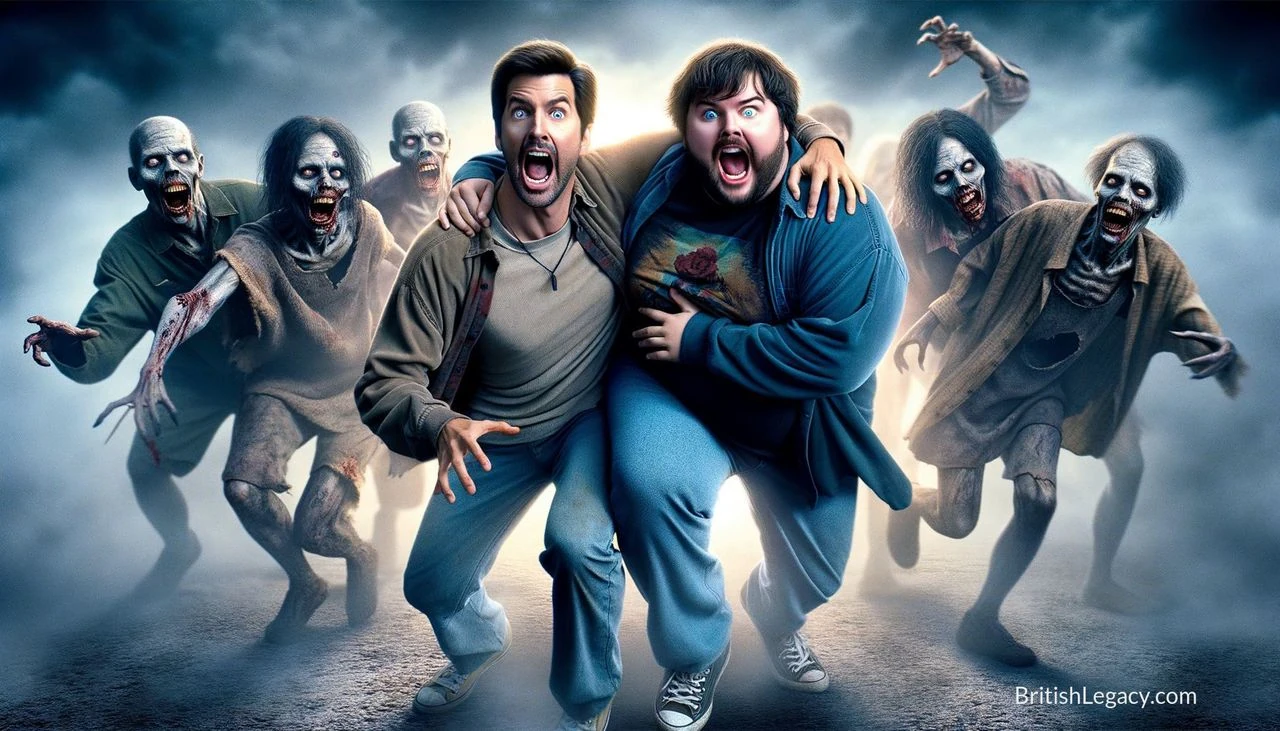
Shaun of the Dead begins with a man so absorbed in his routine that he fails to notice London falling apart around him. That joke also sets the film’s method: ordinary streets, strained relationships and the familiar business of getting to the pub become the setting for a zombie horror story. Directed by Edgar Wright and written by Wright and Simon Pegg, the 2004 British film makes comedy and danger work together rather than treating one as a break from the other.
A crisis Shaun is slow to notice
Simon Pegg plays Shaun, a 29-year-old sales adviser in London whose life is going nowhere quickly. He is at odds with his colleagues, has disappointed his girlfriend Liz, and relies heavily on his best friend and flatmate Ed, played by Nick Frost. At home, their other flatmate Pete complains about the pair’s behaviour. Shaun’s mother, Barbara, and stepfather, Philip, are part of the family tensions he will have to face as the crisis unfolds.
When a zombie outbreak overwhelms the city, Shaun and Ed are among the last to understand what is happening. They eventually set out to collect Barbara and Liz and take refuge at their favourite pub, the Winchester. Their plan brings together friends and relatives with competing loyalties and anxieties. The Winchester offers no simple sanctuary: the group’s arguments, mistakes and efforts to keep one another safe become as important as the zombies outside.
The film lets the relationships carry real weight beneath the gags. Shaun’s troubled relationship with Liz, his unease around Philip and the bond between Shaun and Ed all shape the decisions they make. The outbreak gives Shaun a chance to act decisively, but it does not make him an instantly capable hero. Comedy comes from the clash between the scale of the emergency and the characters’ familiar habits, and from the way personal resentments persist even when survival is at stake.
From Spaced to a feature film
The film grew from ideas Wright and Pegg had explored in their television sitcom Spaced. Its episode “Art” includes Pegg’s character hallucinating a zombie invasion after playing the video game Resident Evil 2. Wright and Pegg shared an enthusiasm for George A. Romero’s zombie films and went on to develop their own story. They wrote the screenplay in eight weeks, drawing on zombie films including Night of the Living Dead and Dawn of the Dead, as well as comedies and other films such as Raising Arizona and Back to the Future.
Getting the film made took longer. Film4 initially took on the project, but its production budget was cut. Working Title Films later picked it up, and the production was announced at the 2002 Cannes Film Festival. Wright and Pegg’s idea depended on a particular point of view: not seasoned action heroes, but two men who might be the last to recognise that a catastrophe was under way. Wright also drew on the dazed feeling of an early-morning walk to the shop. That mundane errand became part of the film’s opening movement, where familiar routine and the signs of disaster sit uncomfortably close together.
Principal photography took place in London and at Ealing Studios in 2003. The production lasted nine weeks, from May to July. Locations in north London—including Crouch End, where the story is set, as well as Highgate, Finsbury Park and East Finchley—give the crisis a recognisable urban geography. The pub used for the Winchester scenes was the Duke of Albany in New Cross, south London; the building later closed and was converted into flats. The film’s setting is not an abstract apocalypse: it is a network of shops, streets and pubs that its characters already know.
Precision, performance and the music
Wright’s brisk editing and visual repetition make small details do more than one job. A movement or line can return with a changed meaning, while the film’s quick transitions keep the story moving from everyday business to sudden violence. This precision is part of the comedy, but it also helps the horror land: the characters’ environment feels ordinary until it does not. The film draws on Romero’s zombie tradition without relying on the familiar image of highly prepared, heavily armed survivors. Shaun and Ed meet the emergency with the limited means and muddled judgement of the people they were before it began.
Pegg’s performance holds together Shaun’s slackness, anxiety and growing determination. Frost’s Ed is his foil: carefree and loyal, but not always helpful when the situation demands attention. Their on-screen partnership gives the film a domestic, conversational centre even as the scale of the danger grows. The ensemble includes Kate Ashfield as Liz, Lucy Davis as Dianne, Dylan Moran as David, Bill Nighy as Philip and Penelope Wilton as Barbara. Rather than making the story solely a two-man comic routine, the cast gives the group’s conflicting ties and decisions room to matter.
The music helps turn set pieces into carefully timed sequences. Pete Woodhead and Daniel Mudford composed a score that draws on Italian zombie-film soundtracks. In one of the film’s best-known scenes, Queen’s “Don’t Stop Me Now” plays from the pub jukebox while Shaun, Ed and Liz fight a zombie with pool cues. Wright wanted the song’s upbeat energy to collide with the violence on screen; Pegg has said the scene was choreographed to the track before its use had been cleared. The result is a joke built not only on the choice of song, but on timing, movement and the characters’ urgent need to keep quiet.
Release, reception and afterlife
Shaun of the Dead premiered in London on 29 March 2004 and opened in UK cinemas on 9 April. It was released in the United States later that year. Its UK campaign made the film’s premise part of the advertising: actors dressed as zombies appeared around London, and posters in Underground tunnels used the image of passengers crowded among the undead. Those choices extended the film’s blend of the everyday and the alarming beyond the cinema screen.
The film earned about $38.7 million worldwide on a reported budget of $6 million and received three nominations at the British Academy Film Awards. Its screenplay won at the British Independent Film Awards, and the film won the Empire Award for Best British Film and the Saturn Award for Best Horror Film. These honours reflect more than its ability to make a zombie attack funny. Reviewers also noted the characterisation and emotional depth beneath the comedy, while the film’s mixed genre gave it ways to appeal to audiences interested in horror, romance and comedy.
Its critical reputation has endured: Rotten Tomatoes’ listed reviews are predominantly positive, and the film has appeared in best-of lists for comedy, horror and British cinema. It also became the first instalment in Wright and Pegg’s Three Flavours Cornetto trilogy, followed by Hot Fuzz and The World’s End. The Cornetto link is a recurring joke across the films, not a shared story. Shaun of the Dead also expanded beyond the screen through a tie-in strip in the British comic 2000 AD and later comic adaptations. Its reception and afterlife suggest that the film’s distinctive combination of genre craft and recognisable social awkwardness has continued to travel.
Why Shaun of the Dead deserves a place in British Legacy
Shaun of the Dead deserves a place in British Legacy because it takes its British setting seriously without turning it into a checklist of national symbols. The film’s London is made from ordinary streets, shops and pubs, and its comedy grows from the habits and relationships of people who live there. Its central contrast—an immense emergency met by characters whose attention is still caught by work, friendship, family and the local—makes the horror both funny and human. The local details are not decoration: they shape how the characters move through the crisis and how the audience understands its scale.
The film also demonstrates how British television comedy and film-making can feed into an original feature. Wright and Pegg developed ideas in Spaced, built them into a screenplay influenced by international genre cinema, and made a film that could appeal to horror fans and comedy audiences at once. Its London production, British cast and recognition through awards including Best British Film at the Empire Awards give that achievement a clear connection to British screen culture. The film’s enduring reputation, further adaptations and place within the Cornetto trilogy show the reach of the work; its more lasting accomplishment is the craft behind it. Editing, performance, music and location all serve the same precise comic-horror design. That combination made a distinctly situated British story legible to audiences well beyond Britain, without sanding away the particularity that gives it life.
Sources
Shaun of the Dead — Wikipedia revision
Adapted in part from Shaun of the Dead by Wikipedia contributors, under CC BY-SA 4.0. Text has been edited and combined with the existing article; this adapted text is shared under the same licence. Contributor history.