The Imitation Game turns the work of wartime codebreakers into a tense story of ingenuity, secrecy and injustice. Directed by Morten Tyldum and written by Graham Moore, the 2014 film stars Benedict Cumberbatch as mathematician Alan Turing, whose work at Bletchley Park helped Britain decipher German wartime messages. Its international success carried a British subject into cinemas around the world. Its liberties with the historical record also made the film a prominent example of the challenge involved in adapting a complicated life for popular drama.
A codebreaking story shaped for the screen
Based on Andrew Hodges’s biography Alan Turing: The Enigma, the film brings together three periods of Turing’s life: his school years, his wartime work and the police investigation that followed a 1951 burglary at his home. In its wartime story, Turing designs a machine to decipher Enigma and works with fellow cryptographers, including Joan Clarke, played by Keira Knightley. Matthew Goode, Rory Kinnear, Charles Dance and Mark Strong also appear in the ensemble.
The film gives its machine the name Christopher, after Turing’s school friend, and frames codebreaking as a struggle led by an isolated genius. In the historical account, the British Bombe was a collaborative project, partly inspired by work by Polish cryptanalyst Marian Rejewski. Turing designed a new machine in 1940 with a major contribution from mathematician Gordon Welchman. More than 200 Bombes were built under the supervision of engineer Harold Keen; the film’s suggestion that Turing’s team built a single machine at Bletchley Park is not an accurate account of their construction.
Nor did British work on Enigma begin with a sudden breakthrough by a small team. Polish cryptanalysts had been breaking German Enigma messages before the war and shared their work with British and French allies in 1939. At Bletchley Park, large numbers of people worked on the problem, with advances and setbacks as German systems changed. The film’s emphasis on Enigma also leaves out the breaking of the Lorenz cipher, known as Tunny, and the work of contributors including W. T. Tutte and Tommy Flowers.
Performances, craft and a worldwide release
Cumberbatch’s portrayal of Turing was widely acclaimed and earned him an Academy Award nomination for Best Actor. Knightley was also nominated for major acting awards. The film received eight Academy Award nominations and won for Moore’s adapted screenplay. It was nominated for nine BAFTAs and won Best Adapted Screenplay there as well. Alexandre Desplat composed the score, recorded by the London Symphony Orchestra at Abbey Road Studios in London.
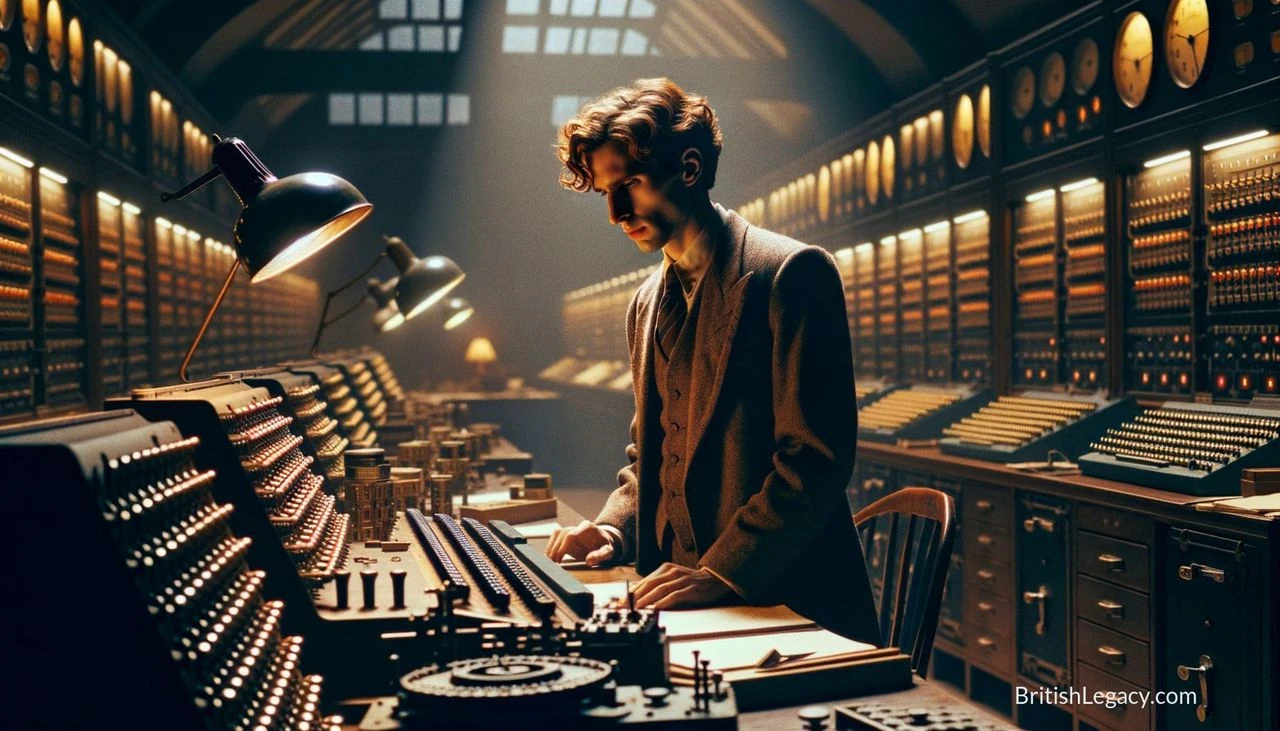
Filming took place in Britain, including at Bletchley Park, Turing’s former school, Sherborne, and locations in London, Oxfordshire and Buckinghamshire. The production’s bombe was based on a replica housed at Bletchley Park, though the film’s designers made it larger and exposed more of its workings for the camera. Such choices show the difference between historical reconstruction and dramatic design: a recognisable setting can evoke the past without making every detail documentary evidence.
The film premiered at the Telluride Film Festival in August 2014 and opened the BFI London Film Festival in October. Its British theatrical release preceded its US release. With a reported production budget of $14 million, it grossed about $233.5 million worldwide and became the top-grossing independent film release of 2014. Its success was therefore not confined to awards attention: a story rooted in British wartime history reached a large international audience.
Drama and the historical record
The film’s emotional structure depends on conflicts that make an intricate subject legible as a thriller. But several of its most memorable plot devices are inventions. Turing did not recruit Clarke through a newspaper crossword; her former academic supervisor, Gordon Welchman, recruited her to the Government Code and Cypher School. Puzzles were used in recruitment at Bletchley Park, but not in the way the film depicts. The film also invents or reshapes encounters among Turing, intelligence officer Stewart Menzies and Soviet spy John Cairncross; there is no evidence that Turing and Cairncross met.
The convoy episode, in which the team chooses not to act on a decoded message because a colleague’s brother is at risk, is likewise not a reliable record of how decisions about Ultra intelligence were made. The film’s portrayal of Turing as socially isolated and difficult to work with has also been criticised as a distortion of accounts of his personality and working relationships. These departures matter because a drama that draws its force from real persecution and scientific achievement can leave audiences with mistaken impressions about both.
The film does, however, place Turing’s treatment by the state within its story. In 1952 he was convicted of gross indecency and underwent chemical castration rather than imprisonment. The film depicts his death in 1954 as suicide after hormone treatment, but the circumstances remain disputed: the inquest ruled suicide, while some later discussion has raised the possibility of an accident. Queen Elizabeth II granted Turing a posthumous Royal Pardon in 2013. That pardon is part of the historical context, not a resolution of the wider injustice experienced by men prosecuted under laws against homosexual acts.
Why The Imitation Game deserves a place in British Legacy
The Imitation Game deserves a place in British Legacy not because it is a definitive account of Bletchley Park, but because it made a British wartime story visible to a broad cinema audience. Its locations include the actual codebreaking site, and its central figure is a British mathematician whose contribution to wartime cryptanalysis and the history of computing has enduring significance. The film’s commercial reach, award recognition and British release gave audiences a route into a history long kept secret. It also brought the injustice of Turing’s prosecution into the same public narrative as his intellectual work.
That reach brings responsibility. The film’s version of events compresses collective work into a lone-genius plot, overlooks the Polish contribution to Enigma cryptanalysis and omits important work on other German ciphers. Remembering the film alongside those limitations gives its legacy more substance than unqualified celebration would. It can prompt viewers to distinguish a compelling scene from a documented event, and to ask whose labour a familiar story leaves out. The result is a distinctly useful British legacy: not a claim that a film has settled history, but recognition that popular cinema can revive attention to British people and places while making the accuracy of their representation a matter for public discussion.
Sources
The Imitation Game — revision 1379058000 · The Imitation Game
Adapted in part from The Imitation Game by Wikipedia contributors, under CC BY-SA 4.0. Text has been edited and combined with the existing article; this adapted text is shared under the same licence. Contributor history.