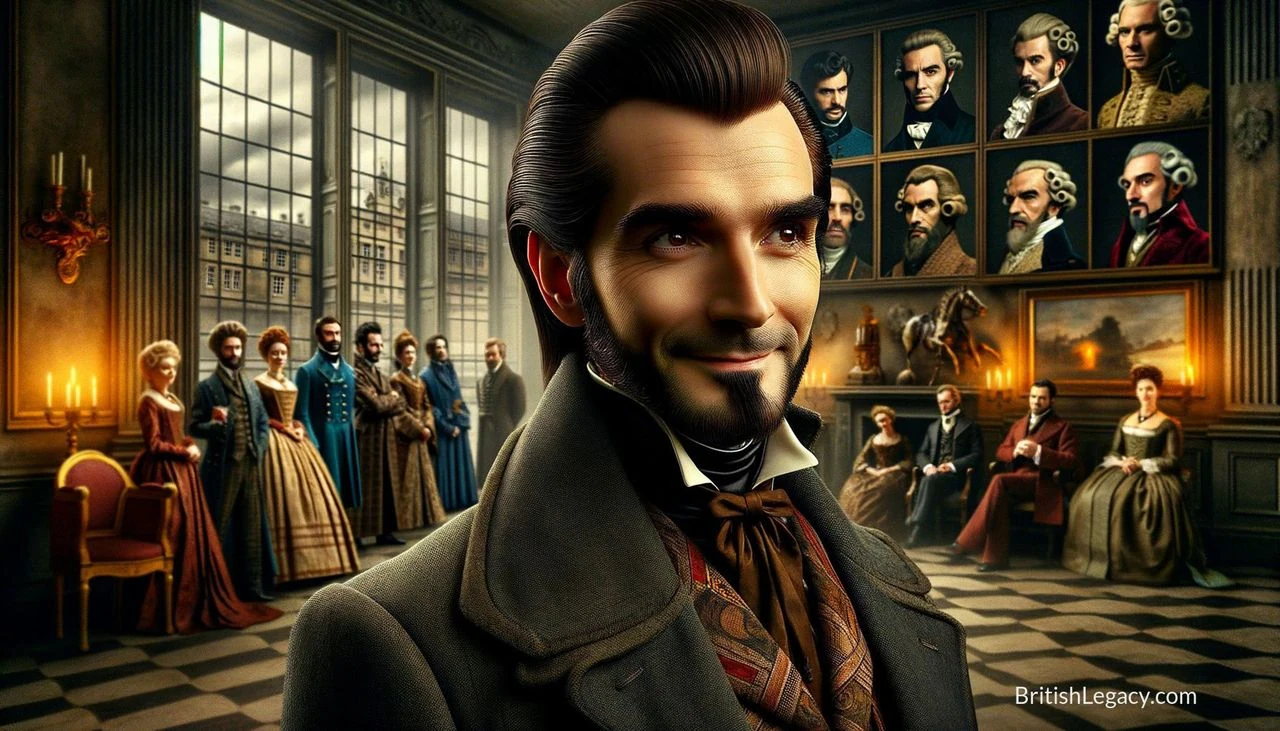
Edmund Blackadder’s fortunes change with every century. He begins as a bumbling prince in a made-up medieval succession, becomes a sharper courtier under Elizabeth I, serves a foolish Prince Regent and, in the First World War, tries to avoid being sent over the top. Across four BBC sitcom series, Rowan Atkinson’s character gives Blackadder a comic thread through very different periods of British history. The settings are deliberately distorted, but the changing relationships between Blackadder and his servant Baldrick make each era part of a distinctive television comedy.
A medieval beginning and a sharper second series
The first series, The Black Adder, was broadcast on BBC1 in 1983. Its alternative history is set in 1485, after a fictional version of the Battle of Bosworth: Richard III is killed after being mistaken for someone else, and Richard IV succeeds him. Atkinson plays Prince Edmund, Duke of Edinburgh, who calls himself the Black Adder and tries to improve his standing with his father. The series gives Edmund little of the intelligence that would define him later. Here, Baldrick, played by Tony Robinson, is the more capable of the pair.
The production was ambitious, using location filming, large casts, horses and elaborate medieval-style costumes. Its expense and reception prompted a long gap before the next series. For Blackadder II, broadcast in 1986, the setting moved to the court of Elizabeth I, and the production changed substantially. The series was made in the studio, with a live audience at recording, and Ben Elton joined Richard Curtis as co-writer. The revised character dynamic became the pattern for what followed: Edmund is now a calculating, witty courtier, while Baldrick is his dim-witted servant.
Miranda Richardson plays Queen Elizabeth I, known in the series as Queenie, and Stephen Fry is Lord Melchett, her obsequious adviser and Blackadder’s rival for her attention. Tim McInnerny returns as Lord Percy Percy. The court is no attempt at documentary history: its costumes, characters and situations serve comic invention. The series instead uses the distance of a historical setting to make ambition, flattery and social rank its targets.
Regency service and a First World War reckoning
Blackadder the Third, broadcast in 1987, places Edmund in the Regency period. Atkinson’s Blackadder is now a butler to George, the Prince Regent, played by Hugh Laurie as a foolish aristocrat. Although Blackadder is more intelligent than his master, he remains dependent on him for money and status. Laurie’s George and Robinson’s Baldrick give him two very different problems to manage: one above him in rank, the other below him in wit. The episode titles also play on Jane Austen’s novels, including Sense and Sensibility and Pride and Prejudice.
The fourth series, Blackadder Goes Forth, moves to the Western Front in 1917. Captain Edmund Blackadder’s stated aim is to stay alive; his attempts to avoid the next offensive repeatedly bring him back to the trenches. Baldrick serves as his batman, while Laurie’s Lieutenant George is an idealistic counterpoint. Fry’s General Melchett directs events from a château well behind the front, assisted by McInnerny’s Captain Kevin Darling, a staff officer and Blackadder’s antagonist.
The humour is darker here. Trench privations sit beside the officers’ distance from the fighting and their wasteful plans for the men under their command. In the final episode, “Goodbyeee”, Blackadder, Baldrick, George and Darling go over the top into fog and smoke. The series ends without turning the characters’ danger into a last joke; its shift from farce to silence gives the comedy its most affecting close.
Writers, performers and the shape of the series
Richard Curtis and Rowan Atkinson wrote the first series; Curtis and Elton wrote the second, third and fourth. John Lloyd produced all four. The changed writing partnership coincided with a major change in the central character: the weak, less intelligent Edmund of the first series gives way to the resourceful schemer viewers encounter thereafter. The supporting cast helps make each new historical world recognisable without simply repeating the same roles. Robinson is the constant as Baldrick, while performers including Fry, Laurie, Richardson and McInnerny return in different parts across the series.
The show’s reach also rests on its one-off stories. Blackadder: The Cavalier Years, made for Comic Relief’s Red Nose Day in 1988, is set during the English Civil War. Blackadder’s Christmas Carol, broadcast later that year, turns the familiar Dickens story on its head: its kindly Ebenezer Blackadder is shown the advantages his ancestors gained by being wicked. The 1999 millennium production, Blackadder: Back & Forth, sends a modern Blackadder and Baldrick through time after a supposed time machine unexpectedly works. These specials extend the series’ central comic device—the collision between self-interest and circumstance—beyond the four regular periods.
The show’s standing has been recognised in British television polls and rankings. In 2000, Blackadder Goes Forth placed sixteenth in the British Film Institute’s list of the 100 Greatest British Television Programmes. A 2004 BBC poll named Blackadder the second-best British sitcom. The series’ afterlife has included later performances and sketches, as well as continued discussion of a possible fifth series; proposed settings and ideas have not amounted to a new regular series.
Why Blackadder deserves a place in British Legacy
Blackadder deserves a place in British Legacy because it made a distinctive form of British television comedy out of the country’s past without pretending to offer a faithful chronicle. Each series uses a different period to test the same tensions: who holds authority, who must serve them, and how far a clever person can get by manipulating the rules. The first series’ fictional Richard IV and alternative account of succession make its licence plain; later settings similarly provide a comic frame rather than a lesson in exact history. That freedom lets the series satirise power and status while inviting viewers to recognise the distance between grand claims and ordinary self-interest.
Its achievements are also specific to television craft. The shift from the costly, location-heavy first series to a studio-based second series accompanied a reshaping of the central partnership and helped establish the format that carried through the later eras. Atkinson’s changing Blackadder, Robinson’s constant Baldrick and a returning ensemble made each new setting feel connected without making the characters static. In Blackadder Goes Forth, the established comic voice could confront the waste of trench warfare and end in a moment of genuine gravity. The BFI ranking and BBC sitcom poll record the series’ place in British television culture; its continuing value lies in combining formal invention, memorable performance and satire that can make history funny without making its human costs trivial.
Sources
Blackadder — Wikipedia, revision 1378913047
Adapted in part from Blackadder by Wikipedia contributors, under CC BY-SA 4.0. Text has been edited and combined with the existing article; this adapted text is shared under the same licence. Contributor history.