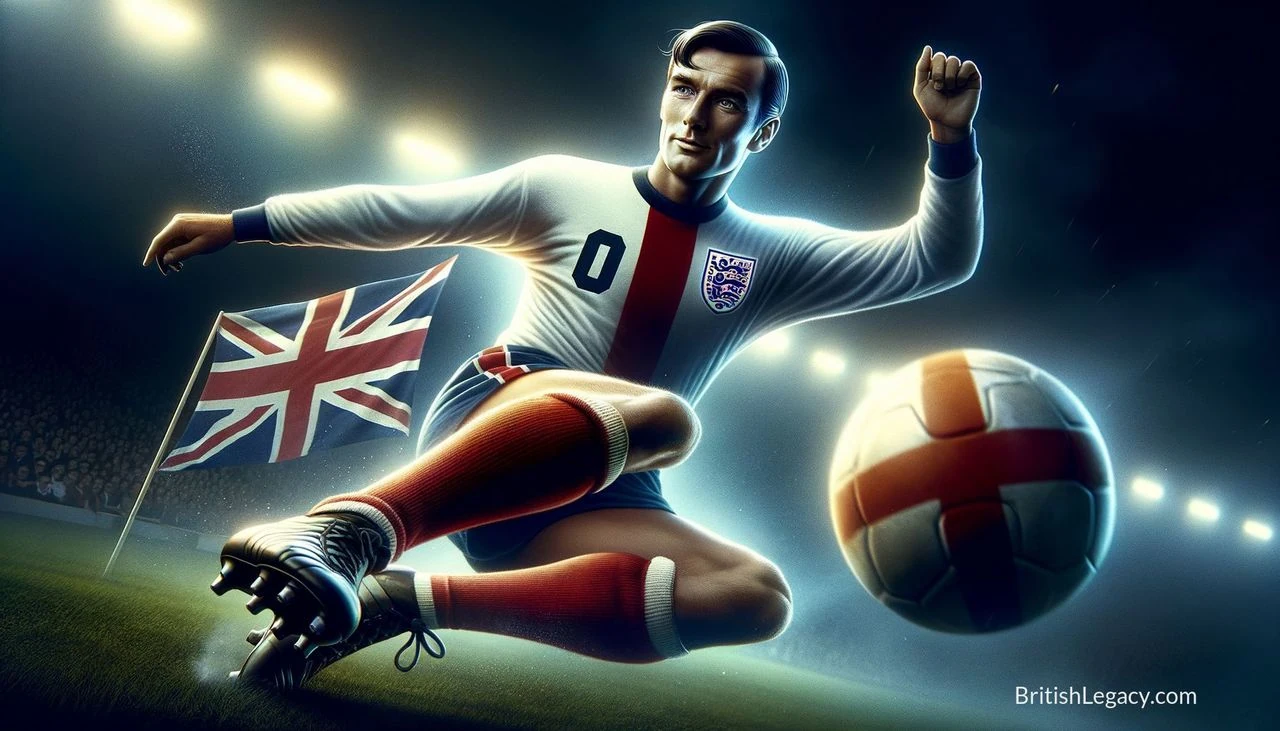
Sir Bobby Charlton’s career was shaped by two defining moments: his survival of the 1958 Munich air disaster and his two goals in Manchester United’s 1968 European Cup final. Between them lay a rebuilding club, an England team that won the World Cup on home soil and a player whose long-range shooting and attacking play made him one of the era’s leading footballers. Born in Ashington, Northumberland, Charlton spent most of his playing career at Old Trafford, but his achievements reached well beyond his club.
From Ashington to Manchester United
Robert Charlton was born in Ashington on 11 October 1937. Football ran through his mother Cissie’s family: her relatives included several professional players, among them Newcastle United and England footballer Jackie Milburn. Charlton later credited his mother and his grandfather Tanner with much of his early development. His elder brother Jack also became a professional footballer, going on to play for Leeds United.
Manchester United scout Joe Armstrong spotted Charlton playing for East Northumberland Schools in February 1953. He signed amateur forms for the club at 15, the same day as Wilf McGuinness. His mother was wary of the uncertainty of a football career, and Charlton began an apprenticeship as an electrical engineer before turning professional in October 1954. He progressed through the club’s youth and reserve teams, part of the group known as the Busby Babes.
Charlton made his first-team debut against Charlton Athletic in October 1956, scoring twice in a 4–2 win. He was 18 and, while beginning his professional career, also completed National Service with the Royal Army Ordnance Corps in Shrewsbury. Manchester United manager Matt Busby had advised him to apply there so that he could continue playing for the club at weekends. United won the league championship in Charlton’s first season, and he became a regular in a side that was beginning to establish itself in European competition.
Munich and the work of rebuilding
On 6 February 1958, Manchester United’s aircraft crashed at Munich during its return from a European Cup tie in Belgrade. Charlton survived with cuts to his head and severe shock. He had been thrown from the aircraft in his seat; goalkeeper Harry Gregg found him and pulled him away from the wreckage. Eight United players died as a result of the crash, part of a total death toll of 23.
Charlton returned to England after a week in hospital and resumed playing within weeks. United reached the FA Cup final that season, although Bolton Wanderers won it 2–0. The team’s recovery was gradual. Charlton was part of the side that won the FA Cup in 1963, beating Leicester City 3–1, and then the league title in 1965 and 1967. His role developed from that of a winger towards attacking midfield, where his passing, stamina and powerful shooting with either foot helped him contribute both goals and creative play.
Manchester United’s European Cup campaign brought the post-Munich story to a defining point. In the 1968 final at Wembley, Charlton captained the team against Benfica and scored twice in a 4–1 win after extra time. United became the first English club to win the competition. Charlton had scored 249 goals in 758 appearances for the club by the time he left at the end of the 1972–73 season; his appearance record stood until Ryan Giggs surpassed it in 2008, and Wayne Rooney later passed his goals record.
England’s 1966 team
Charlton’s England debut came in April 1958, just over two months after the Munich crash. He scored in a 4–0 win over Scotland at Hampden Park. He was selected for the 1958 World Cup squad but did not play; he later appeared at the 1962, 1966 and 1970 tournaments as well. Under manager Alf Ramsey, his role developed into that of an attacking midfielder around whom England’s play could be built.
At the 1966 World Cup in England, Charlton scored against Mexico in the group stage and twice in the semi-final against Portugal. England then beat West Germany 4–2 after extra time in the final at Wembley. Charlton’s contribution to the winning side was recognised with the Ballon d’Or, which he won that year. He also finished second in the award voting in 1967 and 1968.
Charlton appeared at the 1970 World Cup in Mexico, his fourth World Cup squad. England were knocked out by West Germany in the quarter-final. He ended his international career that year with 106 caps and 49 goals. At the time, he was England’s most-capped player and its record goalscorer; both records were later surpassed. His international record remains an important measure of the length and consistency of his contribution to England across several tournaments.
Management, Manchester United and public service
After leaving United, Charlton became manager of Preston North End in 1973 and brought his former United and England teammate Nobby Stiles in as player-coach. Preston were relegated in Charlton’s first season. He returned to playing, becoming player-manager, but left during the following season after a disagreement with the board over the proposed transfer of John Bird. He later made a small number of appearances for Waterford United and Australian clubs, and was briefly caretaker manager of Wigan Athletic in 1983.
Charlton joined Wigan as a director and became a member of Manchester United’s board in 1984. He remained closely associated with the club after his playing career, while also working as a football pundit and running soccer schools in several countries. He supported bids to bring major sporting events to Manchester and the United Kingdom, including Manchester’s bids for the Olympic Games and Commonwealth Games, England’s bid for the 2006 World Cup and London’s successful 2012 Olympic bid.
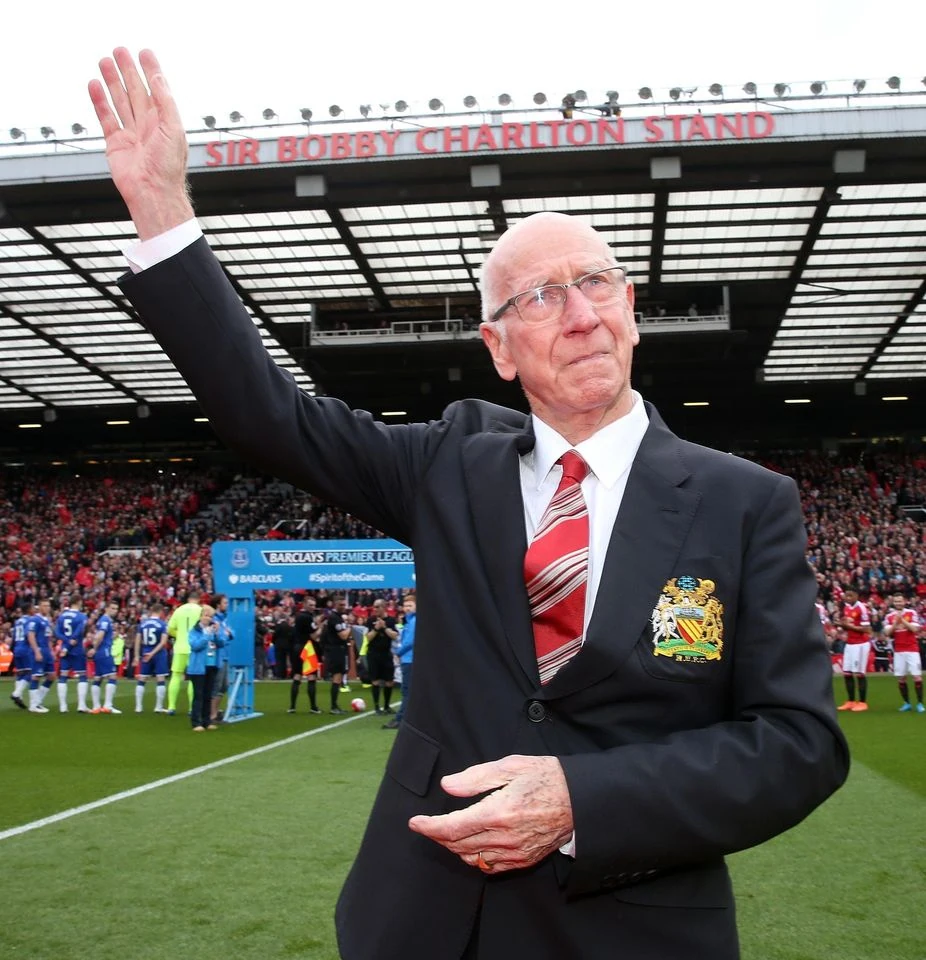
His public honours included appointment as an Officer of the Order of the British Empire in 1969, a Commander of the Order of the British Empire in 1974 and a knighthood in 1994. He became an inaugural inductee of the English Football Hall of Fame in 2002 and received the BBC Sports Personality of the Year Lifetime Achievement Award in 2008. Manchester named the South Stand at Old Trafford in his honour in 2016.
Charlton also supported charitable work, including fundraising for cancer hospitals. After visiting Bosnia and Cambodia, he became involved in landmine clearance and founded the Sir Bobby Charlton Foundation, formerly called Find a Better Way, to fund research into improved civilian landmine clearance. This work connected his public profile to a cause beyond football.
Later years and remembrance
Charlton married Norma Ball in 1961; they had two daughters. In 2020, it was announced that he had been diagnosed with dementia and he withdrew from public life. He died in Macclesfield, Cheshire, on 21 October 2023, aged 86. At the subsequent inquest, the coroner recorded the cause of death as trauma in the lungs, a fall and dementia.
Manchester United marked his death at Old Trafford with a minute’s silence, tributes in the match programme and a wreath in the director’s box. His funeral took place in November 2023, with a procession passing Old Trafford before the service at Manchester Cathedral. The tributes reflected the place he held in the club’s history and his long association with the city.
Why Bobby Charlton deserves a place in British Legacy
Bobby Charlton’s place in British sporting history rests on achievements that were significant both for their scale and for their context. He was a central figure in England’s 1966 World Cup-winning side, scoring twice in the semi-final before the team won the final at Wembley. At Manchester United, he helped the club rebuild after the Munich air disaster and later captained the side to its first European Cup, scoring two goals in the final. These were not isolated moments: his 106 England caps and long career at United show the sustained contribution behind them.
His legacy also links football to public life. Charlton supported efforts to bring major sporting events to British cities, helped promote youth football through soccer schools, and used his profile in charitable work, including support for research into civilian landmine clearance. The honours he received—from the OBE and CBE to his 1994 knighthood—recognised services to football over many years. Remembering him in British Legacy means recording more than trophies: it means recognising a Northumberland-born player whose work helped shape Manchester United’s recovery and whose performances became part of England’s most celebrated football achievement.
Sources
Bobby Charlton — Wikipedia revision 1379310352 · Bobby Charlton — Wikipedia
Adapted in part from Bobby Charlton by Wikipedia contributors, under CC BY-SA 4.0. Text has been edited and combined with the existing article; this adapted text is shared under the same licence. Contributor history.