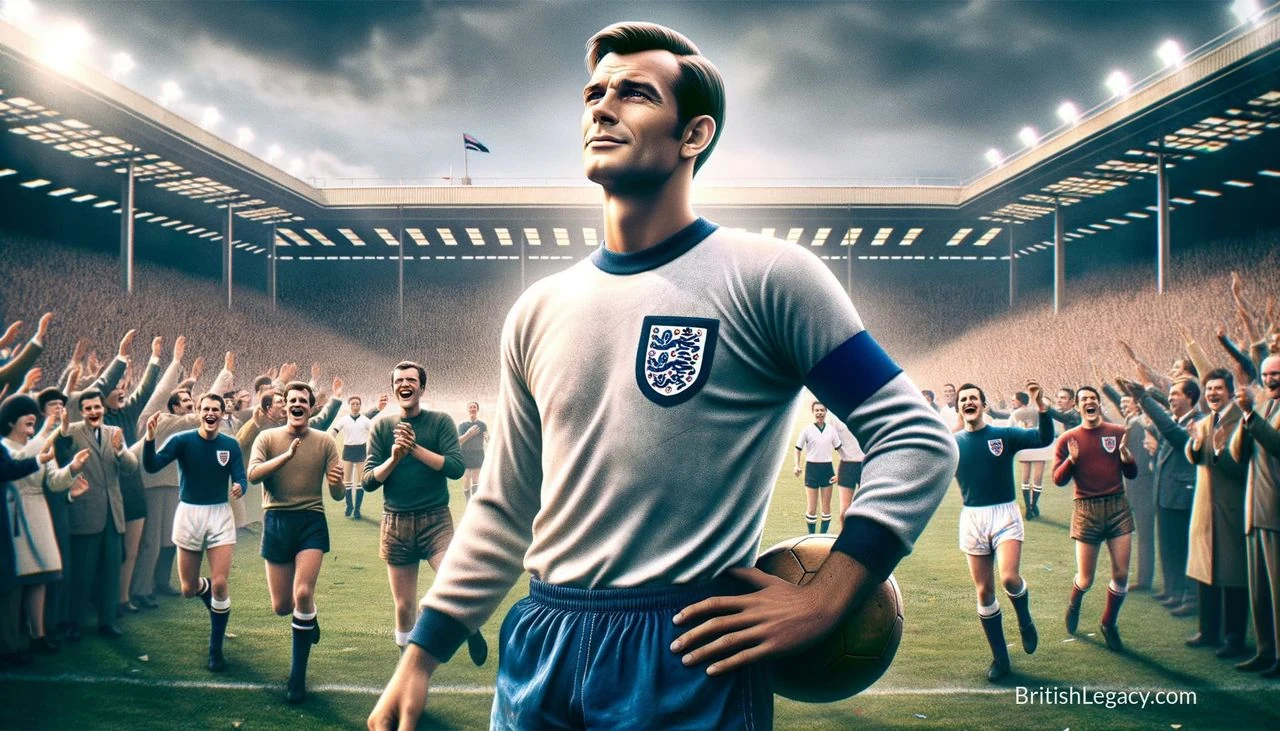
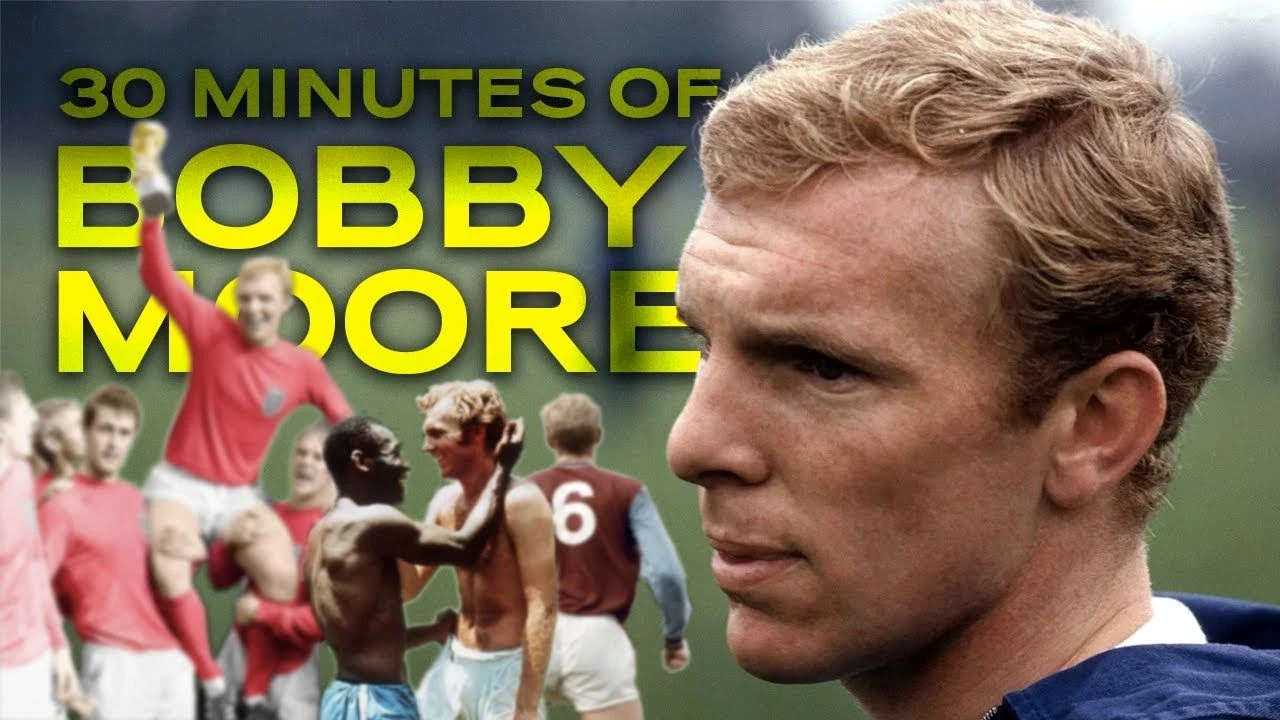
Bobby Moore’s place in English football rests on more than the photograph of him lifting the World Cup at Wembley in 1966. He was a composed defender whose reading of the game helped define his style, West Ham captain for more than a decade and England captain from the age of 22. His career carried him from Barking to the international stage, then through clubs and coaching roles in several countries. The lasting public reminders are tangible: a retired West Ham shirt number, a statue outside Wembley and a charity bearing his name.
From Barking to West Ham
Robert Frederick Chelsea Moore was born in Barking, Essex, on 12 April 1941. He attended Westbury Primary School and Tom Hood School, where he played football. In 1956 he joined West Ham United’s youth set-up. He made his first-team debut against Manchester United on 8 September 1958, aged 17, and went on to spend 16 years with the club.
Moore became known not for imposing physical play but for anticipating danger. He read opponents’ movements, organised those around him and timed his tackles. That calmness and judgement distinguished him as a central defender. He captained West Ham for more than ten years, making 544 league appearances for the club according to the career figures in the biographical account. Across competitions, he played more than 600 games for West Ham.
His first major Wembley success came in 1964, when West Ham beat Preston North End 3–2 in the FA Cup final. The following year, the club won the European Cup Winners’ Cup, defeating 1860 Munich 2–0. Moore was named Football Writers’ Association Footballer of the Year in 1964. His achievements at West Ham formed the foundation of a career that became closely identified with England’s national team.
England captain and the 1966 final
Moore made his England debut against Peru in May 1962. He first captained his country in 1963, aged 22, and was later given the role permanently by manager Alf Ramsey. In 1966, he led England through a World Cup played on home soil. The team reached the final at Wembley and beat West Germany 4–2 after extra time.
Moore’s contribution to the final included a quick free kick that set up Geoff Hurst’s first goal. Late in extra time, with England under pressure, he collected the ball near his own penalty area and sent a long pass upfield to Hurst, who scored England’s fourth. Moore then received the Jules Rimet trophy from Queen Elizabeth II. The final made him a national figure, but it was one part of a longer international career: he won 108 England caps, a record when he retired from international football in 1973, and captained the side 90 times.
His celebrated tackle on Jairzinho belongs to a different World Cup. It came during England’s group match against Brazil in Mexico in 1970, not a 1966 semi-final. Moore’s cleanly timed challenge became one of the defining images of that tournament. England lost the match 1–0 but advanced from their group before being eliminated by West Germany in the quarter-final. Moore’s 1970 campaign also followed a difficult episode in Colombia, where he was detained over an accusation of theft before the case was dropped; he rejoined the squad in Mexico.
Beyond the England shirt
Moore left West Ham in 1974 and joined Fulham. He played for Fulham in the 1975 FA Cup final against his former club, which West Ham won 2–0. His playing career also took him to the North American Soccer League, including spells with San Antonio Thunder and Seattle Sounders, and to Denmark with Herning Fremad. His final professional appearance in England was for Fulham in 1977.
After retiring as a professional player, Moore moved into coaching and management. He managed Oxford City from 1980 to 1981, Eastern in Hong Kong from 1982 to 1983 and Southend United from 1984 to 1986. At Southend, the club faced serious financial difficulties; after narrowly avoiding re-election in his first full season, it finished ninth in the following campaign. Moore later served on the club’s board until his death. He also worked as a football analyst and commentator for Capital Gold from 1990.
His honours reflected both his playing and public standing. He received the BBC Sports Personality of the Year award in 1966, the first footballer to win it, and was appointed an Officer of the Order of the British Empire in 1967. Later recognition included induction into the English Football Hall of Fame in 2002 and selection as England’s Golden Player for UEFA’s Jubilee in 2003.
Illness, remembrance and public legacy
Moore was treated for testicular cancer in 1964. In 1993, he announced that he had colorectal and liver cancer. He died in Putney, London, on 24 February 1993, aged 51. A public memorial service took place at Westminster Abbey later that year.
The Bobby Moore Fund was formed in 1993 by his wife, Stephanie Moore, and Cancer Research UK to raise money for bowel cancer research and public awareness. It gave his name a continuing charitable purpose beyond football. Other tributes mark his place in the game: a bronze statue stands outside Wembley Stadium, and West Ham retired the number 6 shirt in 2008. The club has also named a stand after him. A Blue Plaque was unveiled at his childhood home in Barking in 2016.
Moore’s story has also travelled through popular culture. The lyric about “that tackle by Moore” in the 1996 England song “Three Lions” refers to his challenge on Jairzinho in 1970. The reference helped carry a particular piece of football history into a later generation of supporters.
Why Bobby Moore deserves a place in British Legacy
Moore’s British legacy is anchored in a specific achievement: he captained England to its first World Cup title, won at Wembley in 1966. The campaign was not only a triumph for the national side; it made his leadership and composed defending part of the country’s shared sporting memory. His decisive contribution to the final was practical as well as symbolic: quick thinking helped create Hurst’s first goal, and a long, accurate pass helped set up the fourth. His 108 England caps and 90 appearances as captain show that his importance was sustained beyond a single tournament.
His influence also belongs to the clubs and communities that kept his memory present. At West Ham, he helped win the FA Cup and European Cup Winners’ Cup, and the club’s retirement of his number 6 recognises his long service. The Wembley statue and the plaque at his childhood home connect national recognition with his East End beginnings. The Bobby Moore Fund adds a different kind of legacy, directing attention and fundraising towards bowel cancer research and awareness. Together, these achievements give a fuller account than sporting fame alone: Moore helped shape English football on the pitch, became a lasting symbol of its defining international victory, and remains associated with charitable work in his name.
Sources
Adapted in part from Bobby Moore by Wikipedia contributors, under CC BY-SA 4.0. Text has been edited and combined with the existing article; this adapted text is shared under the same licence. Contributor history.