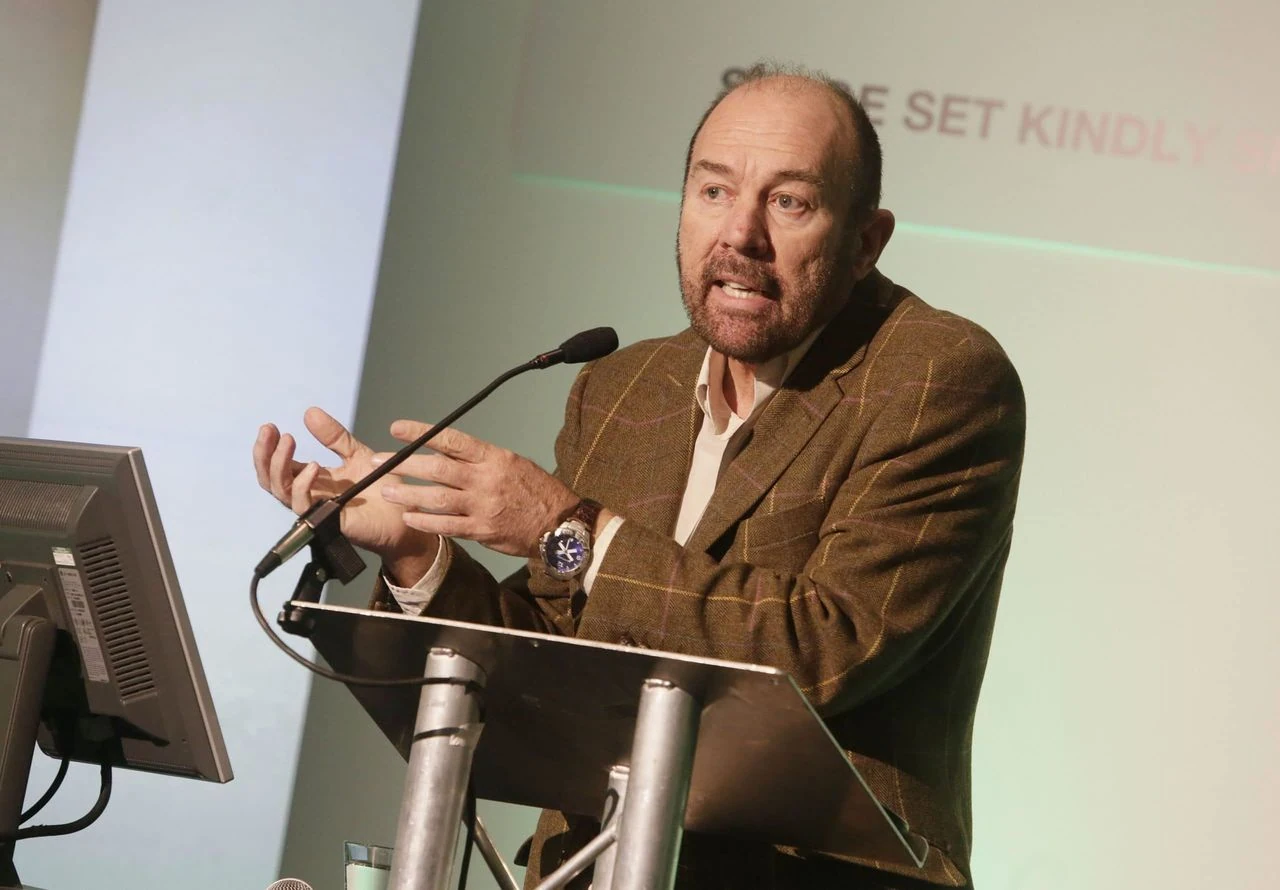
Brian Souter’s career joined the remaking of British bus services to an unusually prominent role in Scottish politics and philanthropy. With his sister Ann Gloag and brother-in-law Robin Gloag, he founded Stagecoach in 1980. The company grew from bus operations into a group spanning buses and rail, while Souter also established Megabus, investment businesses and a charitable trust. His public legacy is not defined by enterprise alone: his campaign against the repeal of Scotland’s Clause 2A, known elsewhere as Section 28, provoked sharp opposition.
From Perth to the bus business
Born in Perth on 5 May 1954, Souter grew up around buses: his father was a bus driver, and Brian often travelled with him on his routes. At school, he became interested in economics and accounts. He studied at Dundee Institute of Technology with the aim of becoming a commerce teacher, then continued at the University of Strathclyde in Glasgow, graduating with a diploma in accountancy and economics. He qualified as a chartered accountant in 1984 and worked at Arthur Andersen & Co.
In 1980, Souter, Gloag and Robin Gloag used money from their father’s redundancy to establish Stagecoach, initially running buses between Dundee and London. Britain’s bus-service deregulation created conditions for further growth. In the late 1980s, the group acquired several former National Bus Company subsidiaries, including operations in Cumberland, Hampshire, the East Midlands and other regions. It also bought bus businesses in Scotland, Newcastle and London, with Manchester added later.
In 1993, Stagecoach was valued at £134 million and floated on the London Stock Exchange, giving it access to capital for further transport ventures. The company expanded into Australia and New Zealand, bought Hong Kong operator Citybus and acquired the American coach company Coach USA. The description of Stagecoach as an international operator captures the breadth of that expansion, but its growth was not simply a story of new routes and markets. The group’s competitive practices also attracted regulatory criticism: the Monopolies and Mergers Commission described conduct by a Stagecoach subsidiary in Darlington as “predatory, deplorable and against the public interest”.
Buses, rail and low-cost journeys
Souter’s interests extended from road transport into the privatised railway. Stagecoach first experimented with a Scotland-to-London service branded Stagecoach Rail. During the privatisation of British Rail, the group won the South West Trains franchise in 1996 and the Island Line Trains franchise later that year. It retained both when they were retendered, before they passed to South Western Railway in 2017. Stagecoach also held interests in Virgin Rail Group, operated the East Midlands Trains franchise and, with a 90 per cent share in Virgin Trains East Coast, ran the InterCity East Coast franchise from 2015 to 2018.
In 2003, Souter added Megabus to the group. Its low-cost intercity services connected cities in Britain and Europe. In 2013, he announced an overnight sleeper service between Scotland and London. The specially built coaches had seats convertible into bunk beds, but the service ended in 2017 after consistently making a loss. The episode illustrates both the ambition and commercial uncertainty of the business model: low fares and new formats could attract attention, but did not guarantee a sustainable operation.
In 2012, Souter and Gloag formed Highland Global Transport, an investment vehicle with transport-related holdings. Its portfolio included Stagecoach, the Polish intercity operator PolskiBus, bus manufacturer Alexander Dennis and ferry and coach businesses in several countries. Some investments were later sold. In 2015, New Zealand transport interests were brought together under the InMotion Group, including bus and ferry operators; several bus businesses were subsequently sold, leaving Fullers360 as Souter’s remaining New Zealand subsidiary by late 2019. These ventures show how his work shifted from operating a single bus service towards ownership and investment across transport markets.
Charitable giving and public office
In 1992, Souter and his wife established the Souter Charitable Trust to support humanitarian projects in the UK and overseas, with a particular, though not exclusive, emphasis on Christian causes. The trust has supported work including malaria prevention and daily meals for schoolchildren in Africa. The article’s broad portrait of giving across education and community life is better understood through these documented activities than through unquantified claims about particular scholarships, university projects or rehabilitation centres.
In 2019, Souter announced that 28 per cent of the shares in Souter Investments, then estimated to be worth £109 million, would be donated to charitable causes. The trust had already reported spending more than £98 million in support of 13,000 causes over 13 years. These figures convey the scale of his philanthropy, while the stated focus on humanitarian and Christian work describes its character. His business and charitable roles also overlapped: in 2009, after receiving a £1.6 million bonus, he donated £900,000 to the trust, with most of the remainder going to the staff pension fund.
Souter held professional and business honours as well as company positions. He became vice-president of the Institute of Chartered Accountants of Scotland in 2015 and its president in 2017. His awards included the Scottish Entrepreneur Award and recognition for services to the bus industry. He was knighted in the 2011 Birthday Honours for services to transport and the voluntary sector. The honour was criticised by politicians and gay-rights campaigners, in part because of his political campaigning.
Clause 2A and the political dispute
In 2000, Souter led the Keep the Clause campaign against the Scottish Executive’s proposed repeal of Clause 2A, the Scottish provision corresponding to Section 28. He spent £1 million on a privately funded postal ballot intended to gauge public opinion. Of the 3,970,712 ballot papers sent out, 31.8 per cent resulted in valid votes; 86.8 per cent of those votes favoured keeping the clause. The campaign did not prevent repeal. The Electoral Reform Society declined to organise the poll, questioning whether it could be a legitimate democratic exercise without details of what would replace the law. Critics also argued that the low participation undermined claims that the result represented public opinion.
Souter’s stance drew condemnation from gay-rights campaigners, and the knighthood revived that criticism. His political activity also included substantial donations to the Scottish National Party. In 2007, he gave the party £500,000, saying he wanted to address what he saw as an imbalance in political funding. He pledged further support in 2011 and, according to the account of his donations, gave £1 million to the campaign for Scottish independence in 2014. The SNP’s positions and Souter’s business interests became part of public debate, but the party denied a direct link between his donation and its decision to drop a bus re-regulation commitment from its 2007 manifesto.
That record matters alongside the transport and charitable work. Souter’s wealth gave him the means to support large-scale giving and to fund political advocacy directly. The resulting public argument concerned not only his views, but also the influence that private money could exert in political campaigns and public life.
Why Brian Souter deserves a place in British Legacy
Brian Souter belongs in a British legacy collection because his career shaped important parts of the country’s transport landscape. Stagecoach began in 1980 with a bus service between Dundee and London and grew, through deregulation, acquisitions and public-market investment, into an international transport group. Souter’s later ventures reached into rail franchising and low-cost coach travel. Those developments affected how services were organised and how passengers could travel between towns and cities. The record also includes failed experiments and regulatory criticism, details that make the history more useful than an uncomplicated success story.
His charitable work offers another specific part of that legacy. The Souter Charitable Trust, founded with his wife, directed substantial resources towards humanitarian causes in Britain and overseas, including malaria prevention and school meals. At the same time, his role in the Clause 2A campaign shows that a business leader’s public influence can be contentious: Souter used personal wealth to organise a national ballot, and his position was opposed by gay-rights campaigners and others. Remembering him fully means holding these strands together. His story illuminates the reach of private enterprise and philanthropy in modern Britain, and the public scrutiny that follows when personal conviction and money enter political debate.
Sources
Brian Souter — revision 1367740396 · Brian Souter
Adapted in part from Brian Souter by Wikipedia contributors, under CC BY-SA 4.0. Text has been edited and combined with the existing article; this adapted text is shared under the same licence. Contributor history.