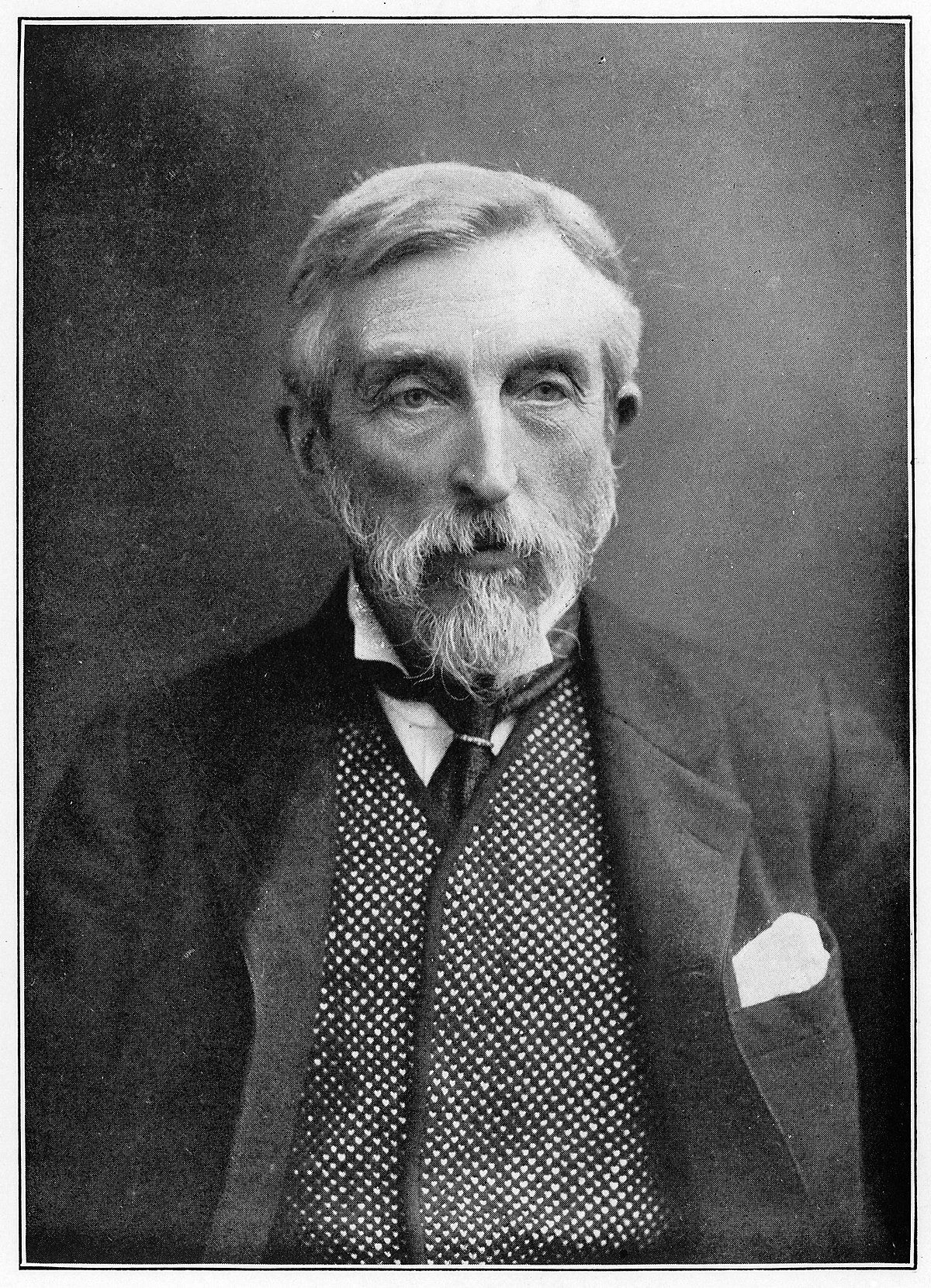
Charles Booth brought the habits of a businessman to a question that public debate often treated in generalities: how did poverty shape life in London? From 1886, he commissioned and directed an extensive investigation of the capital’s living and working conditions. Its street-by-street observations, statistical research and colour-coded maps made deprivation visible in a new way. The work did not settle how poverty should be defined, but it gave reformers and policymakers a substantial body of evidence with which to argue about it.
A Liverpool business background
Booth was born in Liverpool on 30 March 1840 to Charles Booth, a shipowner and corn merchant, and Emily Fletcher. He attended the Royal Institution School before entering the family business as an apprentice at sixteen. After his father died in 1860, Booth became involved in the leather trade with his elder brother Alfred. The brothers established Alfred Booth and Company, with offices in Liverpool and New York, and later built a shipping business. In 1866 they began a service between Brazil and Europe; Charles made the first voyage himself.
That commercial career continued alongside Booth’s public work for decades. The shipping business helped fund his research, and he remained actively involved in it until retiring in 1912. His early political activity was less successful: he campaigned for the Liberal Party in Liverpool in 1865 but lost. He later concluded that commissioning social investigations offered him a more effective way to contribute than seeking elected office.
Booth’s interests also extended beyond business. In the 1860s he became interested in the positivist philosophy of Auguste Comte. His developing social outlook formed part of the context for the research he would later undertake, though his approach rested on gathering and organising evidence about people’s circumstances.
Investigating life and labour
Booth began his major survey in 1886, starting with a pilot study in Tower Hamlets before extending the investigation across London. He was sceptical of existing statistics on poverty and examined census returns, later contributing to a parliamentary committee on improving census data. The inquiry considered poverty, occupations and religion, and relied on a team of investigators as well as Booth’s own supervision.
The researchers recorded conditions in London’s streets and households. Among those who worked on the project were Booth’s cousin, Beatrice Potter, later known as Beatrice Webb, and the economist Clara Collet, who studied women’s work. For its initial East End study, Booth’s team reported that 35 per cent of the population lived in abject poverty. That finding concerned the area covered by the study, not the whole of London. The survey’s later volumes broadened its scope, and the final, expanded edition of Life and Labour of the People in London appeared in seventeen volumes in 1902–03.
Booth’s maps classified streets according to observed levels of poverty and comfort. His eight categories, labelled A to H, represented a range of economic circumstances. The maps made differences between neighbourhoods legible at a glance, while the accompanying records provided more detail about work and living conditions. Booth also popularised the idea of a poverty line, setting it at an estimated ten to twenty shillings a week for a family of four or five. His categories and poverty line were not neutral, precise measurements of need: later discussion has emphasised that his approach described classes and conditions rather than establishing a subsistence threshold based on minimum requirements.
The project also examined religious life. In a later phase, Booth and his team carried out 1,800 interviews with religious and secular leaders, publishing their findings in seven volumes on religious influences. The wider investigation therefore encompassed more than a map of deprivation: it explored occupations, institutions and the circumstances in which people could find themselves poor or near poverty.
From evidence to reform
Booth used his findings to support old-age pensions and to campaign for the decasualisation of labour. He described pensions as “limited socialism”, seeing reform as a practical response to hardship as well as a means of preventing more radical political change. His work contributed to the public and political discussion that preceded early twentieth-century measures including old-age pensions and free school meals for the poorest children. It should not be treated as the sole cause of those policies: the research formed part of a wider reform movement, and later investigators, including Seebohm Rowntree, also influenced policy debates.
The survey’s importance lay in its combination of statistical and qualitative methods, and in its attention to the location and context of poverty. It influenced other researchers and reformers, among them Rowntree, Beatrice Webb and Helen Bosanquet. Its maps helped bring environmental and neighbourhood conditions into empirical study, while its volumes preserved observations that continue to interest social historians and researchers.
Booth’s work also had limits. The maps classified households through broad descriptions, and some information gathered by school-board visitors was extrapolated to families without school-age children. The research was rich in detail but largely descriptive. Booth’s published account also included antisemitic language about Jewish immigration. These aspects matter when reading the survey today: its records offer important evidence about Victorian London, but its methods and assumptions require scrutiny rather than uncritical celebration.
Family, honours and later life
In 1871 Booth married Mary Macaulay, who advised him on business matters and contributed to his investigation of London life. They had seven children. The family moved to Grace Dieu Manor near Thringstone in Leicestershire in 1886, although Booth’s professional life remained closely tied to his company and his research in London.
Recognition followed his work in social statistics. The Royal Statistical Society elected him its president in 1892 and awarded him its first Guy Medal in Gold. In 1899 he was elected a Fellow of the Royal Society, and in 1904 he was sworn of the Privy Council. In 1912 he stepped down as chairman of Alfred Booth and Company, returning to work during the war despite evidence of heart disease. He died of a stroke on 23 November 1916 and was buried at St Andrew’s, Thringstone.
Booth’s papers and work have continued to be preserved and used. The University of Liverpool holds a collection of his manuscripts and typescript and appoints academics to a Charles Booth Chair of Social Sciences. The London School of Economics maintains an online searchable database of his work. These records allow later readers to examine not only the findings he published but also the methods and observations behind them.
Why Charles Booth deserves a place in British Legacy
Charles Booth deserves a place in British Legacy for making social investigation a practical instrument in debates about poverty. His London survey brought together street observations, statistics, maps and detailed volumes on work and living conditions. The result was not simply a striking visual record: it gave reformers, researchers and public officials evidence with which to examine where deprivation occurred and how it related to people’s circumstances. Booth’s work helped influence the early discussion of pensions and other measures for people living in poverty, while also contributing to the development of social research in Britain.
His legacy is valuable partly because it is complex. The survey advanced the study of poverty, but its classifications were broad, its methods had limitations, and its published work included antisemitic views that should be acknowledged rather than glossed over. Reading Booth with that care makes his records more useful, not less: they reveal both the possibilities and the biases of Victorian social inquiry. His manuscripts and maps remain resources for understanding London’s past, while the questions his work raised—how poverty is measured, where it is concentrated and what public institutions owe those affected—continue to matter in British social policy and research.
Sources
Charles Booth (social reformer), revision 1357928630 · Charles Booth (social reformer)
Adapted in part from Charles Booth (social reformer) by Wikipedia contributors, under CC BY-SA 4.0. Text has been edited and combined with the existing article; this adapted text is shared under the same licence. Contributor history.