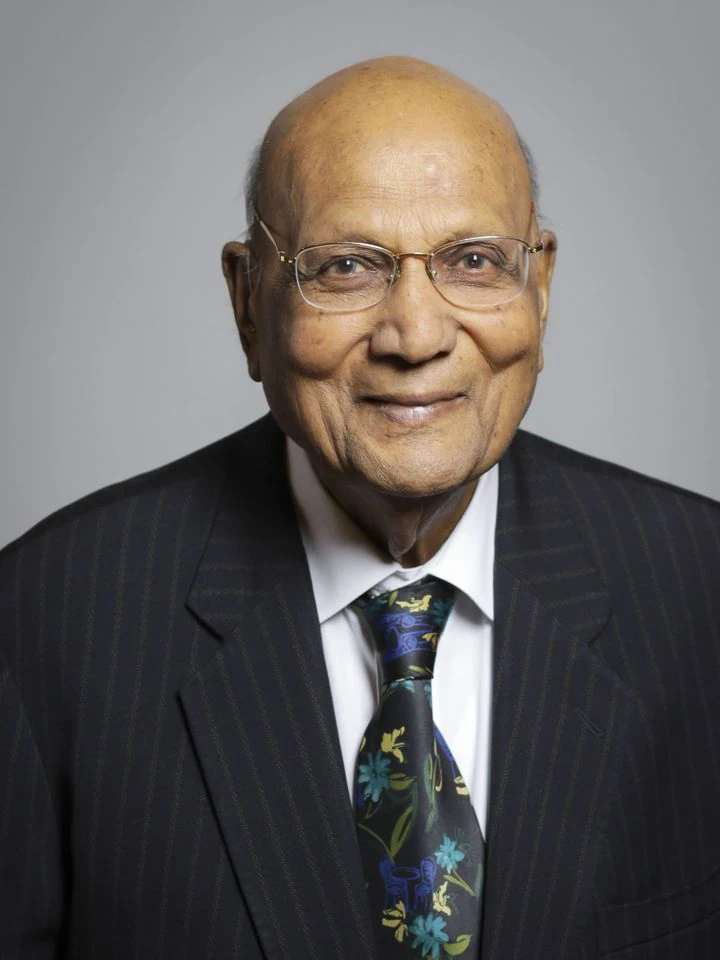
Swraj Paul came to Britain in 1966 seeking treatment for his young daughter. After her death, he founded a steel business that grew into the Caparo Group, then became a life peer and a major supporter of educational institutions. His career joined manufacturing and public life with philanthropy spanning Britain, India and the United States.
From Jullundur to British industry
Paul was born in Jullundur, in the Punjab Province of British India, on 18 February 1931. His father, Payare Lal, ran a small foundry making steel buckets and farming equipment. Paul attended Labbu Ram Doaba School, Forman Christian College in Lahore and Doaba College in Jalandhar. He later studied mechanical engineering at the Massachusetts Institute of Technology, earning BSc, MSc and MechE degrees.
After MIT, he returned to India to work in the family business, Apeejay Group, founded by his father and then managed by his elder brothers, Satya and Jit. In 1966 he moved to the United Kingdom to seek medical care for his young daughter, who had leukaemia. Following her death, and a period of grief, he established Natural Gas Tubes. Starting with one steel unit, he expanded through acquisitions and founded Caparo Group in 1968.
Caparo became one of the UK's largest steel conversion and distribution businesses. Its products included structural steels, precision and spirally welded tubes, industrial wire and cold-rolled strip. Paul stepped down from managing the group in 1996. By autumn 2015, Caparo employed more than 10,000 people across North America, Europe, India and the Middle East. That October, 16 of the 20 limited companies making up most of Caparo's UK operations entered administration.
Philanthropy through education
The Paul family's foundation, named for his daughter Ambika, channelled profits from Caparo India into charitable work. Its support for education took several forms: buildings and facilities, scholarships, and contributions to universities where Paul held senior roles. At the University of Wolverhampton, where he became chancellor in 1998, a student union centre was renamed the Ambika Paul Student Union Centre in 2010 after a donation towards its refurbishment. In 2015, the foundation gave the university £1 million, then its largest single donation.
Paul was chancellor of the University of Westminster from 2006 to 2014. His foundation gave £300,000 to establish Ambika P3, an event and exhibition space. Earlier, he had served as pro-chancellor of Thames Valley University from 1997 to 2000 and as its chancellor from 2000 to 2001. The family foundation also established the Ambika Paul School of Technology in Jalandhar, India.
His support extended to MIT, where he served on the Mechanical Engineering Visiting Committee from 1998 to 2001. The university received an Ambika Paul Mezzanine and Study Space and a Swraj Paul Scholarship fund; in 2020, $5 million was donated for the Swraj Paul Theatre at the Kresge Auditorium. He also supported projects at the Zoological Society of London, including the Ambika Paul children's zoo at Regent's Park, and became an honorary fellow of the society in 2019.
Public service and the House of Lords
Paul entered the House of Lords in 1996 as a Labour life peer, taking the title Baron Paul, of Marylebone in the City of Westminster. He was appointed deputy speaker in December 2008 and sworn of the Privy Council in October 2009. He was the first person of Indian origin to hold the deputy-speaker post. His public roles also included acting as an ambassador for British business from 1998 to 2010 and co-chairing the Indo-British Roundtable from 2000 to 2005.
He took part in London's successful bid for the 2012 Olympic Games as a member of the board responsible for the 2005 submission. He later chaired the Olympic Delivery Committee, which was tasked with securing the land for the new venues and delivering it on time and within budget. This work connected his industrial and parliamentary experience with a major British public project.
Paul's parliamentary career also included a dispute over expenses. After a newspaper report in 2009, he asked for his claims to be investigated and repaid £41,982. A police investigation concluded there was no case. The House of Lords Privileges Committee found that he had not acted dishonestly or in bad faith, but that he had been negligent and liable to sanction; he was suspended for four months. Paul disputed the finding and resigned as deputy speaker in November 2010. His parliamentary record therefore included both senior responsibilities and a public disciplinary episode.
Honours, family and later life
Paul received 15 honorary degrees from universities in the UK, the United States, India, Russia and Switzerland. His honours included India's Padma Bhushan in 1983, the Freedom of the City of London in 1998 and a Lifetime Achievement Award from the Black Country Asian Business Association in 2014. In 2018 he received the IOD Golden Peacock Award for Lifetime Achievement in Business Leadership and the Global Punjabi Society Lifetime Achievement Award. These recognitions reflected work across manufacturing, education and philanthropy, rather than a single field.
He published Beyond Boundaries: A Memoir in 1998 and a biography of Indira Gandhi in 1984. Paul lived in London from the 1960s. His son Angad, Caparo's chief executive, died in 2015 after falling from his Marylebone flat; police said there were no suspicious circumstances. Swraj Paul died in London on 21 August 2025, aged 94.
Why Swraj Paul deserves a place in British Legacy
Paul's place in British history rests on a distinctive combination of industrial enterprise and sustained institution-building. He arrived in Britain in circumstances of personal loss, founded Natural Gas Tubes and developed Caparo into a substantial steel conversion and distribution business. Its reach across several continents illustrates the international scale of a company built from a single steel unit. The later collapse of most of Caparo's UK operating companies is also part of that record: his legacy in industry should be understood through both the group's growth and its eventual difficulties.
His philanthropic contribution is especially visible in educational institutions. Donations helped establish facilities at Wolverhampton and Westminster, supported students through scholarships, and funded projects at MIT. His connection to Wolverhampton lasted from his appointment as chancellor in 1998 until his death; the foundation's £1 million gift in 2015 was the university's largest single donation at the time. These were practical investments in places where students study, meet and pursue research. Alongside his House of Lords work, his role in securing land for London's Olympic venues and his efforts to promote British business abroad, they give his British connection substance beyond biography: he helped shape businesses, public institutions and civic projects. His career offers a record of how philanthropy can extend a businessman's influence into education and public life, while leaving the complexities of industrial decline and parliamentary accountability in view.
Sources
Swraj Paul, Baron Paul — revision 1376727936
Adapted in part from Swraj Paul, Baron Paul by Wikipedia contributors, under CC BY-SA 4.0. Text has been edited and combined with the existing article; this adapted text is shared under the same licence. Contributor history.