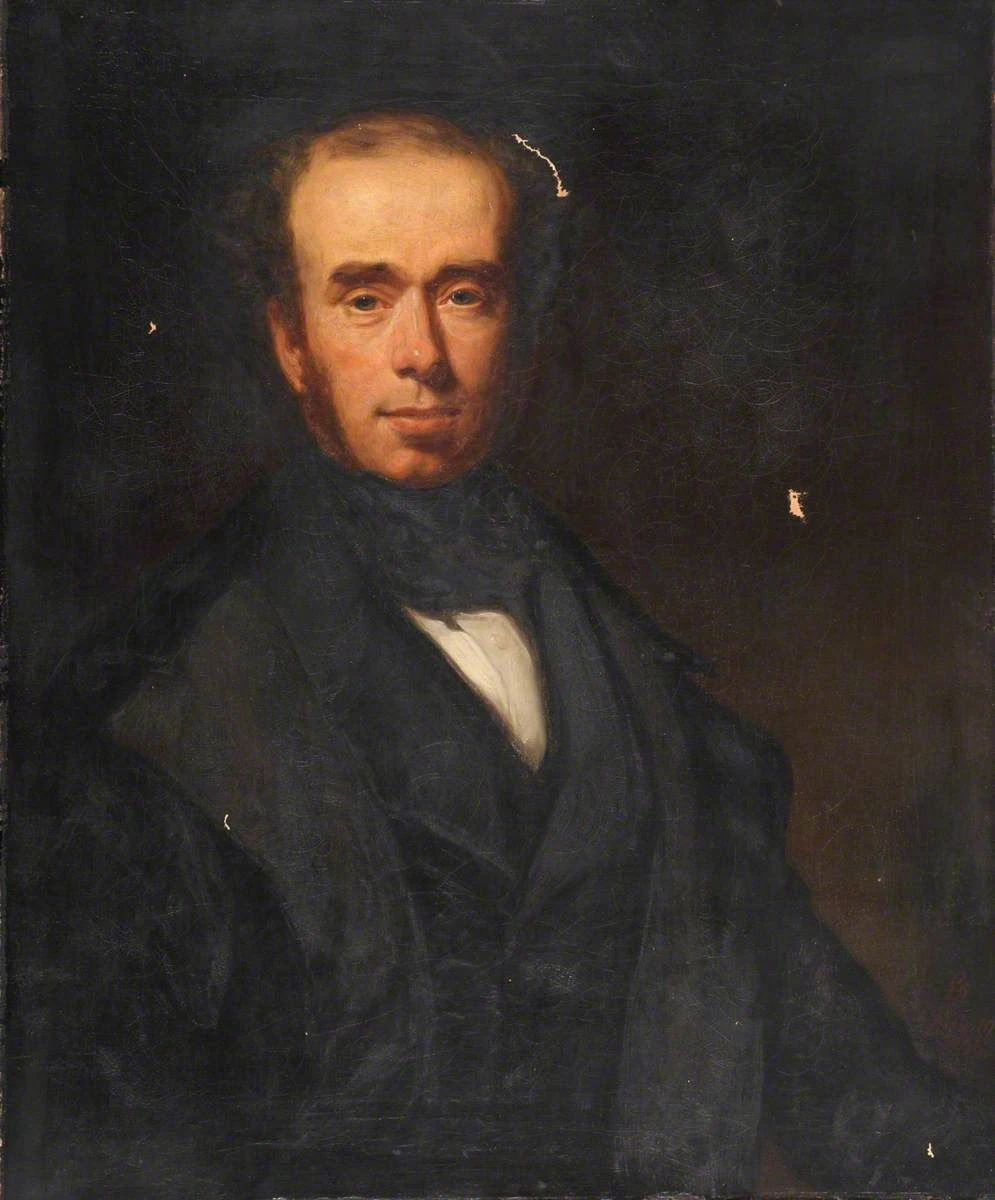
Joseph Whitworth made precision a practical engineering principle. His 1841 system for screw threads gave manufacturers a shared standard; his machine tools and measuring methods pushed accuracy further. He also directed much of his wealth towards education and public institutions in Manchester. His story joins the development of British engineering to a distinctive programme of civic giving.
From mill machinery to his own works
Whitworth was born in Stockport on 21 December 1803, the son of Charles Whitworth, a teacher and Congregational minister. Educated near Bradford, he showed an early aptitude for mechanics. His first apprenticeship was not with the celebrated engineer Henry Maudslay, as some accounts suggest, but with his uncle Joseph Hulse, a cotton spinner at Amber Mill in Derbyshire. Whitworth spent four years there, followed by four years working as a mechanic in a Manchester factory.
He later moved to London and worked for Maudslay, whose workshop was known for its machine tools. Whitworth also worked for lathe-maker Holtzapffel & Co and in Joseph Clement’s workshop, where he helped manufacture Charles Babbage’s Difference Engine. These experiences exposed him to the difficulties caused by inconsistent workmanship and inadequate accuracy. At Maudslay’s, Whitworth developed precision tools and introduced a box-casting method for iron machine-tool frames that made them both more rigid and lighter.
In 1833 he returned to Openshaw, Manchester, to establish a business making lathes and other machine tools. Its reputation rested on careful workmanship. Whitworth’s concern with accuracy extended beyond the finished machine: he worked on how flat surfaces could be made reliably and how measurements could be taken with greater precision. In the 1830s he popularised a three-plate scraping method for producing accurate flat surfaces. In 1840 he developed a measuring system using a precision flat plane and measuring screw. Its exceptionally fine resolution was demonstrated at the Great Exhibition of 1851, although practical limits, including thermal expansion, restricted its absolute accuracy.
A standard for the machine age
In 1841 Whitworth devised a screw-thread system with a fixed angle of 55 degrees and a standard pitch for each diameter. Until then, different railway companies used different thread forms, making parts harder to interchange. The new system was adopted by railway companies and became the first nationally standardised screw-thread system. Known as British Standard Whitworth, it became an important point of reference for British manufacturing.
Whitworth’s work on measurement and standardisation addressed a basic industrial problem: machines and their components could not be made reliably interchangeable without agreed dimensions and accurate ways to produce and check them. His contribution was not a single tool or invention, but a set of methods and standards that helped make precision repeatable. In 1844 he is also credited with introducing the unit known as the thou, one thousandth of an inch.
His engineering work included weapons as well as machine tools. Commissioned by the British War Department to design a replacement for the Pattern 1853 Enfield rifle, he produced a smaller-bore rifle with a hexagonal barrel and matching elongated bullet. Tests in 1859 found it more accurate than the Enfield, but its barrel was prone to fouling and it cost four times as much to manufacture. The British government therefore rejected it. Some rifles later reached Confederate forces during the American Civil War, where they became known for their accuracy as “Whitworth Sharpshooters”.
Whitworth also designed a rifled, breech-loading cannon. The British Army preferred a competing design, but Whitworth’s gun was used in the American Civil War. Seeking stronger gun barrels, he patented a process for casting steel under pressure, known as fluid-compressed steel, and built a steel works near Manchester. His technical reputation grew alongside his business success: he was elected a Fellow of the Royal Society in 1857 and received the Albert Medal in 1868.
Technical education and Manchester
Whitworth’s interests reached beyond his own works. He supported the Mechanics’ Institute in Manchester, later UMIST, and helped found the Manchester School of Design. In 1868 he gave £128,000 to the government to bring science and industry closer together and support scholarships. That year he established the Whitworth Scholarship for the advancement of mechanical engineering. The scheme was designed to support people with both academic and practical ability, and the scholarship programme continued under the administration of the Institution of Mechanical Engineers.
His will also set in motion a substantial contribution to Manchester institutions. Whitworth appointed three legatees, including his friend Richard Copley Christie, and entrusted them with money for philanthropic purposes. They directed more than a fifth of the funds towards Owens College and the purchase of land now occupied by Manchester Royal Infirmary. Christie later gave additional money for the Whitworth Building at Owens College and took an active interest in medical charities. The college developed into the University of Manchester; the Whitworth Art Gallery and Whitworth Park were also established in accordance with Whitworth’s will.
His name remains visible across the city in places including Whitworth Street, Whitworth Park and the Whitworth Building. His gifts also reached beyond Manchester: part of his bequest helped fund the Whitworth Institute in Darley Dale. These memorials reflect different aspects of his plans, from education and engineering to art and public institutions.
Recognition and later years
Whitworth held leading roles in the engineering community, including the presidency of the Institution of Mechanical Engineers in 1850. In 1853 he was appointed a British commissioner for the New York International Exhibition and toured industrial sites in several American states with the artist and art educator George Wallis. Their report described machinery, manufacturing and applied arts in the United States. Whitworth was created a baronet by Queen Victoria in 1869.
He divided his time between Manchester and Derbyshire, where he bought Stancliffe Hall in 1854 and moved with his second wife, Louisa, in 1872. He died in Monte Carlo on 22 January 1887, aged 83, while travelling in the hope of improving his health. He was buried at St Helen’s Church in Darley Dale. His company later merged with W. G. Armstrong & Mitchell to form Armstrong Whitworth in 1897.
Why Joseph Whitworth deserves a place in British Legacy
Whitworth’s place in British Legacy rests first on the practical reach of his engineering. The screw-thread system he devised in 1841 addressed a real obstacle to manufacturing: parts made to different standards could not be readily exchanged. Its adoption by railway companies and its subsequent national standing made precision useful beyond a single workshop. His work on flat surfaces, measuring instruments and machine tools likewise helped establish ways to make and assess accuracy. Together, these achievements show how engineering progress depends not only on inventive ideas but also on dependable methods that others can use.
His legacy also connects industrial success with opportunities for learning. Whitworth supported technical institutions in Manchester, endowed scholarships in mechanical engineering and left funds for public and educational purposes. The effects can be traced in the scholarship scheme, the University of Manchester’s institutional history, the Whitworth Art Gallery and other named places. These were different forms of benefit: support for engineers in training, resources for education and science, and institutions serving the wider public. Whitworth’s significance is therefore not confined to a standard or a celebrated machine. His technical work and philanthropy together helped shape the engineering and educational life of Manchester, giving his British legacy a concrete local foundation.
Sources
Joseph Whitworth (revision 1368513544)
Adapted in part from Joseph Whitworth by Wikipedia contributors, under CC BY-SA 4.0. Text has been edited and combined with the existing article; this adapted text is shared under the same licence. Contributor history.