
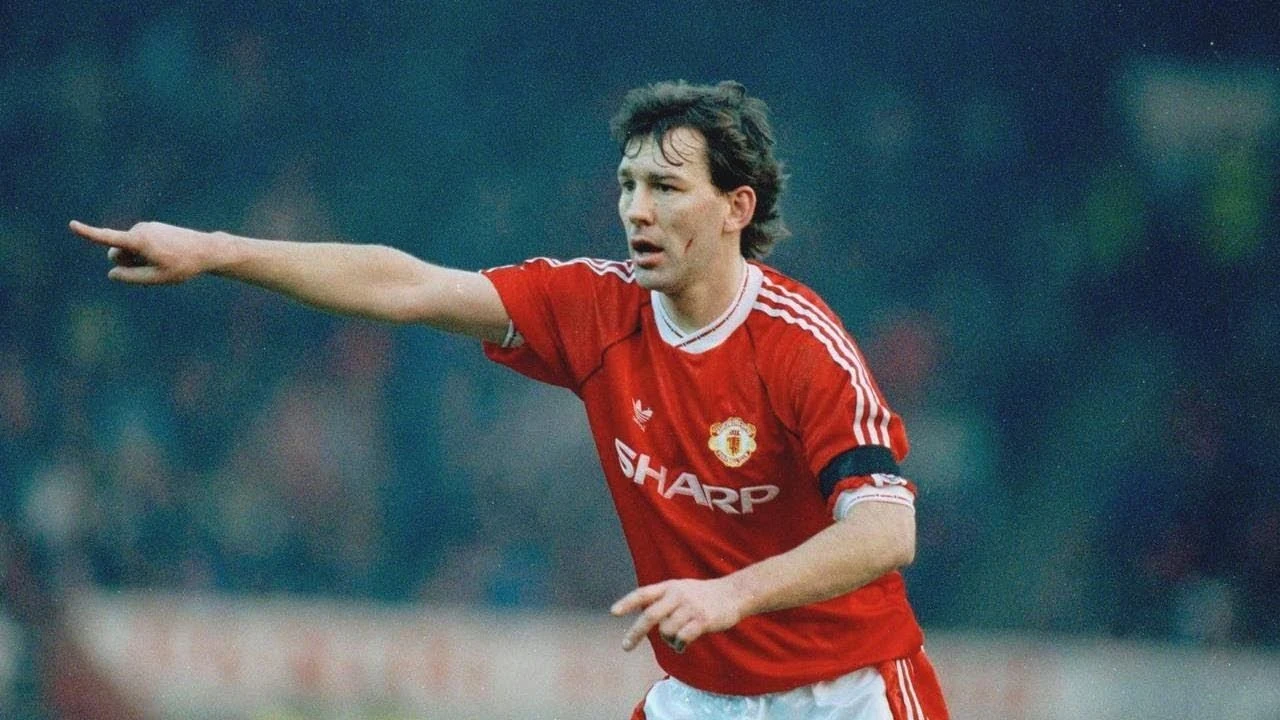
Bryan Robson’s reputation rests on more than the captain’s armband. A box-to-box midfielder who could tackle, pass, win the ball and arrive to score, he became one of the defining leaders of English football in the 1980s and early 1990s. He captained Manchester United to three FA Cups and two league titles, represented England at three World Cups and, after his playing career, managed clubs in England and the Thailand national team.
From County Durham to West Bromwich Albion
Robson was born in Chester-le-Street, County Durham, on 11 January 1957. He grew up in the area, first in Witton Gilbert and then in Chester-le-Street, and attended Birtley South Secondary Modern School and Lord Lawson of Beamish comprehensive school. Football was part of his life from an early age: he captained his school and district teams, and supported Newcastle United as a boy.
As a teenager, Robson had trials with several clubs before joining West Bromwich Albion as an apprentice in 1972. He made his first-team debut in April 1975, aged 18, and scored in his first home game. His first seasons demanded patience. Competition for places meant he played in different positions, including centre-half and left-back, before establishing himself in central midfield. A series of serious injuries interrupted his progress, but he returned to the team and became a regular under manager Ron Atkinson.
Robson’s contribution helped Albion finish third in the First Division in 1978–79 and fourth in 1980–81. He had become an England international by the end of that period. When Atkinson left for Manchester United in 1981, Robson followed, joining United for a British record transfer fee of £1.5 million.
A captain at Manchester United
Robson spent 13 years at Old Trafford. His 461 appearances and 99 goals in all competitions tell part of the story; the rest is in the trophies he lifted and the influence he retained through changes of manager and teammates. A forceful, versatile midfielder, he combined defensive work with the movement and awareness to create and score. His nickname, “Captain Marvel”, captured his public image, but his place in the side was built on performance as well as personality.
He lifted his first FA Cup as United captain in 1983. After the final against Brighton ended in a draw, Robson scored twice in the replay against the same opposition. He could have attempted a hat-trick, but allowed regular penalty taker Arnold Mühren to take the spot-kick that completed the 4–0 win. United’s next FA Cup triumph with Robson as captain came in 1985, when a Norman Whiteside goal in extra time defeated Everton. In 1990, Robson became the first United captain to lift the FA Cup three times, after a replay victory over Crystal Palace.
In Europe, one of his most memorable performances came against Barcelona in the 1984 European Cup Winners’ Cup. United had lost the first leg 2–0; Robson scored twice in the return match at Old Trafford as they won 3–0 and went through. Injuries prevented him from playing in both legs of the semi-final against Juventus. He later captained United to victory in the 1991 European Cup Winners’ Cup final against Barcelona.
Robson also won the league title with United in 1992–93, the club’s first league championship since 1967. He had sought that medal since his West Brom days, but by then competition and injuries had reduced his opportunities. United retained the title in 1993–94, and Robson made enough appearances to earn another championship medal. His final United appearance came in May 1994. He had played 461 times for the club in all competitions and scored 99 goals.
England captain and World Cup goalscorer
Robson made his senior England debut in February 1980 and went on to win 90 caps, scoring 26 goals. He played at the 1982, 1986 and 1990 World Cups, as well as the 1988 European Championship. He first captained England in November 1982; across his international career he led the side 65 times.
His goal in England’s opening match at the 1982 World Cup, against France in Bilbao, came after 27 seconds. It was the third-fastest goal in the history of the World Cup finals until Hakan Şükür scored after ten seconds in 2002. Robson’s goals also included a hat-trick in England’s 8–0 win over Turkey in 1984.
Injuries shaped his later World Cup appearances. A shoulder injury suffered against Morocco in 1986 ruled him out of the rest of that tournament. In 1990, an injury sustained in England’s match against the Netherlands again kept him out of the remainder of the competition; England finished fourth. His international career ended in 1991, after he had helped England qualify for the 1990 tournament.
Robson’s game was not confined to scoring or tackling. He brought stamina, aerial strength, passing and anticipation to central midfield, with the ability to contribute in both halves of the pitch. His teammates and managers recognised the quality of his football as well as his forceful leadership. England colleague Tony Adams praised Robson’s awareness and ability to read where the ball would go; Paul Gascoigne later described him as the best footballer he had shared a pitch with.
From player-manager to ambassador
Robson moved to Middlesbrough in 1994 as player-manager. He led the club to the First Division title and promotion in his first season, and combined the job with serving as assistant coach to England manager Terry Venables between 1994 and 1996. He continued to play for Middlesbrough until January 1997. The club reached both domestic cup finals that season but lost them, and was relegated from the Premier League. Robson remained in charge and took Middlesbrough back into the top flight at the first attempt. He left in 2001 after the team had finished no higher than ninth in the Premier League.
His later management brought mixed outcomes. At Bradford City, he took over in November 2003 but could not prevent relegation, and his contract was not renewed. He returned to West Bromwich Albion in 2004. In 2005, Albion became the first team to avoid relegation from the Premier League after being bottom on Christmas Day; the club went down the following season, and Robson left in September 2006. His spell at Sheffield United ended in February 2008 after the club had begun the season poorly.
In March 2008, Robson returned to Manchester United as an ambassador, working alongside Sir Bobby Charlton to promote the club’s commercial and charitable aims. He took on another international role in 2009, becoming manager of Thailand. His tenure ended in June 2011, after the team failed to progress from its group in the 2010 AFF Championship and did not qualify for the 2011 AFC Asian Cup. He subsequently returned to his Manchester United ambassador role.
Honours and recognition
Robson was awarded the OBE in the 1990 New Year Honours. He was named among the Football League 100 Legends in 1998 and became an inaugural inductee of the English Football Hall of Fame in 2002, recognised for his impact on the English game as a player. In 2004, a West Bromwich Albion poll named him among the club’s 16 greatest players, and he received the Football Writers’ Association Tribute Award in 2006.
His playing honours include two Premier League titles, three FA Cups, two FA Charity Shields and the European Cup Winners’ Cup with Manchester United. As player-manager, he won promotion with Middlesbrough by taking the First Division title in 1994–95. These achievements span different stages of his career: young professional at West Brom, long-serving United captain, and manager entrusted with rebuilding and leading teams.
Why Bryan Robson deserves a place in British Legacy
Robson’s place in British football history is grounded in a rare combination of sustained club service, international achievement and leadership. At Manchester United, he was not simply a captain associated with a successful team: he contributed goals and midfield work across more than a decade, scoring twice in the 1983 FA Cup final replay, lifting three FA Cups and helping United win the league in 1993 and 1994. His performance against Barcelona in 1984 showed how his attacking contribution could change a European tie. These are specific, lasting achievements within the history of one of England’s most prominent clubs.
For England, Robson won 90 caps, scored 26 goals and captained the national side 65 times. His 27-second goal against France at the 1982 World Cup remains a vivid moment in the tournament’s history, while his appearances at three World Cups mark the breadth of his international career. He also carried his experience into management, leading Middlesbrough to promotion and later helping West Bromwich Albion escape relegation in 2005. His later work as a Manchester United ambassador extended his contribution beyond the pitch. Robson’s legacy therefore includes not only medals and statistics, but also the practical example of a player who combined versatility, responsibility and service to clubs and country over many years.
Sources
Adapted in part from Bryan Robson by Wikipedia contributors, under CC BY-SA 4.0. Text has been edited and combined with the existing article; this adapted text is shared under the same licence. Contributor history.

.jpg)